

SkyWalker 2
Last edited
Fact-checked
In review queue
Sources
19 citations
Revision
v5 · 3,554 words
Fact-checks are independent of edits: a reviewer re-verifies the article against its sources and stamps the date. How we verify
| SkyWalker 2 | |
|---|---|
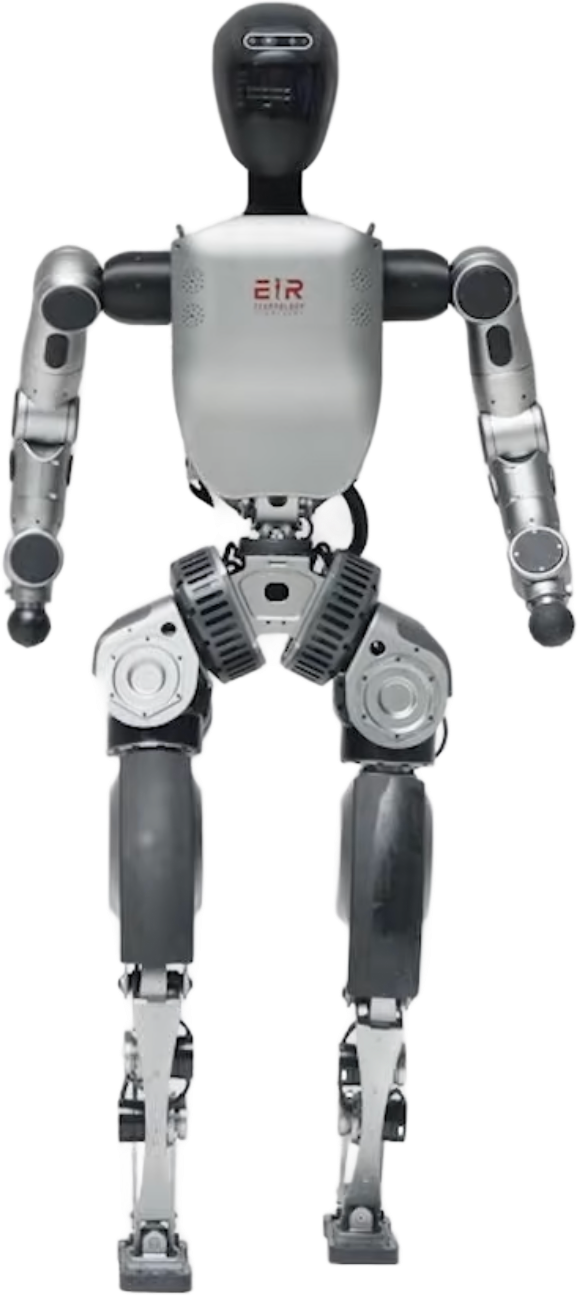 | |
| General information | |
| Manufacturer | EIR Technology |
| Full company name | Sichuan Embodied Humanoid Robot Technology Co., Ltd. |
| Country of origin | China |
| Unveiled | September 24, 2025 |
| Status | Deployed (factories, industrial parks) |
| Price | Not publicly disclosed |
| Website | eir.com.cn |
The SkyWalker 2 (Chinese: 天行者2号, Tianxingzhe 2 Hao) is a full-size humanoid robot built by EIR Technology, the trading name of Sichuan Embodied Humanoid Robot Technology Co., Ltd., a startup in Chengdu, Sichuan Province, China. Unveiled on September 24, 2025 in the Chengdu High-Tech Zone, it stands 165 cm tall, weighs 55 kg, carries 55 degrees of freedom, and runs for about two hours on a charge; EIR presents it as Southwest China's first full-size general-purpose humanoid robot platform [1][2]. The robot is aimed at three markets: intelligent manufacturing, scientific research and education, and elder-care and rehabilitation services [1][3].
SkyWalker 2 is the successor to the SkyWalker 1, which EIR developed in 69 days from founding to prototype, a timeline that drew national attention when the first robot launched in December 2024 [6][8]. With more than 90% localization of core components, an in-house joint-module and whole-body motion-control stack, and a cloud partnership with Tencent Cloud, EIR presents itself as a vertically integrated entrant in the Sichuan robotics cluster [5][7].
Who makes the SkyWalker 2?
EIR Technology, whose full legal name is Sichuan Embodied Humanoid Robot Technology Co., Ltd. (四川具身人形机器人科技有限公司), was founded in September 2024 in Chengdu, the capital of Sichuan Province. It was established as a core incubation enterprise of the Robotics Research Center at the University of Electronic Science and Technology of China (UESTC), one of China's leading universities in electronics and information technology [6].
The company is led by Dr. Feng Zhenyu (冯振宇), its chairman and general manager, described in English-language reporting as CEO. Under his direction, EIR has built an operation spanning research, manufacturing, sales, and after-sales service for both humanoid and quadruped platforms [7][19].
EIR draws on institutional backing from three research partners:
- University of Electronic Science and Technology of China (UESTC): foundational robotics research, particularly motion control and reinforcement learning.
- Sichuan Institute of Machinery Research and Design: precision manufacturing and mechanical engineering support.
- Tianfu Jiangxi Laboratory: co-builder with EIR of the "Frontier Research Center for Interactive Humanoid Robots," focused on human-robot interaction [4][5].
This collaboration between a company, a university, and an applied research institute forms the backbone of EIR's technical strategy. The company draws on Sichuan's precision-manufacturing base, a regional strength rooted in the province's aerospace and defense industries [7].
How was EIR Technology funded?
On May 26, 2025, EIR closed an angel round worth tens of millions of yuan (roughly $5 million to $15 million), reaching a valuation in the hundreds of millions of yuan. The round was co-led by Ceyuan Ventures, an early-stage technology investor, and Peikun Fund [6]. The proceeds were directed toward scaling production of the SkyWalker series and advancing the company's artificial intelligence work, including motion-control algorithms and multimodal perception.
The round drew attention in China's venture community because of EIR's unusually fast product development and its base in Chengdu, a city that had not previously been a major center for humanoid robotics. Most of China's leading humanoid companies sit in the Yangtze River Delta (Shanghai, Hangzhou) and the Pearl River Delta (Shenzhen, Guangzhou), which made EIR's emergence from western China notable [6].
What was the SkyWalker 1?
Before the SkyWalker 2, EIR built the SkyWalker 1 (天行者1号, Tianxingzhe 1 Hao), Sichuan Province's first commercial humanoid robot. The company went from founding to a working prototype in 69 days, described at the time as a record for the fastest concept-to-product timeline in central and western China [6][8].
The SkyWalker 1 was released on December 16, 2024, about three months after EIR's founding. The build required breakthroughs across several domains in quick succession: mechanical design, dynamic simulation, reinforcement learning training, assembly, and hardware debugging [8][9].
| Specification | SkyWalker 1 |
|---|---|
| Height | 165 cm (1.65 m) |
| Weight | ~50 kg |
| Battery life | ~1.5 hours (90 minutes) |
| Motors | 40+ sport motors |
| Localization rate | >90% |
| Capabilities | Autonomous walking, object carrying, tool operation |
| Launch date | December 16, 2024 |
After its unveiling the SkyWalker 1 appeared at several public events. In January 2025 it was shown at the Twin Towers in the Chengdu High-Tech Zone, where EIR presented new collaboration scenarios and an updated visual design [10]. The company reported strong intent orders for both the SkyWalker 1 and its Lingtong series of quadruped robot dogs [9].
Planned upgrades for the SkyWalker 1 included electronic skin for tactile feedback (pressure and material detection), a 10 kg weight reduction, two-handed manipulation, and autonomous navigation in flexible manufacturing settings [8][9]. Several of these improvements were carried into the SkyWalker 2.
How was the SkyWalker 2 developed?
EIR built the SkyWalker 2 as a full upgrade of the SkyWalker 1, targeting the earlier robot's limits in endurance, degrees of freedom, and sensing. The company frames the gains across four areas: platform performance, perception, interaction, and spatial intelligence [1][3].
The work rests on two core competencies: whole-body force motion control and multimodal perception fusion. The motion-control system coordinates the whole body through a three-degree-of-freedom bionic waist that lets the robot bend, twist, and hold balance on demanding surfaces. The perception system combines depth sensing with environmental mapping for autonomous navigation and task execution [4][5].
EIR reports more than 90% localization of core components, meaning most key parts are designed and made domestically, largely in Chengdu. This includes the company's own high-power-density, lightweight integrated joint modules, which Feng Zhenyu has described as a cost advantage over competitors that rely on imported actuators [7]. According to the Tianfu Jiangxi Laboratory, the second-generation joint modules deliver about 40% higher power density at roughly 25% lower weight than the previous design, and support about two hours of continuous operation, roughly 60% longer than the first generation [4].
What are the SkyWalker 2's specifications?
The table below lists the SkyWalker 2's verified specifications, drawn from EIR's launch materials and Chinese press coverage of the September 2025 unveiling [1][2][4].
| Category | Specification | Value |
|---|---|---|
| Physical | Height | 165 cm (5 ft 5 in) |
| Physical | Weight | 55 kg (121 lb) |
| Physical | Head | Flexible display screen for customizable expressions |
| Mobility | Total degrees of freedom | 55 |
| Mobility | Waist | 3-DOF bionic waist |
| Power | Continuous operation | ~2 hours |
| Joints | Power density vs. generation 1 | +40% (EIR) |
| Joints | Weight vs. generation 1 | -25% (EIR) |
| Perception | Sensor suite | LiDAR + 3D vision + tactile feedback |
| Perception | Spatial mapping | Millimeter-level positioning and environment modeling (EIR) |
| Interaction | Modalities | Voice commands, gesture recognition, micro-expression interaction |
EIR has not published figures for the SkyWalker 2's top walking speed, payload, or per-hand degrees of freedom, and third-party specification databases that list such numbers do not agree with EIR's own materials. Where a value is not confirmed by the company or by primary Chinese coverage, it is omitted here.
Physical design
The SkyWalker 2 stands 165 cm tall, the same height as its predecessor, but carries 5 kg more mass (55 kg versus about 50 kg for the SkyWalker 1). The extra weight reflects the actuators needed for 55 degrees of freedom and the added sensor and power hardware. The robot has a gray-black metallic shell, and its head carries a flexible display screen that can render customizable expressions for interaction [1][2].
The form factor is close to the height of an average Chinese adult, which lets the robot work in human-scale settings such as factory workstations, reception areas, and care facilities.
Degrees of freedom and the bionic waist
With 55 degrees of freedom, the SkyWalker 2 is among the more articulated full-size Chinese humanoids, a count comparable to research-grade platforms such as Fourier Intelligence's GR series [1].
The three-degree-of-freedom bionic waist is a distinctive feature. Rather than the single-axis waist joint on many humanoids, EIR's design allows multi-axis rotation that coordinates with the legs and torso for more natural, human-like motion. The robot can twist, lean sideways, and bend forward or backward with coordinated movement rather than stiff, segmented steps [4][5].
Perception and spatial intelligence
The SkyWalker 2's multimodal perception system fuses LiDAR, 3D vision, and tactile feedback to achieve what EIR describes as millimeter-level spatial positioning and environment modeling. On top of this sensing layer, the robot supports voice commands, gesture recognition, and micro-expression interaction, and can hold natural spoken dialogue in service and care settings [1][4]. The combination of language understanding and depth-based spatial perception underpins the "spatial intelligence" the company emphasizes as a step up from the first generation [3].
Locomotion and manipulation
Whole-body force motion control lets the SkyWalker 2 walk over complex terrain, grasp and carry objects, and avoid obstacles dynamically [1][3]. At the launch event the robot ran an end-to-end task sequence: instruction recognition, then beverage grasping, hand recognition, and beverage delivery, illustrating coordinated perception and manipulation [1].
Power system
The SkyWalker 2 runs for about two hours on a charge. EIR states this is roughly 60% longer than the SkyWalker 1's endurance, achieved despite the added power draw of more actuators and sensors through more efficient, higher-power-density joint modules [4]. Two hours of runtime suits the robot's target work in factory inspection and elder care, where multi-hour operation is useful.
How does the SkyWalker 2 compare with the SkyWalker 1?
The SkyWalker 2 improves on its predecessor across most measured dimensions.
| Specification | SkyWalker 1 (Dec 2024) | SkyWalker 2 (Sept 2025) |
|---|---|---|
| Height | 165 cm | 165 cm |
| Weight | ~50 kg | 55 kg |
| Articulation | 40+ motors | 55 degrees of freedom |
| Continuous operation | ~1.5 hours | ~2 hours |
| Waist | Single-axis | 3-DOF bionic waist |
| Perception | Cameras (electronic skin planned) | LiDAR + 3D vision + tactile |
| Spatial mapping | Limited | Millimeter-level |
Feng Zhenyu summarized the generational jump at the launch: "As the second-generation product developed fully in-house from the ground up by Sichuan Embodied Technology, the SkyWalker 2 has significantly improved in overall flexibility, motion-control algorithms, and human-machine interaction." [1] Alongside the flexibility gains, EIR cites about 40% higher joint power density, roughly 25% lower joint weight, and about 60% longer endurance than the first generation [4].
What is the SkyWalker 2 used for?
EIR positions the SkyWalker 2 for three primary domains.
Intelligent manufacturing and inspection
Manufacturing is the robot's lead market. EIR reports that its robots are operational in factories and industrial parks, running equipment inspection rounds and basic service operations [5]. China's manufacturing sector has shown strong interest in humanoids as a response to labor shortages, particularly for repetitive inspection and monitoring work that is hard to automate with fixed industrial robots. The human-like form lets the SkyWalker 2 move through floors designed for people without infrastructure changes. Inspection is well suited to hazardous settings such as chemical plants or high-temperature areas, where the robot can follow set routes, read gauges and displays, and log conditions.
Scientific research and education
EIR markets the SkyWalker 2 as a research and teaching platform, offering a full-size, general-purpose body for laboratories and universities to develop and test embodied-intelligence algorithms [1][3].
Elder care and rehabilitation
EIR has flagged elder care as a priority, reflecting China's aging population and rising demand for care services. According to the National Bureau of Statistics of China, the country's population aged 60 and above passed 310 million by the end of 2024 [13]. The robot's spoken-dialogue and manipulation abilities support tasks such as delivering items, carrying belongings, and structured companionship, and its roughly two-hour runtime covers extended care shifts before recharging [1][3]. EIR's care work is complemented by a dedicated emotional-companion robot, the AIQ (see below).
Who has EIR partnered with?
Tencent Cloud
In September 2025, EIR entered a strategic partnership with Tencent Cloud, one of China's largest cloud platforms. Tencent Cloud provides computing power, data analytics, and cloud-based coordination, and contributes its global cloud infrastructure and audio-visual technology so robots can improve self-learning, environment adaptation, and group collaboration [5].
The two companies said they aim to build an "open, intelligent, and secure humanoid robotics ecosystem." [5] The cloud coordination is relevant for multi-robot deployments, where several SkyWalker units in a factory could share inspection routes and environmental data. The partnership places EIR alongside other Chinese humanoid firms that have secured cloud and AI deals with major technology companies; Unitree Robotics, for example, has worked with Tencent's Robotics X lab, and China's internet giants have moved broadly into the sector [18].
TD Tech
EIR has also partnered with TD Tech, a Chengdu-based communications company, to develop what the two describe as an "independently controllable robot brain." The work focuses on the computing and communication hardware behind the robot's autonomous decision-making, with the goal of a processing platform built entirely from domestically developed components [7].
Tianfu Jiangxi Laboratory
The tie with Tianfu Jiangxi Laboratory goes beyond basic research. EIR and the laboratory jointly run the "Frontier Research Center for Interactive Humanoid Robots," a facility focused on multimodal perception, emotion recognition, and natural-language interaction for humanoid platforms [4][5].
What other robots does EIR make?
Lingtong quadruped robot dog
Alongside the humanoid SkyWalker series, EIR produces the Lingtong line of quadruped robots. These four-legged platforms target uses where wheeled or bipedal robots struggle, such as rough-terrain navigation, outdoor patrol, and agricultural inspection. EIR reported strong market interest in Lingtong alongside the SkyWalker humanoids [9]. The dual focus on humanoid and quadruped platforms mirrors a pattern in Chinese robotics, where companies including Unitree Robotics, Deep Robotics, and LimX Dynamics have expanded across legged-robot categories, reusing locomotion-control expertise.
AIQ (Ai Qiu, EMO1)
EIR has announced the AIQ (Chinese: 爱湫, Ai Qiu; also styled EMO1), a companion-focused humanoid built around emotional interaction. At 143 cm tall and 38 kg, with 32 degrees of freedom, the AIQ is smaller than the SkyWalker 2 and is designed for elder care and cultural-tourism guiding [11][12].
| Feature | Detail |
|---|---|
| Height | 143 cm (4 ft 8 in) |
| Weight | 38 kg |
| Body degrees of freedom | 32 |
| Facial expression | 3D ultra-short-throw projection (59 facial control points) |
| Emotion recognition | 15+ emotion types at 85%+ accuracy |
| Interaction model | Emotion-Language-Action (ELA) model |
| Audio | 360-degree ring microphone array with voiceprint recognition |
| Design inspiration | Wenchuan dragon lizard (龙蜥), a protected Southwest China species |
The AIQ's most distinctive feature is 3D ultra-short-throw projection for facial expressions, used in place of the silicone skin or display screens common on other robots. The approach controls 59 facial points to produce subtle expressions such as an averted gaze or a smiling nod [12]. Its ELA model, paired with a proprietary multimodal emotional-computing engine, reads voice tone and facial cues to recognize no fewer than 15 emotions, including joy, anxiety, and loneliness, at more than 85% accuracy [12].
Feng Zhenyu described the AIQ as "the world's first humanoid robot for emotional interaction," designed to detect human emotions through voice and facial analysis and respond with matching words and gestures [11]. The light-green, streamlined exterior draws on the Wenchuan dragon lizard, reflecting Sichuan's biodiversity [12]. EIR has said the AIQ will move into elder-care and cultural-tourism settings in the second quarter of 2026 [12].
How does the SkyWalker 2 fit into China's humanoid robot industry?
The Chinese market
The SkyWalker 2 enters a crowded Chinese humanoid market that has grown quickly since 2024. In 2025, global humanoid robot shipments reached about 13,000 units, according to the research firm Omdia, with Chinese companies taking most of the volume. AgiBot led with more than 5,100 units, a 39% global share, followed by Unitree Robotics at about 4,200 units and UBTECH at about 1,000 units; Omdia named AgiBot, Figure AI, Tesla, UBTECH, and Unitree as first-tier players [14].
China's position rests on a deep manufacturing supply chain, lower production costs, policy support, and a large domestic market shaped by labor shortages in manufacturing and elder care. In November 2023, the Ministry of Industry and Information Technology issued guidelines setting a goal to establish an innovation system for humanoid robots by the end of 2025, giving companies like EIR policy momentum [15].
Sichuan's robotics ecosystem
EIR operates within Chengdu's robotics cluster, recognized as the only national-level full-chain intelligent-robot cluster in western China. In 2025, Chengdu's core AI and robot sectors generated output worth 150 billion yuan, growing more than 35% [16]. The city hosts over 100 major robot enterprises and supports hardware, software, chip design, and precision manufacturing. Sichuan Province has designated artificial intelligence as its "No. 1 innovation project," and a three-year action plan targets 60 billion yuan in robot-industry-chain value by 2026 [17]. This environment gives EIR access to government resources, testing facilities, and pilot deployments.
How much does the SkyWalker 2 cost?
EIR has not publicly disclosed a price for the SkyWalker 2. Chinese coverage of the September 2025 launch quoted no figure [1][2][3]. Some third-party robot databases list an estimate near $85,000, but that number is not confirmed by EIR and should be treated with caution; other aggregator specifications for the robot, such as a three-hour battery, conflict with EIR's own figures. For context, Chinese makers span a wide range, from Unitree's compact research models at the low end to full-size industrial humanoids that cost tens of thousands of dollars, so buyers weigh capability against price across a broad field.
What challenges does EIR face?
Despite competitive specifications, EIR faces several challenges common to young humanoid companies.
Scale and production capacity. Founded in September 2024, EIR is far smaller than established players such as Unitree (about 4,200 units shipped in 2025) or UBTECH (about 1,000). Scaling output while holding quality will be central to its competitiveness [14].
Brand recognition. Operating from Chengdu rather than Shenzhen, Shanghai, or Hangzhou, EIR has to work harder to attract talent, customers, and investors. The Tencent Cloud partnership raises its profile, but building recognition in a crowded market remains a challenge.
Technical maturity. The platform is newer than robots from firms with longer histories. Real-world reliability, software ecosystems, and support infrastructure take time to build.
Price pressure. Humanoid prices are falling quickly across the market. While the SkyWalker 2 targets industrial and care applications rather than low-cost research use, broad price competition could still shape buyer decisions.
EIR's roadmap includes continued SkyWalker development, commercial launch of the AIQ emotional companion in the second quarter of 2026, expansion of the Lingtong quadruped line, and exploration of brain-computer interface integration for embodied intelligence [6][12]. The Tencent Cloud tie positions the company to use cloud computing for multi-robot coordination and over-the-air updates as deployments grow [5].
See also
- Humanoid robot
- EIR Technology
- Degrees of freedom
- Unitree
- UBTECH
- Fourier Intelligence
- AgiBot
- Tencent
- Reinforcement learning
- Quadruped robot
- Artificial intelligence
References
- "身高165cm能搬会聊!'成都造'人形机器人'天行者2号'登场." Sina Finance, September 2025. ↩
- "'成都高新造'人形机器人'天行者2号'正式亮相." Xinhua (Sichuan), September 26, 2025. ↩
- "'天行者2号'正式亮相 '成都高新造'人形机器人再升级." National Business Daily (NBD), September 24, 2025. ↩
- "天行者2号,即将亮相!" Tianfu Jiangxi Laboratory, September 2025. ↩
- "EIR Technology, Tencent Cloud team up on humanoid robotics ecosystem deployment." Gasgoo Auto News, September 2025. ↩
- "69 days to create a commercial humanoid robot, Chengdu Embodied Intelligence received a new round of financing." CMRA, May 2025. ↩
- "Humanoids to help out in more factories." China Daily, December 20, 2024. ↩
- "Sichuan's First Commercial Humanoid Robot Skywalker 1 Released: 165cm Tall And Will Be Equipped With Electronic Skin." Sango Automation, December 2024. ↩
- "Sichuan's First Commercial Humanoid Robot, Skywalker 1, Is Expected To Be Partially Mass-produced From March." Sango Automation, 2025. ↩
- "New Collaboration! New Scenarios! New Image! Chengdu High-tech Zone Enterprise Unveils a New Look for Skywalker 1 in the New Year." Chengdu High-Tech Zone Government, January 21, 2025. ↩
- "Emotional robot AIQ set to debut in China." China Daily, December 18, 2025. ↩
- "全球首款情感交互人形机器人'爱湫'亮相 2026年Q2落地康养文旅场景." 93913, 2025. ↩
- "Statistical Communiqué on National Economic and Social Development (aging population)." National Bureau of Statistics of China, 2025. ↩
- "Chinese firms lead global humanoid robot production in 2025: report." Xinhua, January 9, 2026. ↩
- "China aims to build innovation system for humanoid robots by 2025." State Council Information Office of the PRC, November 3, 2023. ↩
- "Robot industry thrives in Chengdu, SW China's Sichuan." People's Daily Online, March 23, 2026. ↩
- "Making smart robots in the giant panda's hometown." China Daily, January 2, 2025. ↩
- "JD.com, Alibaba, Tencent, Baidu and other Chinese Internet giants are grabbing market share of humanoid robots." CMRA, 2025. ↩
- EIR Technology official website. ↩
Improve this article
Add missing citations, update stale details, or suggest a clearer explanation. Every suggestion is reviewed for sourcing before it goes live.
4 revisions by 1 contributors · full history