

LimX Oli
Last edited
Fact-checked
In review queue
Sources
34 citations
Revision
v8 · 4,637 words
Fact-checks are independent of edits: a reviewer re-verifies the article against its sources and stamps the date. How we verify
| LimX Oli | |
|---|---|
 | |
| General information | |
| Manufacturer | LimX Dynamics |
| Country of origin | China |
| Year revealed | 2025 |
| Status | In production |
| Starting price | RMB 158,000 (~$21,800 USD) |
| Height | 165 cm (5 ft 5 in) |
| Weight | 55 kg (121 lbs) |
| Degrees of freedom | 31 (Lite), 33 (EDU), 43 (Super) |
| Max speed | 5 km/h (1.4 m/s) |
| Website | limxdynamics.com |
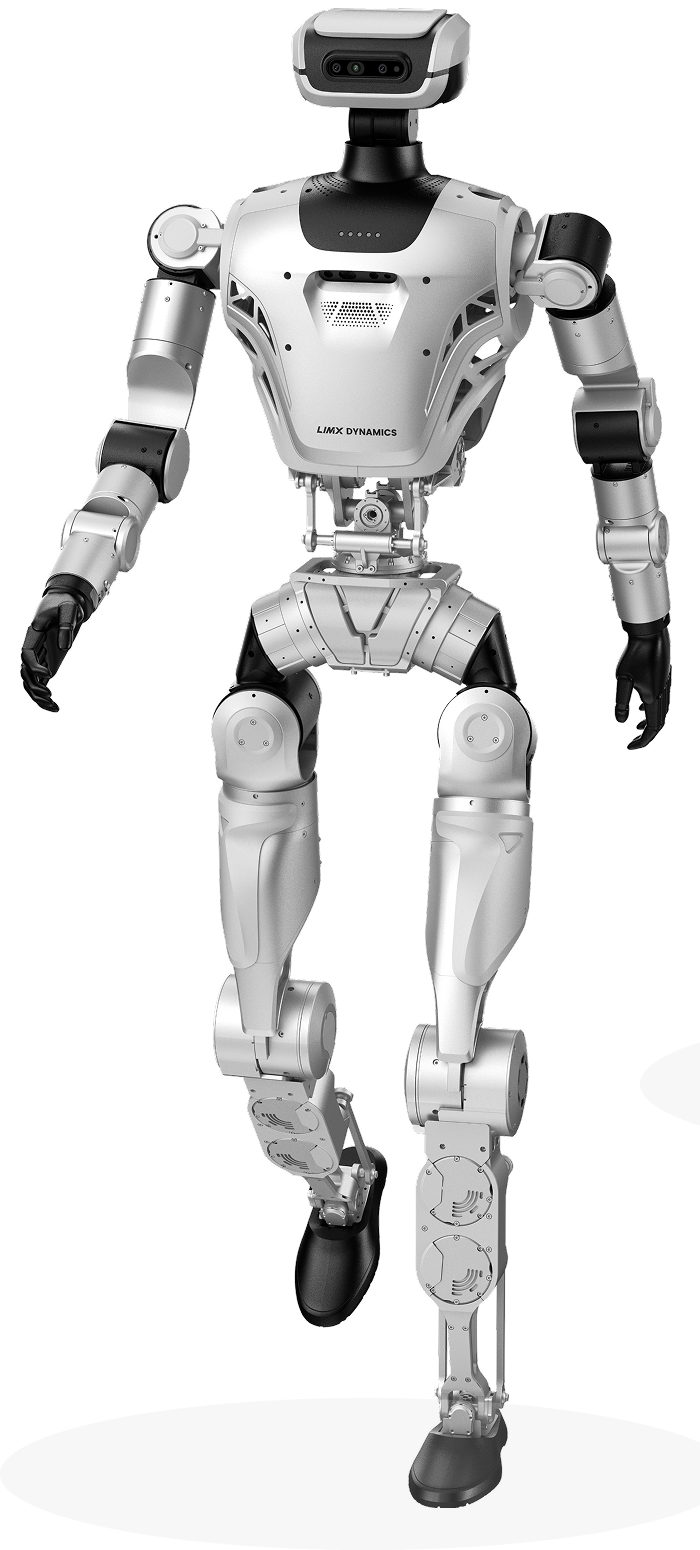
LimX Oli is a full-size, general-purpose humanoid robot developed by LimX Dynamics, a Shenzhen-based robotics company specializing in embodied AI. Officially launched on July 31, 2025 at a starting price of RMB 158,000 (about $21,800), and shown publicly at the World Robot Conference in Beijing that August, the Oli is sold as an open development platform for AI researchers, robotics developers, and solution integrators working in embodied intelligence. The entry-level price sits well below the roughly $100,000 asking price of many rival full-size humanoids.[19][34] The robot evolved from the earlier CL-series humanoid prototypes that gained attention in late 2023 for their stair-climbing ability, which was driven by real-time terrain perception and reinforcement learning.
Standing 165 cm tall and weighing 55 kg, the Oli features 31 active degrees of freedom in its base configuration and is available in three variants: Lite, EDU, and Super. The robot is notable for its reinforcement learning-based locomotion controller, which enables stable bipedal walking across uneven terrain, stairs, and slopes without pre-mapped paths. In research using the platform, the Oli climbed 15 cm and 20 cm stairs, crossed a 46 cm gap, and generalized zero-shot to a spiral staircase it had never encountered in training, all with a single learned controller.[20] LimX Dynamics has positioned the Oli as a developer-friendly platform with a modular SDK, support for popular simulation environments, and compatibility with a range of end effectors, and markets it under the tagline "Cross the Limits With Oli."[17]
Who makes the LimX Oli?
LimX Dynamics
LimX Dynamics (formally registered as Nanke Xiaobai Robot Technology (Shenzhen) Co., Ltd.) was founded in January 2022 by Dr. Wei Zhang, a tenured professor at the Southern University of Science and Technology (SUSTech) in Shenzhen, China. Dr. Zhang holds a Ph.D. in electrical and computing engineering from Purdue University and previously served as a postdoctoral researcher at the University of California, Berkeley and as a tenured professor at Ohio State University.[1] His co-founder and COO, Li Zhang, is a former executive at the autonomous driving unicorn WeRide and a Fortune 500 veteran.[2]
Dr. Jia Pan, a tenured associate professor at the University of Hong Kong, joined the company as Chief Scientist, adding expertise in robot motion planning and computer vision.[2] The company headquarters is located on the 15th Floor of Building E, Nanshan I Valley, in the Nanshan District of Shenzhen. More than 80% of the company's workforce is dedicated to research and development.[3]
LimX Dynamics describes itself as an "AI-first robotics company" committed to "disruptive innovation in Physical AI." The company's three core technology pillars are hardware design and manufacturing, integration of high-level cognition with whole-body control, and its Embodied Agentic Operating System (COSA).[3] Unlike many robotics startups that position themselves primarily as technology companies, founder Wei Zhang has emphasized a product-driven identity. "From day one, we've positioned ourselves as a product-oriented company. We started with technological innovation, but our identity has always been product-driven," he told KrASIA, adding that the company pursues "technologies with commercial value and deployment potential."[1][4]
Beyond the Oli, LimX has built out a family of legged and multi-form platforms. In December 2025 it revealed TRON 2, a modular research robot that can be physically reconfigured into a bipedal walker, a wheeled-legged robot, or a stationary dual-arm manipulator, with an EDU edition priced under $30,000.[32] The company's newer humanoid, Luna, is also built on the Oli architecture (see below).
How much funding has LimX Dynamics raised?
LimX Dynamics has raised significant capital since its founding, reflecting strong investor confidence in the Chinese humanoid robotics sector.
| Round | Date | Amount | Key investors |
|---|---|---|---|
| Angel | July 2022 | Undisclosed | Early-stage investors |
| Angel + Pre-A | October 2023 | Frees Fund, VitalBridge, Future Capital | |
| Strategic investment | May 2024 | Undisclosed | Alibaba Group |
| Series A | July 2024 | Undisclosed | China Merchants Venture Capital, Shang Qi Capital (SAIC Motor), existing investors |
| Strategic investment | July 2025 | Undisclosed | JD.com |
| Series B | February 2026 | $200 million | Stone Venture, JD.com, Oriental Fortune Capital, CoStone Capital, NIO Capital, Zhongding Sealing, NRB Corp., Kyland |
By early 2026, the company had raised a cumulative total of approximately $296 million across six rounds from 22 investors.[5][6] Alibaba Group holds an 18.7% stake in the company through its Hangzhou-based subsidiary Haoyue Enterprise Management, making the internet giant the largest shareholder outside the founding team; the May 2024 round was Alibaba's first investment in a humanoid robotics company.[7][33] The $200 million Series B, announced on February 3, 2026, was the largest single round and is earmarked for three core areas: hardware manufacturing, motion control foundation models, and the development of the company's COSA operating system.[6] Speaking in early 2026, Zhang pushed back on talk of a downturn in the sector, saying he did not think 2026 would be "a winter" for embodied intelligence.[1]
How did the LimX Oli evolve from the CL series?
CL-1: Stair-climbing prototype (2023)
The origins of the Oli can be traced to the CL-1, LimX Dynamics' first full-size humanoid robot prototype, which debuted as a stair-climbing demonstrator in late 2023. Standing approximately 157 cm tall, the CL-1 was designed primarily to validate the company's real-time terrain perception and locomotion control technologies.[8]
The CL-1 distinguished itself as one of the few humanoid robots in the world capable of dynamic stair climbing through real-time terrain perception at the time of its reveal. Rather than relying on pre-programmed trajectories, the robot used advanced perception algorithms integrated with proprietary high-performance actuators to adapt its gait in real time. It could walk onto curbs, climb stairs "dynamically and fluidly," and walk down 15-degree slopes.[9] LimX Dynamics claimed to be "the first in China to implement Perceptive Control in humanoid robots," liberating them from "blind movement" constraints.[10]
The CL-1 evolved from the company's P1 point-foot biped robot, which had already proven the viability of reinforcement learning-based locomotion by successfully navigating forest terrain, withstanding external disturbances such as kicks and stick impacts, and maintaining balance on highly uneven ground.[11]
CL-2 and CL-3: Iterative improvements (2024)
LimX Dynamics iterated rapidly on the CL platform throughout 2024. The CL-2 was described as more compact, powerful, and high-performance than the CL-1, with an emphasis on energy efficiency. The design prioritized the shortest and most direct paths to complete movements, consuming less energy than comparable robots from Boston Dynamics and Unitree Robotics.[12]
The CL-3 represented the most significant step toward what would become the Oli. Standing approximately 164 cm tall and weighing around 45 kg, the CL-3 introduced a 3-DOF waist and 7-DOF arms that enabled complex full-body movements including twists, arm stretches, controlled lying down, parallel squats, waist rotation, and self-lifting from the ground.[13] The CL-3's degree-of-freedom count ranged from 29 to 52 depending on the configuration and end effectors used. The Oli is understood to be the production-ready evolution of the CL-3 platform.[12]
P1 biped and W1 wheeled quadruped
Alongside its humanoid development, LimX Dynamics built complementary robotic platforms. The P1 is a point-foot biped robot that served as a testbed for the company's systematic development of reinforcement learning-based locomotion. The P1's successful navigation of mountain trails (including an expedition on Tanglang Mountain in Shenzhen) validated the RL approach that would later be applied to the CL series and the Oli.[11]
The W1, the company's first wheeled quadruped robot, combined the advantages of legged and wheeled structures. It was the first wheeled quadruped robot in China to achieve autonomous terrain perception for stair climbing and descending through real-time gait planning and control.[14] The W1 has since been discontinued, but the locomotion technologies it pioneered continue to inform LimX's humanoid robot development.
Technical specifications
Physical design
The LimX Oli stands 165 cm tall (175 cm for the Super variant), with a shoulder width of 55 cm (60 cm for the Super) and an arm length of 70 cm (80 cm for the Super). The base model weighs 55 kg including its battery, while the Super weighs up to 60 kg.[15][16]
The robot's design follows a general-purpose humanoid form factor with a modular hardware-software architecture. It features a drawer-type quick-swap battery system that allows operators to change battery packs rapidly without shutting down the entire system.[17]
Degrees of freedom
| Body segment | DOF per segment | Lite/EDU total | Super total |
|---|---|---|---|
| Legs (each) | 6 | 12 | 12 |
| Arms (each) | 7 | 14 | 14 |
| Waist | 3 | 3 | 3 |
| Neck | 2 | 2 | 2 |
| End effectors | Variable | 0 (Lite) / 2 (EDU) | 12 |
| Total | 31 (Lite) / 33 (EDU) | 43 |
The 31-DOF base configuration provides the foundation for bipedal locomotion, upper-body manipulation, and head-mounted perception. The EDU variant adds 2 DOF through its included grippers, while the Super variant's dexterous five-finger hands contribute an additional 12 DOF over the base platform, bringing the total to 43.[15][16]
Sensing and perception
The Oli's sensor suite is built around a self-developed 6-axis IMU (upgraded to 9-axis in the Super variant) with enhanced anti-interference properties and reduced drift. The robot features Intel RealSense D435i depth cameras mounted on both the head and chest, providing stereo depth perception for navigation and object recognition.[17]
| Sensor | Oli Lite | Oli EDU | Oli Super |
|---|---|---|---|
| IMU | 6-axis (self-developed) | 6-axis (self-developed) | 9-axis (self-developed) |
| Head depth camera | Intel RealSense D435i | Intel RealSense D435i | Intel RealSense D435i |
| Chest depth camera | Intel RealSense D435i | Intel RealSense D435i | Intel RealSense D435i |
| Wrist depth camera mount | No | Available | Available |
| Hip depth camera | No | No | Available |
| LiDAR support | External integration | External integration | Integrated support |
| Voice interaction module | No | Yes | Yes |
| Actuator torque sensors | Yes | Yes | Yes |
The robot supports integration of additional external sensors such as LiDAR, extra cameras, microphones, tactile sensors, and additional IMUs for expanded perception in complex environments.[17]
How much computing power does the Oli have?
The Oli uses a dual-processor architecture. An RK3588 system-on-chip handles real-time motion control at frequencies up to 2,000 Hz, paired with 8 GB of RAM and 64 GB of storage. For higher-level perception and AI workloads, the EDU and Super variants add an NVIDIA Orin NX module providing up to 100 TOPS of AI compute power with 16 GB of RAM and up to 2 TB of storage.[15][16] The combined system delivers up to 275 TOPS of processing power on the top-end configuration.[18]
Power system
All three Oli variants use a 9,500 mAh hot-swappable slide-out battery module charged by a 58.8V 10A charger. Battery life is approximately 2 hours for the Lite variant and 1.5 hours for the EDU and Super variants, which consume more power due to their additional computing hardware and sensors. The robot provides peripheral power outputs at 24V 5A and 12V 5A, with the Super variant offering four of each interface for powering additional equipment.[15][16]
End effectors
The Oli supports multiple end-effector configurations through its modular design.
| End effector | DOF | Availability |
|---|---|---|
| Humanoid display hands | 0 | Standard (Lite) |
| Parallel two-finger gripper | 1 | Standard (EDU), optional (Lite, Super) |
| Self-developed two-finger gripper | 1 | Optional (all variants) |
| Self-developed three-finger dexterous hand | 4 | Optional (all variants) |
| Five-finger dexterous hand | 6 | Standard (Super), optional (EDU) |
The five-finger dexterous hand on the Super variant enables fine manipulation tasks including object grasping, tool use, and dexterous operations required for industrial and service applications.[17]
What are the LimX Oli variants and how much do they cost?
LimX Dynamics offers the Oli in three configurations targeting different use cases and budgets. The Lite starts at RMB 158,000 (about $21,800), which the company positions as an accessible entry point for teaching and basic research.[19]
| Specification | Oli Lite | Oli EDU | Oli Super |
|---|---|---|---|
| Height | 165 cm | 165 cm | 175 cm |
| Weight | 55 kg | 55 kg | 60 kg |
| Shoulder width | 55 cm | 55 cm | 60 cm |
| Arm length | 70 cm | 70 cm | 80 cm |
| Degrees of freedom | 31 | 33 | 43 |
| Max joint torque | 150 Nm | 150 Nm | 250 Nm |
| Single-arm payload | 3 kg | 3 kg | 5 kg |
| Max speed | 5 km/h | 5 km/h | 5 km/h |
| Battery life | ~2 hours | ~1.5 hours | ~1.5 hours |
| Motion controller | RK3588 (8 GB / 64 GB) | RK3588 (8 GB / 64 GB) | RK3588 (8 GB / 64 GB) |
| Perception compute | None | Orin NX (100 TOPS, 16 GB / 1 TB) | Orin NX (100 TOPS, 16 GB / 2 TB) |
| IMU | 6-axis | 6-axis | 9-axis |
| End effectors | Humanoid hands | 2-finger gripper (1 DOF) | 5-finger hands (6 DOF each) |
| Voice interaction | No | Yes | Yes |
| LiDAR | External only | External only | Integrated support |
| Connectivity | WiFi 6, BLE 5.4, USB 3.0, GbE | WiFi 6, BLE 5.4, USB 3.0, GbE, Type-C | WiFi 6, BLE 5.4, USB 3.0, GbE, Type-C |
| Target use case | Education, basic research | Advanced R&D, embodied AI development | High-end research, industrial applications |
| Price (approx.) | From RMB 158,000 (~$21,800) | Price on request |
The three-tier product strategy allows LimX Dynamics to serve the full spectrum from university teaching labs (Lite) through advanced embodied AI research (EDU) to demanding industrial pilot programs (Super).[15][16][19]
How does the LimX Oli walk on rough terrain?
Reinforcement learning-based locomotion
The Oli's locomotion system represents one of its most significant technical achievements. The robot uses a reinforcement learning-trained locomotion controller that enables stable bipedal motion across uneven ground, slopes, and stairs without pre-mapped paths or pre-programmed trajectories.[20] This RL-based approach allows the robot to adapt in real time to surface changes it has never encountered during training.
The RL locomotion controller was developed through an extensive sim-to-real transfer pipeline. LimX Dynamics provides a MuJoCo simulation tool for the Oli that supports rapid sim-to-real validation and deployment. In a December 2025 paper titled "Gait-Adaptive Perceptive Humanoid Locomotion with Real-Time Under-Base Terrain Reconstruction," researchers from LimX Dynamics and several universities demonstrated a framework that transfers robustly from simulation to real hardware on complex stair and gap terrains.[20] In those tests, the Oli climbed 15 cm and 20 cm stairs forward, backward, and sideways, crossed a 46 cm gap, walked over loose gravel, and performed turning maneuvers on a spiral staircase that was never seen during training, demonstrating zero-shot generalization to previously unseen stair geometries.[20]
The control system operates at frequencies up to 2,000 Hz, enabling the kind of rapid feedback loops necessary for maintaining balance on unstable or unpredictable surfaces.[18]
Whole-body loco-manipulation
In October 2025, LimX Dynamics demonstrated what it termed "Whole-Body Loco-Manipulation with Active Perception" on the Oli platform. In a widely shared demonstration video, the robot autonomously located, walked toward, and picked up a tennis ball. The entire sequence, which included walking, bending, and squatting, was fully autonomous and relied on zero motion capture data and no remote control.[21] This capability coordinates the movement of the robot's entire body while actively sensing and responding to its environment, representing a significant step beyond simple pick-and-place manipulation performed while stationary. Roboticist Chris Paxton noted that this kind of autonomous loco-manipulation is very rarely seen from leading humanoid robots.[21]
Autonomous get-up routine
Also in October 2025, LimX Dynamics showcased two Oli humanoids performing an autonomous get-up sequence. The robots transitioned from a standing position to sitting on the floor, then to a flat lying position, and then reversed the process by lifting their legs, engaging the hip joint, and returning to a standing position in a human-like manner.[22] This full-body coordination demonstrates the maturity of the Oli's whole-body control algorithms.
What software and developer tools does the LimX Oli support?
Developer tools
The Oli is designed as a developer platform with comprehensive software support. LimX Dynamics provides a modular SDK written in Python with both high-level task-scheduling APIs and low-level joint-control interfaces. The open interfaces grant developers access to the robot's full-body state, sensor data, joint-level control, and task-level orchestration. As one company description put it, "developers can rapidly build and test without modifying the underlying architecture."[17][34]
The platform is compatible with leading simulation environments including NVIDIA Isaac Sim, MuJoCo, and Gazebo, and includes complete URDF models for sim-to-real optimization. The robot supports teleoperation and imitation learning pipelines, and can deploy onboard large language models for natural language interaction.[17]
The Oli ships with roughly 15 preloaded interactive actions and dance routines and a bilingual (Chinese and English) voice interaction system, and LimX delivers continuous over-the-air (OTA) updates for its motion and dance libraries so deployed robots benefit from ongoing algorithmic improvements.[17] In a November 2025 update, the company added conversational voice control that lets an operator issue spoken commands in natural language; in one demonstration the robot replied, "I can chat with you, make jokes, write poems, and translate. I can also follow action commands."[31]
COSA: Cognitive Operating System for Agents
On January 12, 2026, LimX Dynamics launched COSA (Cognitive OS of Agents), an embodied Agentic Operating System designed specifically for humanoid robots. COSA integrates the "brain" (high-level cognition) and "cerebellum" (motion control) functions of the robot into a unified framework.[23]
The system is built on a three-layer architecture:
- Foundation layer: Manages stable movement patterns using low-level physics models to create smooth, natural motion without jerky transitions.
- Skills layer: Handles mid-level capabilities including navigation, manipulation, obstacle avoidance, and task execution.
- Cognitive layer: Processes natural language understanding, task planning, and autonomous decision-making.
COSA enables robots to retain semantic memory, remembering past interactions, object locations, and encountered obstacles. This transforms the robot from a purely reactive agent into one that makes judgments based on accumulated experience.[23] The system's "Agentic native" design means it can autonomously perceive, understand, decide, and act from its foundational layer, rather than being an adaptation of traditional robotic systems with AI functions added on top. In one demonstration, an Oli running COSA was carrying out a water-delivery task when it received a new instruction mid-task; it paused, folded the new instruction into its plan, reprioritized, adjusted its route, and continued.[23]
VideoGenMotion (VGM)
LimX Dynamics developed the VideoGenMotion (VGM) framework, an embodied manipulation system that leverages existing video generation models to translate human manipulation videos into robotic actions. VGM requires zero real robot data and achieves cross-embodiment generalization, meaning the same algorithm can be deployed across different robotic platforms with consistent results.[24]
The framework incorporates depth information, allowing generated operational videos to include 3D spatial data. When prompted with a scene image and task instruction, VGM autonomously performs task understanding, object manipulation trajectory generation, and robot execution. LimX Dynamics introduced the concept of "Data-to-Performance ROI" to evaluate data efficiency in this context.[24]
Demonstrations and milestones
Rubble terrain navigation (2025)
In a widely circulated demonstration video, the Oli navigated a simulated construction site featuring loose sand, shifting boards, protruding rocks, and piles of debris. When the robot's foot landed on an edge and briefly pitched its body forward, the control software reacted immediately, reading the irregular momentum and adjusting subsequent steps. The robot shortened one stride and planted the other foot into a nearby patch of loose gravel, using it to absorb the impact and realign its center of mass. The debris shifted around the robot while it stayed upright and continued walking without hesitation.[25] The clip was part of a November 29, 2025 update in which LimX showcased more robust recovery on unstable ground alongside the new voice control and simplified setup features.[31]
Gym, warehouse, and dance demonstrations (2025)
LimX Dynamics released a "daily routine" video showcasing the Oli's versatility across multiple environments. The robot lifted dumbbells in a gym to demonstrate upper-body strength and coordination, performed Chinese kung fu movements alongside a human trainer to showcase balance and fluid mobility, and picked up and sorted items in a warehouse setting to demonstrate its potential for logistics applications. A separate segment showed the Oli performing choreographed dance routines.[26]
Scalable autonomous deployment (January 2026)
In January 2026, LimX Dynamics released a video showing 18 Oli humanoid robots autonomously emerging from shipping crates, standing up, walking in formation, and performing a coordinated routine without any human intervention. The company described this as the world's first scalable, autonomous deployment of multiple humanoid robots.[27] The demonstration built on a simplified setup process introduced in late 2025, in which each Oli ships folded inside a molded hard case and stands up on its own once its battery is inserted and it is powered on.[31]
The 18 robots operated as a coordinated group under the COSA system, demonstrating the ability to navigate around each other, prioritize tasks, and manage spatial awareness collectively. LimX Dynamics stated that this demonstrated a future workflow where robots could be delivered to a factory and manage their own setup without human commands or pre-programmed paths.[27]
How does the LimX Oli compare to other humanoid robots?
The Oli enters a rapidly growing Chinese humanoid robotics market that includes several well-funded competitors.
| Company | Key humanoid | Height | DOF | Starting price | Notable funding |
|---|---|---|---|---|---|
| LimX Dynamics | Oli | 165 cm | 31-43 | ~$21,800 | $296M total |
| Unitree Robotics | G1 / H1 | 127-180 cm | 23-43 | ~$13,500 (G1) | IPO-bound (Hong Kong) |
| UBTECH Robotics | Walker S1 | 170 cm | 41 | ~$100,000+ | $400M+ raised; Hong Kong-listed |
| Agibot | A2 | 175 cm | 49 | ~$100,000 | Shanghai AI Lab-backed |
| Fourier Intelligence | GR-2 | 175 cm | 53 | ~$100,000+ | $200M+ raised |
LimX Dynamics differentiates itself from competitors through its emphasis on full-stack vertical integration: proprietary real-time motion generation, cognition-motion integration, in-house actuator design, and hardware manufacturing. This approach accelerates the productization cycle beyond the demonstration phase that many competitors remain in.[4]
Founder Wei Zhang has emphasized that LimX targets human-centric applications, specifically commercial service scenarios first and then households, while explicitly avoiding factory automation despite the potential opportunities there.[4] "LimX's bipedal humanoid robots will not go into factories," Zhang said. "We serve people, not production processes. We target commercial scenarios first, and eventually households."[1] This strategic positioning contrasts with competitors like Agibot and UBTECH, which have focused heavily on manufacturing deployments.
In the international context, the Oli competes with platforms from Tesla (Optimus), Figure AI (Figure 02), 1X Technologies (NEO), and Apptronik (Apollo). Industry analysts have compared LimX's approach to that of Boston Dynamics, given the company's strong emphasis on dynamic locomotion and terrain adaptability.[12]
What is LimX Luna?
In 2026, LimX Dynamics unveiled Luna, a new humanoid robot built on the general architecture of the Oli platform. While the Oli is known for its industrial metallic silver finish and rugged terrain navigation capabilities, Luna adopts a "lifestyle" aesthetic with a more refined silhouette and an agile, lifelike gait.[28]
Luna stands 165 cm tall and weighs approximately 55 kg, matching the Oli's dimensions. It features 33 degrees of freedom and walks at up to 5 km/h. Luna uses dual Intel RealSense D435i depth cameras, RGB cameras, LiDAR, and SLAM for real-time environmental understanding. The robot operates on a Linux-based environment using ROS 2 and Python, and integrates both the COSA operating system and the VGM framework for video-based learning of human movements.[28][29]
Luna was shown on March 26, 2026 at the Taobao Influencer Festival, where it performed a catwalk routine including illusion turns and spins, demonstrating the expressive motion capabilities enabled by the Oli-derived platform.[28][30]
See also
- Humanoid robot
- LimX Dynamics
- Reinforcement learning
- Embodied AI
- Sim-to-real transfer
- Unitree Robotics
- UBTECH Robotics
- Tesla Optimus
- Boston Dynamics
References
- LimX Dynamics founder says embodied intelligence is just getting started, despite bubble concerns - KrASIA ↩
- Why this autonomous vehicle veteran joined a legged robotics startup - TechCrunch ↩
- About Us - LimX Dynamics Official Website - LimX Dynamics ↩
- LimX Dynamics founder interview on embodied intelligence - KrASIA ↩
- LimX Dynamics picks up $200M for humanoid robot expansion - The Robot Report ↩
- LimX raises $200M to build embodied intelligence for humanoid robotics - SiliconANGLE ↩
- LimX Dynamics - Robotics Company - Aparobot ↩
- LimX Dynamics shows off its CL-1 humanoid's stair climbing abilities - The Robot Report ↩
- LimX Dynamics Elevates Humanoid Robotics Capabilities with Updates on Stair Climbing and Running - LimX Dynamics (Medium) ↩
- LimX Dynamics' first humanoid robot gains real-time terrain perception - Interesting Engineering ↩
- LimX Dynamics P1 Bipedal Robot - Tanglang Mountain expedition - TechTimes ↩
- LimX Dynamics' CL-2: China's Answer to Atlas by Boston Dynamics? - Mike Kalil ↩
- China's new humanoid robot stretches like humans after a long day of work - Interesting Engineering ↩
- LimX Dynamics launches W1 wheeled quadruped - The Robot Report ↩
- LimX Dynamics Oli Lite specifications - Dobot ↩
- LimX Dynamics Oli Super specifications - Dobot ↩
- LimX Oli - Full-Size General Humanoid Robot - LimX Dynamics Official Website ↩
- Oli - Robot Details, Use Case and Specifications - Aparobot ↩
- LimX Dynamics launches humanoid robot LimX Oli starting at $21,800 - TechNode ↩
- Gait-Adaptive Perceptive Humanoid Locomotion with Real-Time Under-Base Terrain Reconstruction - arXiv ↩
- LimX Dynamics' New Humanoid Robot Demonstrates Autonomous Loco-Manipulation - Humanoids Daily ↩
- LimX Dynamics' Oli humanoid robot performs autonomous get-up routine - Interesting Engineering ↩
- LimX Dynamics Launches COSA: Cognitive OS Enabling Autonomous Humanoid Task Prioritization - Robot Central ↩
- LimX VGM: LimX Dynamics Demonstrates Embodied Manipulation by Using Human Videos - LimX Dynamics (Medium) ↩
- LimX's Oli Takes a Gritty Stroll Through the Rubble - TechEBlog ↩
- Oli: LimX's new humanoid robot masters gym, warehouse, dance floor - Interesting Engineering ↩
- LimX Dynamics Powers Up 18 Robots Without a Human in Sight - TechEBlog ↩
- LimX Dynamics Unveils Luna: A High-Performance Humanoid Built for the Spotlight - Humanoids Daily ↩
- Luna by LimX Dynamics: Price, Details, Review 2026 - Origin of Bots ↩
- LimX's humanoid captivates crowd with catwalk, illusion turn and spin - Interesting Engineering ↩
- LimX Dynamics Updates Oli with Voice Control, Robust Recovery, and Simplified Unboxing - Humanoids Daily ↩
- LimX Dynamics unveils TRON 2 shape-shifting limbed robot - The Robot Report ↩
- Chinese Robot Startup LimX Dynamics Raises $200 Million - Caixin Global ↩
- LimX Dynamics launches LimX Oli full-size humanoid robot - The Robot Report ↩
Improve this article
Add missing citations, update stale details, or suggest a clearer explanation. Every suggestion is reviewed for sourcing before it goes live.
7 revisions by 1 contributors · full history