

MagicBot G1
Last edited
Fact-checked
In review queue
Sources
24 citations
Revision
v5 · 3,537 words
Fact-checks are independent of edits: a reviewer re-verifies the article against its sources and stamps the date. How we verify
| MagicBot G1 | |
|---|---|
 | |
| General information | |
| Manufacturer | MagicLab |
| Country of origin | China |
| Release year | 2024 |
| Status | In production |
| Generation | Gen1 (G1) |
| Availability | Available (enterprise sales) |
| Website | magiclab.top |
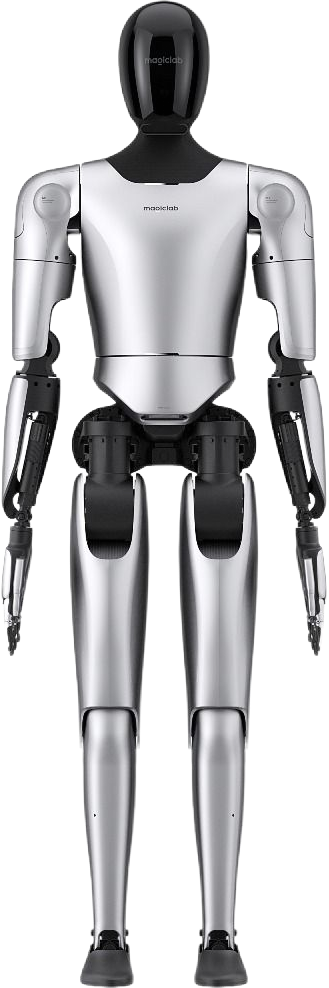
The MagicBot G1 (also called MagicBot Gen1) is a full-size, general-purpose humanoid robot built by MagicLab (legally Magic Atom Robotics Technology), a Chinese robotics startup based in Wuxi, Jiangsu Province. It stands 174 cm tall, weighs roughly 67.5 to 70 kg, and has 42 active degrees of freedom, and MagicLab markets it as "China's First General-Purpose Humanoid Robot with Multi-Robot Collaboration."[1][2][22] The G1 is MagicLab's flagship industrial humanoid, designed for factory automation, logistics, precision assembly, and commercial service work.
The MagicBot G1 was first shown publicly in December 2024, when MagicLab released footage of multiple units collaborating on a real electronics factory production line. It gained wider attention after appearing at the 2026 CCTV Spring Festival Gala, where two G1 units performed alongside pop stars before an audience of more than 1.2 billion viewers.[1][16][17] Each arm is rated to carry up to 20 kg (40 kg total body load), the robot walks at over 2 m/s, and it runs for about 4 to 5 hours on a single charge.[2][3]
What is the MagicBot G1?
The MagicBot G1 is a bipedal, fully electric humanoid robot intended for real industrial and commercial deployment rather than laboratory demonstration. It pairs human-scale proportions (174 cm, ~67.5 kg) with 42 degrees of freedom, a dual-arm payload of up to 20 kg per arm, and an onboard AI compute module of roughly 100 TOPS, which MagicLab positions for factory inspection, material handling, precision assembly, and service tasks.[2][3] MagicLab describes the G1 as the first Chinese general-purpose humanoid to demonstrate multi-unit collaboration on a working production line.[1][22]
Who makes the MagicBot G1?
MagicLab (Magic Atom Robotics Technology)
MagicLab was founded in December 2023 (with formal incorporation in January 2024) by Wu Changzheng and Wang He. Wu Changzheng previously led the development of Xiaomi's well-known quadruped robot project, bringing deep experience in robotics engineering and large-scale product development. Wang He, born in 1992, studied electronic engineering at Tsinghua University before completing his doctorate at Stanford University under renowned robotics researcher Leonidas Guibas. After returning to China, Wang joined Peking University, where he established a laboratory focused on embodied perception and human-robot interaction.[3][4]
The company's legal name is Magic Atom Robotics Technology (Wuxi) Co., Ltd., and it was incubated within the Dreame Technology ecosystem.[1] At the time of its angel funding round, MagicLab had approximately 100 employees, with over 80% dedicated to research and development and more than 50% holding master's degrees or higher. Core team members graduated from institutions including Tsinghua, Shanghai Jiao Tong University, Zhejiang University, Beihang University, and New York University.[5]
MagicLab pursues an "Embodied Intelligence + X" strategy built on a "1+2+N" framework: one full-stack technology platform, two core product lines (humanoid robots and quadruped robots), and N ecosystem touchpoints to build what the company calls "an intelligent ecosystem for the real world."[6]
How is MagicLab funded?
| Round | Date | Amount | Lead investor(s) |
|---|---|---|---|
| Angel | December 2024 | 150 million RMB (~$20.6 million USD) | Zhui Chuang Venture Capital, Yi Pu Fund |
| Series A | March 2026 | 500 million RMB (~$68 million USD) | Tuopu Group and others |
The angel round funds were allocated to technology R&D, mass production of complete robots, and initial commercialization. The Series A round, announced on March 9, 2026, focused on accelerating product iteration, cost optimization, and establishing a leading position in the embodied intelligence robotics market. The investment from Tuopu Group, an automotive parts manufacturer, was expected to strengthen MagicLab's manufacturing systems, core component supply chain, and mass production capabilities.[5][6]
Leadership changes
In March 2026, MagicLab underwent a significant management reshuffle. Founder and CEO Wu Changzheng stepped down at the end of February 2026, and no replacement CEO was named at the time. Co-founder Chen Chunyu was retained as CTO, and the company appointed several new leaders, including Li Xiang, a professor at Tsinghua University, as Chief Scientist focusing on dexterous hands and human-robot interaction. Other appointments included Zhang Tao (Head of Embodied Models, formerly at Alibaba and NIO), Gao Chunchao (Head of Joint Module Division, formerly at Dreame Technology), and Tan Yongzhou (Head of International Markets, formerly at UBTECH).[7]
What are the MagicBot G1's specifications?
Physical characteristics
The MagicBot G1 is built to human adult proportions, standing 174 cm tall and weighing approximately 67.5 to 70 kg (third-party reseller listings cite ~67.5 kg, while MagicLab's official spec page lists approximately 70 kg). Its dimensions are roughly 174 x 58 x 28 cm. The chassis uses high-strength, lightweight materials designed for durability in industrial environments. The robot carries an IP66 dust and water resistance rating, making it suitable for factory floor conditions.[2][8][22]
Degrees of freedom and actuation
The G1 features 42 active degrees of freedom distributed across its full body (2 in the neck, 7 per arm, 11 per hand, 2 in the waist, and 6 per leg), providing human-like mobility in the torso, arms, legs, and hands. The robot uses fully electric actuators with high-torque servo motors, eliminating the maintenance complexity associated with hydraulic systems used by some competitors. Maximum joint torque is rated at 350 N-m or higher per joint, providing the power needed for heavy-duty manipulation tasks.[2][9][22]
MagicLab manufactures its joint modules, reducers, drivers, and main control systems in-house, and develops more than 90% of its hardware components internally. This vertical integration gives the company tighter control over performance specifications and cost structures compared to competitors reliant on third-party components.[5]
Manipulation and dexterous hands
MagicLab states the G1's arms support a payload of up to 20 kg per arm, or 40 kg of total body load when both arms work together. This figure, drawn from MagicLab's December 2024 factory release, rivals industrial collaborative robots (cobots) and significantly exceeds most humanoid competitors. For context, the Unitree G1 supports roughly 2 kg per arm.[1][10]
The robot's hands use six miniaturized high-torque servo actuators per hand, equipped with multi-dimensional pressure sensors enabling sub-millimeter positioning accuracy. MagicLab claims the hands can mimic approximately 70% of human hand gestures and handle objects of varying shapes, sizes, weights, and materials, including soft or malleable items.[9]
In February 2025, MagicLab unveiled the MagicHand S01, a next-generation dexterous hand designed for the MagicBot platform. Key specifications include:
| Specification | Value |
|---|---|
| Degrees of freedom | 11 |
| Hand weight | ~580 g |
| Individual finger grip force | ~2.5 kg |
| Combined four-finger grip force | ~9.1 kg |
| Payload capacity | 5 kg per hand |
| Force resolution | 0.1 N |
| End-position repeatability | ~0.2 mm |
| Control method | Hybrid force/position (current + tactile feedback) |
The MagicHand S01 integrates MagicLab's proprietary six-axis electric actuator, encoder, and tactile sensors. Its actuators are built with a 30% safety margin to ensure reliability during sustained industrial operations, and MagicLab states that when fitted to a humanoid the hand can support payloads exceeding 20 kg in working environments.[11][23]
Sensing and perception
The G1 is equipped with a comprehensive sensor suite for 360-degree environmental awareness and semantic recognition:
- 3D LiDAR for environmental detection and SLAM navigation
- Head-mounted and waist-mounted RGBD depth cameras
- Three fisheye cameras providing wide-angle coverage
- Ultrasonic sensors for proximity detection
- Force-torque sensors in the arms and hands
- Omnidirectional microphone array for voice interaction
MagicLab refers to this as a "super perception sensor" system that enables the robot to navigate complex environments autonomously while maintaining real-time terrain adaptability.[9][12][22]
Computing and AI
The G1 is powered by an 8-core high-performance CPU with approximately 100 TOPS of onboard AI compute for real-time perception and decision-making. The robot supports large language model integration; in November 2024, MagicLab confirmed it was in talks with ByteDance to integrate the Doubao LLM into its third-generation MagicBot robots, to enhance natural interaction and task understanding. As of 2026 that partnership had not been formally announced.[2][9][24]
The software platform includes the Magic Atom Motion Control Platform, which supports both imitation learning and reinforcement learning. MagicLab claims that new movement behaviors can be trained within a 24-hour cycle. The system enables real-time adaptive joint stiffness, allowing the robot to dynamically adjust its compliance based on the task being performed.[2]
Supporting the motion control platform is the MagicData AI engine, which processes four types of training data: synthetic data, teleoperation data, imitation learning data, and real-time scene data. The engine supports both local and cloud-based data annotation, processing, and simulation training.[9]
Power and connectivity
| Specification | Value |
|---|---|
| Battery capacity | 25 Ah (~1.35 kWh) |
| Battery life | 4 to 5 hours (continuous operation) |
| Charging time | ~3 hours |
| Connectivity | Wi-Fi 6 (dual-band), 4G/5G cellular, Bluetooth 5.2 |
| Software updates | Over-the-air (OTA) |
The 4-to-5-hour runtime during continuous walking and operational tasks makes the G1 suitable for full shift coverage in industrial settings with scheduled charging breaks.[2][8][22]
Full technical specifications
| Category | Specification | Value |
|---|---|---|
| Physical | Height | 174 cm (5 ft 8.5 in) |
| Physical | Weight | ~67.5 to 70 kg (149 to 154 lb) |
| Physical | Dimensions | 174 x 58 x 28 cm |
| Physical | IP rating | IP66 |
| Mobility | Degrees of freedom | 42 |
| Mobility | Max walking speed | >2 m/s (~7.2 km/h, ~4.5 mph) |
| Mobility | Stair climbing | Yes |
| Actuation | Actuator type | Fully electric (PMSM motors) |
| Actuation | Peak joint torque | >=350 N-m |
| Manipulation | Arm payload | Up to 20 kg per arm (40 kg total body load) |
| Manipulation | Hand type | 6-DOF dexterous hand (upgradable to MagicHand S01, 11 DOF) |
| Manipulation | Fingers per hand | 5 |
| Manipulation | Hand gesture coverage | ~70% of human gestures |
| Sensors | LiDAR | 3D LiDAR |
| Sensors | Cameras | RGBD depth cameras (head + waist), 3 fisheye cameras |
| Sensors | Other | Ultrasonic, force-torque sensors, microphone array |
| Computing | CPU | 8-core high-performance processor |
| Computing | AI compute | ~100 TOPS |
| Computing | LLM integration | Yes |
| Power | Battery | 25 Ah (~1.35 kWh) |
| Power | Runtime | 4 to 5 hours |
| Connectivity | Wireless | Wi-Fi 6, 4G/5G, Bluetooth 5.2 |
| Software | Updates | OTA |
What can the MagicBot G1 do?
Factory deployment (December 2024)
In December 2024, MagicLab released video footage showing multiple MagicBot G1 units working together on a production line at an unnamed electronics factory. The robots performed product inspections, material transport, precision assembly, barcode scanning, and inventory management tasks. In one demonstrated scenario, one unit transferred material packages to another robot at a workstation, which then extracted components and passed them to processing machinery.[1][9]
A MagicLab researcher acknowledged that the robots were "still in the skill training and learning phase" and could not yet operate fully autonomously, requiring human oversight. Nevertheless, the deployment marked an important milestone as one of the first instances of multiple humanoid robots collaborating on real production tasks, rather than operating in controlled laboratory settings.[1]
Weight-pulling demonstration
MagicLab released a demonstration video showing the MagicBot G1 pulling progressively heavier loads on a cart. The robot successfully pulled 80 kg (176 lb), then 170 kg (375 lb), and finally 250 kg (551 lb), which was equivalent to three adult humans seated on the cart. Walking speed decreased from 0.7 m/s at lighter loads to 0.3 m/s at the maximum load, but the robot maintained steady balance throughout.[13]
Outdoor running test (March 2025)
In March 2025, MagicLab published footage of the MagicBot running outdoors continuously for four minutes, featuring what the company described as a more human-like, straight-legged gait. The robot demonstrated the ability to navigate uneven outdoor terrain using what MagicLab called "powerful anti-interference and anti-shock properties." The company attributed the improved locomotion to its motion control network, which enables the robot to self-learn and refine its walking posture over time.[14]
Beijing humanoid robot half-marathon (April 2025)
The MagicBot, operating under the service name "Xiaomai" (meaning "little wheat" in Chinese), participated in the world's first humanoid robot half-marathon held in Beijing on April 19, 2025. Twenty-one bipedal robots raced alongside approximately 12,000 human runners. Only six of the 21 robotic participants completed the course. The race was won by Tiangong Ultra from the Beijing Innovation Center of Humanoid Robotics, which finished in 2 hours and 40 minutes.[15]
2026 CCTV Spring Festival Gala
MagicLab was the first robotics company to appear on stage at the 2026 CCTV Spring Festival Gala, which was watched by over 1.2 billion viewers. Two MagicBot G1 units and six MagicBot Z1 units performed in a song-and-dance number titled "Intelligent Manufacturing Future" alongside artists including Yi Yangqianxi and Jerry Yan. The G1 units performed interactive gestures such as waving, while the Z1 units executed dynamic choreography including the Thomas 360 breakdance spin, which MagicLab claimed was an industry first for a humanoid of that size.[16][17]
The Gala performance had an immediate commercial impact. Within minutes of the broadcast, MagicLab's robots sold out on JD.com. Data from the platform showed that within two hours, searches for robots surged by 300%, customer service inquiries increased by 460%, and order volume jumped by 150%. New orders came from over 100 cities across China.[18]
CES 2026
MagicLab made its international exhibition debut at CES 2026 in Las Vegas, showcasing three products: the MagicBot Gen1, the MagicBot Z1, and the MagicDog quadruped robot. The company used the event to accelerate its global development strategy and explore international partnerships.[19]
Service deployments
Beyond factory automation, MagicLab has deployed the MagicBot G1 in commercial service roles under the brand name "Xiaomai." The robot has been tested in retail settings as a receptionist and shopping guide in home appliance stores, powered by a voice interaction model designed to sound more natural and human-like. Additional service deployments include parking assistance at commercial facilities, ushering at events, hotel concierge operations, car dealership support, and hair salon assistance tasks.[20]
MagicLab also developed a four-legged companion robot with AI-powered interaction capabilities designed to assist visually impaired individuals, helping them with shopping and hailing taxis.[20]
MagicNet fleet management
A distinguishing feature of the MagicBot G1 platform is MagicNet, MagicLab's multi-robot collaboration layer. MagicNet enables:
- Shared environmental maps across multiple robot units
- Coordinated task scheduling and assignment
- Integration with Manufacturing Execution Systems (MES)
- Centralized fleet monitoring and control
MagicNet is designed for factory and campus deployments where multiple robots need to work in coordination. The system allows robots to share spatial awareness and divide tasks dynamically based on workload and proximity, enabling what MagicLab calls "redefining efficiency and collaboration in industrial settings."[1][9]
What is the MagicBot Z1?
The MagicBot Z1 is MagicLab's compact, agile humanoid robot designed as a lower-cost, highly dynamic complement to the G1. Standing 140 cm tall and weighing 40 kg, the Z1 gained viral attention in mid-2025 when MagicLab released a 45-second video showing the robot performing backflips, martial arts spin kicks, and dodging an arrow with a side flip.[21]
| Specification | MagicBot G1 | MagicBot Z1 |
|---|---|---|
| Height | 174 cm | 140 cm |
| Weight | ~67.5 kg | ~40 kg |
| Degrees of freedom | 42 | 24 (expandable to 50) |
| Max walking speed | >2 m/s | 2.5 m/s |
| Arm payload | 20 kg per arm | 3 kg per arm |
| Peak joint torque | >=350 N-m | >130 N-m |
| Battery life | 4 to 5 hours | ~2 hours |
| Primary focus | Industrial automation, heavy manipulation | Dynamic mobility, commercial/consumer |
| Joint range | Standard | Up to 320 degrees |
The Z1 uses low-inertia high-speed PMSM motors with a 25 kHz control frequency for rapid dynamic movements. Its sensor suite includes 3D LiDAR, an Intel RealSense D435 depth camera, dual fisheye cameras, and a head tactile sensor with microphone array. When equipped with the optional 11-DOF MagicHand S01, the Z1 gains voice interaction and gesture-based emotional recognition capabilities.[2][21]
How does the MagicBot G1 compare to other humanoid robots?
The MagicBot G1 competes in the rapidly growing Chinese humanoid robot market alongside several notable rivals:
| Robot | Manufacturer | Height | Weight | DOF | Arm payload | Approximate price |
|---|---|---|---|---|---|---|
| MagicBot G1 | MagicLab | 174 cm | 67.5 kg | 42 | 20 kg/arm | Enterprise pricing (est. $50K-$100K+) |
| Unitree G1 | Unitree Robotics | 127 cm | 35 kg | 43 | ~2 kg/arm | From ~$16,000 |
| Unitree H1 | Unitree Robotics | 180 cm | 47 kg | 19 | N/A | ~$90,000 |
| Walker S2 | UBTECH | 170 cm | 60 kg | 44 | 15 kg/arm | Enterprise pricing |
| AgiBot A2 | AgiBot | 175 cm | 68 kg | 42 | 7 kg/arm | Enterprise pricing |
| Figure 02 | Figure AI | 170 cm | 70 kg | 41+ | N/A | Enterprise pricing |
The G1's primary competitive advantages include its high stated payload capacity (up to 20 kg per arm), which surpasses most humanoid competitors, and its demonstrated multi-robot collaboration capabilities through MagicNet. Its factory deployment since December 2024 also gives MagicLab a head start over competitors still in the R&D or prototype phase.[1][2][10]
According to GGII (Gaogong Industry Research Institute), domestic shipments of humanoid robots in China were projected at approximately 18,000 units in 2025, representing a nearly 650% increase over 2024 volumes, with growth expected to reach 62,500 units by 2026.[18]
How is the MagicBot G1 sold and priced?
MagicLab planned to produce approximately 400 humanoid robots in 2025, with delivery volumes expected to reach thousands of units in 2026. Since commercial sales began in May 2025, the company secured 500 million RMB ($68 million USD) in letters of intent within six months, with firm orders totaling 130 million RMB ($18 million USD).[6][20]
Through its "Thousand-Scenario Co-Creation" initiative, MagicLab has partnered with more than 100 organizations worldwide on proof-of-concept validation and real-world pilot deployments. Commercial partners include Dreame Technology, Starry Plan, Zhiyue Youchuang, and Qingting Intelligent, spanning retail, manufacturing, and specialized application sectors.[6]
MagicLab established its national headquarters in Wuxi Liangxi Science and Technology City. The company's 2026 product roadmap includes expanding beyond humanoid and quadruped robots to additional multi-form robotic platforms for consumer, industrial, commercial, and public space applications.[6]
See also
- Humanoid robots
- MagicBot Z1
- Unitree G1
- Unitree H1
- UBTECH Walker S2
- Figure 02
- Embodied AI
- Robot learning
References
- "MagicLab's humanoid army turns factory into precision powerhouse," Interesting Engineering, December 2024 ↩
- "MagicLab MagicBot Review: Price, Specs & Factory Deployment," Robozaps, 2026 ↩
- "China's 'Iron Legion': Wang Xingxing, Jiang Zheyuan, Wu Changzheng and Wang He and the Breakthrough Year of Embodied Intelligence," The Icons, March 2026 ↩
- "Chinese Embodied AI Startup MagicLab Bags USD20.6 Million in Angel Funds," Yicai Global, December 2024 ↩
- "Embodied Intelligence company Magic Atom completed a 150 million yuan Angel round of financing," 36Kr, December 2024 ↩
- "MagicLab Officially Announces 500 Million Yuan New Funding," Gasgoo, March 2026 ↩
- "MagicLab's management undergoes major reshuffle," Gasgoo, March 2026 ↩
- "MagicLab MagicBot G1 Standard Edition Humanoid Robot," Europa Satellite ↩
- "MagicLab MagicBot Collaborative Industrial Humanoid Robots," Mike Kalil, December 2024 ↩
- "MagicLab MagicBot comparison with Chinese humanoid robots," Mike Kalil ↩
- "MagicLab Unveils MagicHand S01 Dexterous Hand, Progressing Toward Mass Adoption of Humanoid Robots," Yahoo Finance, February 2025 ↩
- "MagicLab MagicBot G1," Wellbots ↩
- "China's MagicBot humanoid robot pulls 551 pounds with ease," Interesting Engineering, 2025 ↩
- "MagicLab's humanoid runs outdoors for 4 minutes straight in latest test," Interesting Engineering, March 2025 ↩
- "Beijing hosts world's first humanoid robot half-marathon," Global Times, April 2025 ↩
- "Humanoid robots take center stage at 2026 Spring Festival Gala," TechNode, February 2026 ↩
- "Analysis: China's biggest TV event had a clear star: the robot," CNN, February 2026 ↩
- "Orders for robots surge after Spring Festival Gala," China Daily, February 2026 ↩
- "MagicLab made its debut at CES, accelerating global development," The AI Journal, January 2026 ↩
- "Watch China's humanoid robot valet cars, style hair, assist in hotels," Interesting Engineering, 2025 ↩
- "MagicBot Z1 robot nails spin kicks, dodges arrow with a side flip," Interesting Engineering, 2025 ↩
- "General-Purpose Humanoid Robot (MagicBot Gen1 specifications)," MagicLab official site ↩
- "In-House Developed Dexterous Hand MagicHand S01," MagicLab official site ↩
- "Magiclab Develops Third-Generation Humanoid Robot, in Talks for Collaboration with ByteDance's Doubao Model," TMTPost, November 2024 ↩
Improve this article
Add missing citations, update stale details, or suggest a clearer explanation. Every suggestion is reviewed for sourcing before it goes live.
4 revisions by 1 contributors · full history