

Matrix-1
Last edited
Fact-checked
In review queue
Sources
12 citations
Revision
v3 · 2,956 words
Fact-checks are independent of edits: a reviewer re-verifies the article against its sources and stamps the date. How we verify
 | |
| Developer | Matrix Robotics (Matrix Hyperintelligence) |
| Type | Humanoid robot |
| Generation | 1st |
| Unveiled | December 26, 2024 |
| Country of origin | China |
| Height | 180 cm (5 ft 11 in) |
| Weight | 67 kg (148 lb) |
| Degrees of freedom | 55 (total body); 22 (per hand) |
| Battery | 2.28 kWh; ~5 hours runtime |
| Charging | 45 minutes (fast charge) |
| Walking speed | 2.1 m/s (7.6 km/h; 4.7 mph) |
| Payload | 10 kg per arm |
| Cameras | 8 RGB cameras |
| Actuators | Self-developed; 196 N-m/kg peak torque density |
| AI system | MLM2.0 embodied manipulation model |
| Status | Prototype / Development |
| Price | ~$100,000 USD (estimated) |
| Website | matrixrobotics.ai |
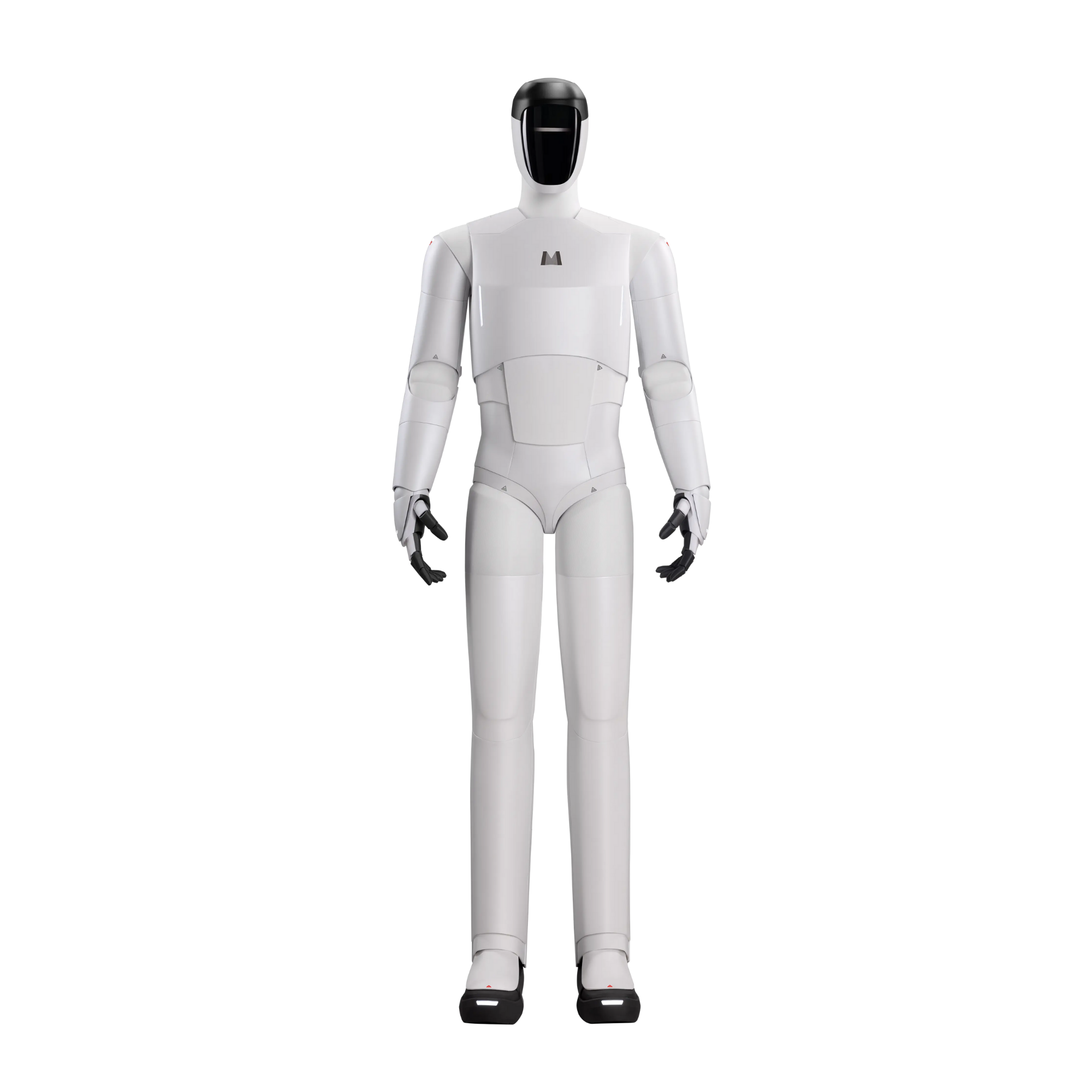
Matrix-1 (stylized as MATRIX-1) is a general-purpose humanoid robot developed by Matrix Robotics, a Shanghai-based robotics startup formally known as Shanghai Matrix Superintelligent System Integration Co., Ltd. (also referred to as Matrix Hyperintelligence). Unveiled on December 26, 2024, Matrix-1 was the company's debut product and the first humanoid robot to emerge from the firm's research program. Standing 1.8 meters tall and weighing 67 kilograms, it was designed for industrial, logistics, and service applications, combining a soft-skin exterior with 55 degrees of freedom and a proprietary "brain-cerebellum-limb" collaborative operating system.
Matrix-1 is notable for its distinctive rounded, soft-skinned appearance that sets it apart from the hard-metal aesthetics common among competing humanoid platforms. The robot walks at speeds up to 7.6 km/h, operates for approximately five hours per charge with 45-minute fast charging, and features third-generation dexterous hands with 22 degrees of freedom per hand. Matrix Robotics positions the platform as a bridge between current industrial robots and future general-purpose humanoid assistants, with the more advanced MATRIX-3 successor announced in January 2026.
Company background
Matrix Robotics
Matrix Robotics was founded in 2024 by Zhang Haixing (also known as Allen Zhang), the former founding leader of Tesla's China Design and Research Center. Zhang has over 20 years of experience in product research and development, design, and technology entrepreneurship spanning consumer electronics, electric vehicles, and artificial intelligence. He holds more than 100 patents and has received multiple international design awards, including the German Red Dot Award, Japan's GOOD DESIGN AWARD, and the CES Innovation Award.[1][2]
At Tesla, Zhang contributed to projects including the Optimus humanoid robot program, autonomous robotaxi development, electric vehicle design, and smart charging infrastructure. He applied lessons learned from Tesla's hardware engineering approach to redefine dexterous hand engineering and humanoid robot body design at Matrix Robotics.[2]
The company is headquartered in Shanghai, China, and operates under the formal corporate name Shanghai Matrix Superintelligent System Integration Co., Ltd. Matrix Robotics describes its mission as "elevating human potential through AGI robots in the physical world."[3]
Star Dynamics joint venture
On September 19, 2025, Hongrun Construction Group and Matrix Super Intelligence (Matrix Robotics' parent entity) established Star Dynamics Technology Co., Ltd. as a joint venture dedicated to humanoid robot research, development, production, and commercialization. Hongrun Construction holds a 60 percent stake in the venture, while Matrix Super Intelligence retains 40 percent.[4] The two parties had signed the partnership agreement earlier in September 2025.
Star Dynamics unveiled its first humanoid robot, the Star Dynamics No. 1 (Star-1), featuring a polished exterior without exposed wiring or visible joints. CEO Zhang Haixing stated that the Star-1 would enter mass production in 2026, with the company aiming to bring robot prices to a level affordable for consumer-end customers within two to three years.[4] Zhang emphasized that the core control architecture had been significantly streamlined, reducing code from hundreds of thousands of lines to under 3,000 lines, which reportedly decreases system errors and improves stability for scaling production.[5]
Development and unveiling
Matrix-1 was unveiled on December 26, 2024, marking the company's formal entry into the humanoid robotics market. The robot was introduced through promotional materials and video demonstrations that highlighted its soft-skin exterior and human-like proportions.[6] The launch positioned Matrix-1 as a practical, responsibility-oriented humanoid designed for logistics, manufacturing, workplace patrolling, and home assistance tasks.
The development of Matrix-1 reflected a deliberate design philosophy centered on approachability. While most humanoid robots at the time used hard metal or plastic shells, Matrix Robotics wrapped the Matrix-1's neck and torso in a soft, rounded enclosure material that gives the robot a more human-friendly appearance.[6] This design choice was not purely aesthetic; the soft enclosure enhances flexibility and reduces injury risks during close human-robot interaction, allowing more complex body posture adjustments that better mimic human movements.[7]
In July 2025, Matrix Superintelligence publicly debuted the Matrix-1 along with its brain-cerebellum-limb collaborative operating system at an industry event, demonstrating the robot's integrated perception, planning, and execution capabilities.[8]
Technical specifications
Physical design
Matrix-1 stands 180 centimeters (5 feet 11 inches) tall and weighs 67 kilograms (148 pounds), including its battery pack. The robot's proportions are designed to approximate an adult human frame, allowing it to operate in environments built for people, including standard doorways, corridors, and workstations. The soft enclosure material covering the neck and torso distinguishes it from most competing platforms, providing both safety padding and a more approachable appearance.[3][7]
Degrees of freedom
The robot has 55 total degrees of freedom distributed across its body, enabling a wide range of joint motion for walking, bending, reaching, and manipulation tasks. The hands alone account for 22 degrees of freedom each, providing finger articulation comparable to human dexterity. The remaining degrees of freedom are distributed across the legs, torso, arms, and head, enabling coordinated whole-body movements.[3]
Detailed specifications
| Parameter | Value |
|---|---|
| Height | 180 cm (5 ft 11 in) |
| Weight | 67 kg (148 lb) with battery |
| Total degrees of freedom | 55 |
| Hand degrees of freedom | 22 per hand |
| Fingers per hand | 5 |
| Arm payload capacity | 10 kg per arm |
| Maximum walking speed | 2.1 m/s (7.6 km/h; 4.7 mph) |
| Battery capacity | 2.28 kWh |
| Battery life | ~5 hours continuous operation |
| Fast charging time | 45 minutes |
| RGB cameras | 8 |
| LiDAR | Yes (optional) |
| Ultrasonic sensors | Yes (optional) |
| Microphones | Multi-microphone array with ANC |
| Onboard compute | 8-core CPU with integrated GPU |
| Actuator peak torque density | 196 N-m/kg |
| Stair climbing | Yes |
| Autonomous charging | Yes (docking base) |
Actuators and motors
Matrix-1 uses fully self-developed motors and actuators, a point of differentiation that Matrix Robotics emphasizes as critical for controlling cost and performance at scale. The actuators achieve a peak torque density of 196 N-m/kg, providing the power needed for dynamic locomotion and manipulation while keeping weight manageable.[3] The actuator system is designated MPA 3.0, reflecting three generations of iterative development within the company. The proprietary actuator design allows Matrix-1 to achieve an exceptionally wide range of joint motion, delivering what the company describes as "superior flexibility" across all limb segments.[3]
Dexterous hands
The Matrix-1's hands represent the third generation of Matrix Robotics' hand design. Each five-fingered hand provides 22 degrees of freedom, comparable to the range of motion found in human hands. The hand system, designated DexH13GEN2, uses force-position hybrid control that combines positional accuracy with force feedback, allowing the robot to grip delicate objects without crushing them and heavy objects without dropping them.[3][7]
The hands incorporate tactile sensors that detect contact forces and textures during manipulation. According to Matrix Robotics, the hands achieve "human-equivalent strength," enabling the robot to use standard tools, operate switches and handles, and perform assembly tasks that require fine motor control.[3] When combined with the 10 kg per-arm payload capacity, the hands enable practical manipulation across a range of industrial and service tasks.
Sensors and perception
Matrix-1 is equipped with eight onboard RGB cameras that power its AI-driven vision system, providing coverage around the robot for environmental awareness and object recognition. The sensor suite can optionally be expanded with LiDAR and ultrasonic sensors for enhanced obstacle detection and distance measurement in complex environments.[3]
For audio, the robot features a multi-microphone array with active noise cancellation and echo cancellation, paired with an integrated speaker. This combination enables voice recognition and synthesis, allowing the robot to engage in dialogue with human operators and respond to spoken commands.[3]
Computing and AI
The onboard computing system features an 8-core processor with an integrated GPU running a real-time operating system optimized for AI algorithms used in perception, planning, and control. Matrix Robotics claims the system delivers four times the reasoning power of its previous-generation computing hardware.[7]
Matrix-1 runs what the company calls the MLM2.0 embodied manipulation model, which enables the robot to learn manipulation tasks through observation and practice rather than explicit programming. The system also incorporates a vision-language model (VLM) for visual reasoning, allowing the robot to understand scenes, identify objects, and plan actions based on visual input combined with natural language instructions.[3]
Brain-cerebellum-limb architecture
One of Matrix-1's distinguishing software features is its "brain-cerebellum-limb" collaborative operating system, a hierarchical control architecture that coordinates the robot's cognitive, motor, and execution systems in a manner inspired by human neuroanatomy.[8]
The architecture divides control into three tiers:
- Brain layer: Handles high-level decision-making, task planning, and natural language understanding. This layer processes sensory input from cameras and microphones to form a semantic understanding of the environment and determine what actions are needed.
- Cerebellum layer: Manages fine motor control and coordination. This layer translates high-level plans into smooth, coordinated movement sequences, handling balance, gait generation, and precise limb positioning.
- Limb layer: Executes physical actions through the actuators and motors, providing real-time feedback on force, position, and contact state back to the higher layers.
This three-tier approach allows the robot to "see, think, and act" in an integrated manner rather than executing rigid pre-programmed sequences. The brain-cerebellum-limb OS was publicly demonstrated in July 2025 alongside the Matrix-1 hardware.[8]
Applications
Matrix Robotics targets Matrix-1 at several market segments where humanoid form factors provide advantages over traditional fixed or mobile robots.
Logistics and warehousing
With 10 kg per-arm lifting capacity and bipedal mobility, Matrix-1 is designed for warehouse environments where it can pick items from shelves, transport materials between stations, and deliver goods to packing areas. Its human-scale proportions allow it to navigate aisles and reach shelves designed for human workers without requiring facility modifications.[7]
Manufacturing and assembly
In factory settings, the robot can assist assembly line workers by holding tools, fetching components, performing vision-based quality inspections, and executing repetitive assembly tasks that require dexterity. The force-position hybrid control in its hands enables it to handle both robust industrial parts and more delicate components.[7]
Healthcare and elder care
Matrix-1's soft exterior and safe interaction design make it a candidate for healthcare environments where it could assist with patient monitoring, deliver supplies within medical facilities, or provide companionship and basic assistance in elder care settings.[7]
Service and hospitality
The robot's natural language dialogue capability and approachable appearance position it for customer-facing service roles in hospitality, retail, and public spaces, including reception, wayfinding, and information delivery.[3]
Security and patrolling
With autonomous navigation, obstacle avoidance, and camera-based surveillance, Matrix-1 can perform patrol routes in offices, campuses, and industrial facilities, detecting anomalies and reporting to human security personnel.[7]
Comparison: Matrix-1 vs. MATRIX-3
In January 2026, Matrix Robotics unveiled MATRIX-3, its third-generation flagship humanoid robot, representing a ground-up redesign spanning algorithms, hardware, and applications.[9] The MATRIX-3 shifts the company's approach from rigid task execution toward adaptive interaction with the real world.
| Feature | Matrix-1 | MATRIX-3 |
|---|---|---|
| Unveiled | December 26, 2024 | January 10, 2026 |
| Generation | 1st | 3rd |
| Height | 180 cm | 170 cm |
| Weight | 67 kg | Not disclosed |
| Total DOF (body) | 55 | 37 (body) + 27 per hand |
| Hand DOF | 22 per hand | 27 per hand |
| Hand actuation | Force-position hybrid control | Cable-driven (tendon-driven) |
| Tactile sensing | Tactile sensors in hands | 0.1 N fingertip sensitivity; 3D biomimetic skin |
| Skin/exterior | Soft enclosure (neck and torso) | 3D woven biomimetic fabric (full body) |
| Walking speed | 7.6 km/h | Not disclosed |
| Battery life | ~5 hours | Not disclosed |
| AI capability | MLM2.0 embodied manipulation | Zero-shot generalization; natural language task execution |
| Actuators | Self-developed rotary (MPA 3.0) | Integrated linear actuators |
| Status | Prototype / Development | In development; pilot deployments mid-2026 |
| Estimated price | ~$100,000 | ~$85,000 |
The most significant advancements in MATRIX-3 include the cable-driven 27-DOF dexterous hands that closely mirror human hand anatomy, the 3D woven biomimetic skin with a distributed sensing network covering the entire chassis, and a proprietary neural network architecture enabling zero-shot generalization (the ability to perform new tasks from natural language instructions without task-specific training).[9][10] The MATRIX-3 also features a spatial perception foundation model for its upgraded vision system and integrated linear actuators providing high power density with low-noise operation.[9]
However, the MATRIX-3 announcement drew some skepticism from industry observers because the showcase relied entirely on computer-generated imagery (CGI) rather than footage of a functioning physical prototype. RoboHorizon noted that the specification sheet "reads straight out of science fiction" and reserved judgment until actual hardware demonstrations could be verified.[11]
Competitive landscape
Matrix-1 entered a crowded and rapidly growing humanoid robotics market, particularly within China, which as of 2025 hosts over 140 manufacturers producing more than 330 humanoid robot models.[12] The company competes against both well-established robotics firms and newer startups backed by significant venture capital.
| Company | Robot | Key Features | Status (as of early 2026) |
|---|---|---|---|
| Matrix Robotics | Matrix-1 | 55 DOF, soft-skin design, 5-hour runtime | Prototype |
| Unitree Robotics | H1 / G1 / R1 | Low cost ($5,900 for R1); top seller globally | Commercial (5,500 units sold in 2025) |
| Agibot | A2 series | High-volume manufacturing; 10,000+ units by March 2026 | Commercial |
| Tesla | Optimus | Target price $20,000-$30,000 | Prototyping |
| Figure AI | Figure 02 / Figure 03 | Helix VLA; BMW factory deployment | Commercial (limited) |
| Boston Dynamics | Atlas (electric) | 56 DOF, 50 kg lift; Hyundai backing | Commercial launch 2026 |
| UBTECH | Walker S series | Factory deployment experience; NIO partnership | Commercial |
Matrix-1's positioning at an estimated $100,000 price point places it in the mid-range of the humanoid robot market. The dramatic price compression in the Chinese market, exemplified by Unitree's R1 at $5,900, creates significant competitive pressure. Matrix Robotics' strategy appears to focus on differentiation through proprietary actuator technology, the soft-skin design philosophy, and the integrated brain-cerebellum-limb software architecture rather than competing purely on price.[3][12]
The Star Dynamics joint venture with Hongrun Construction represents one path toward achieving the manufacturing scale and cost reduction needed to compete in what CEO Zhang Haixing has described as a market where "systematic engineering capabilities and rapid industrial collaboration" will determine competitive positioning.[5]
Reception and analysis
Matrix-1 attracted attention upon its December 2024 unveiling for its unusual soft-skin aesthetic and competitive specifications. Industry commentators noted that the robot "does not look like the hard metal" typical of humanoid robots, with its body appearing to be "wrapped in a layer of soft and round skin."[6] The 7.6 km/h walking speed was among the fastest for commercial humanoid platforms at the time of announcement, and the five-hour battery life compared favorably with competitors.
However, as with many humanoid robot announcements from Chinese startups during the 2024-2025 period, independent verification of all claimed specifications remained limited. The humanoid robotics sector has experienced a pattern where promotional materials and specification claims outpace demonstrated, independently verified capabilities. This pattern was more pronounced with the MATRIX-3 announcement, which relied entirely on CGI for its showcase.[11]
Matrix Robotics' approach of developing proprietary actuators, hands, and AI software in-house follows a vertical integration strategy similar to that pursued by Figure AI and Tesla in the United States, and by Agibot and Unitree in China. The company's ability to translate prototype capabilities into reliable, mass-produced commercial products will ultimately determine its success in an increasingly competitive market.
See also
- MATRIX-3
- Matrix Robotics
- Humanoid robot
- Embodied AI
- Tesla Optimus
- Figure 02
- Unitree H1
- Robot learning
References
- "Matrix Robotics Unveils MATRIX-3, Next-Generation Humanoid Robot with Advanced Physical AI." TMTPOST, January 2026. https://en.tmtpost.com/post/7840778 ↩
- "MATRIX-3: The Humanoid Robot Redefining Physical Intelligence." Oreate AI Blog, January 2026. https://www.oreateai.com/blog/matrix3-the-humanoid-robot-redefining-physical-intelligence/ ↩
- "MATRIX-1." Matrix Robotics official website. https://www.matrixrobotics.ai/ ↩
- "Zhang Haixing reveals Star Dynamics Star-1 humanoid robot mass production plans." Webull News, 2025. https://www.webull.com/news/13792664259281920 ↩
- "China's Star Dynamics Unveils First Humanoid Robot." Yicai Global, 2025. https://www.yicaiglobal.com/news/chinas-star-dynamics-unveils-first-humanoid-robot ↩
- CyberRobo. "A new humanoid robot: MATRIX-1." X (Twitter), December 2024. https://x.com/CyberRobooo/status/1872597853820137704 ↩
- "MATRIX-1 - Robot Details, Use Case and Specifications." Aparobot, 2025. https://www.aparobot.com/robots/matrix-1 ↩
- "From the Spring Festival Gala stage to the assembly line: 2025, the 'coming-of-age' of humanoid robots." Gasgoo, 2025. https://autonews.gasgoo.com/articles/news/from-the-spring-festival-gala-stage-to-the-assembly-line-2025-the-coming-of-age-of-humanoid-robots-2007830483872522240 ↩
- "MATRIX-3." Matrix Robotics official website. https://www.matrixrobotics.ai/matrix-3 ↩
- "China's new humanoid robot senses delicate touch with soft skin tech." Interesting Engineering, January 13, 2026. https://interestingengineering.com/ai-robotics/china-humanoid-robot-moves-human-style ↩
- "MATRIX-M3 Humanoid Debuts With Impressive CGI and Big Promises." RoboHorizon, January 2026. https://robohorizon.com/en-us/videos/matrix-m3-humanoid-debuts-with-impressive-cgi-and-big-promises/ ↩
- "China is winning the humanoid robot race while Tesla's Optimus lags." Rest of World, 2026. https://restofworld.org/2026/china-humanoid-robots-unitree-agibot-tesla-optimus/ ↩
Improve this article
Add missing citations, update stale details, or suggest a clearer explanation. Every suggestion is reviewed for sourcing before it goes live.
2 revisions by 1 contributors · full history