

Naver Labs Ambidex
Last edited
Fact-checked
In review queue
Sources
30 citations
Revision
v8 · 4,297 words
Fact-checks are independent of edits: a reviewer re-verifies the article against its sources and stamps the date. How we verify
| Ambidex | |
|---|---|
 | |
| General information | |
| Manufacturer | Naver Labs |
| Country of origin | South Korea |
| Year unveiled | 2017 |
| Status | Active research platform |
| Type | Dual-arm cable-driven manipulator |
| Website | naverlabs.com/en/ambidex |
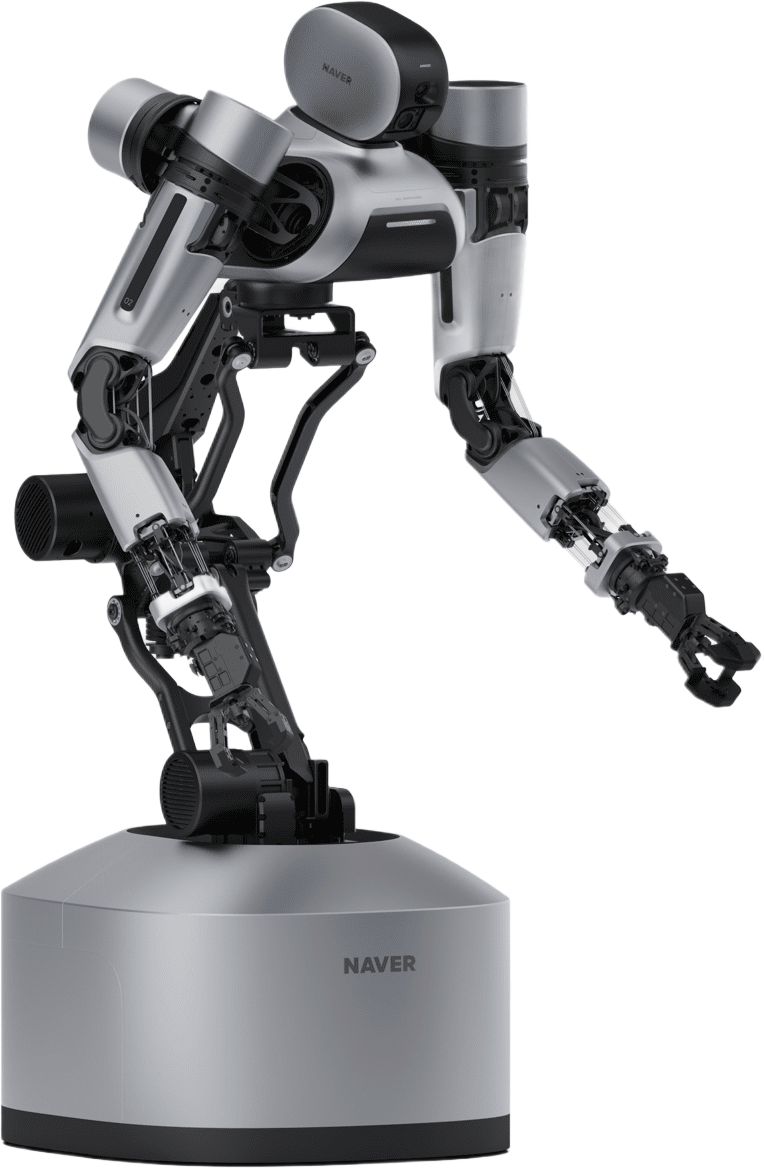
Naver Labs Ambidex (stylized as AMBIDEX) is a dual-arm, cable-driven robot system developed by Naver Labs, the research and development subsidiary of Naver Corporation, South Korea's largest internet company. First revealed through R&D in 2017 and publicly demonstrated at CES 2019 in Las Vegas, Ambidex uses an innovative wire-structure power transfer mechanism that places all heavy actuators in the shoulder and body rather than in the arm joints. This design produces arms that weigh just 2.6 kg each, lighter than the average human arm, while still achieving speeds of up to 5 m/s and payload capacities of 3 kg per arm.[1][2]
The system was developed through a long-term industry-university collaboration between Naver Labs and the Korea University of Technology and Education (KOREATECH), led by Professor Yong-Jae Kim, a recognized world leader in cable-driven robot mechanisms.[3] Ambidex was recognized as a CES 2019 Innovation Award Honoree in the Robotics and Drones category, and CNET selected it as one of the most exciting robot technologies exhibited at CES that year.[4][5]
Ambidex represents a core element of Naver's broader robotics strategy, which includes autonomous delivery robots, cloud-based robot intelligence systems, and the world's first robot-friendly office building. The project's central research goal is to develop learning methods that enable robots to acquire human-like force control and physical intelligence for performing complex everyday tasks such as cooking, cleaning, and personal care.[1]
Who developed Ambidex?
Naver Labs is the R&D subsidiary of Naver Corporation, a South Korean internet conglomerate headquartered in Seongnam, Gyeonggi Province. Naver Corporation was founded by Lee Hae-jin in 1999 and operates the Naver search engine, which has been South Korea's dominant search portal for over two decades. The company's businesses span search, advertising, e-commerce, digital content (including Naver Webtoon), fintech, cloud computing, and artificial intelligence.[6]
Naver Labs began as an internal R&D division within Naver in 2013 and was officially established as a separate entity in Pangyo in January 2017. The subsidiary focuses on future technologies including autonomous driving, robotics, AI, and digital twins, with the overarching goal of achieving "ambient intelligence," where technology seamlessly integrates into human environments.[7] In 2017, Naver also acquired Xerox Research Centre Europe in Grenoble, France, rebranding it as Naver Labs Europe. This European division conducts research in computer vision, natural language processing, machine learning, robot learning, and human-robot interaction.[8]
Naver Labs' robotics research encompasses several platforms beyond Ambidex, including the ROOKIE autonomous delivery robots, the AROUND outdoor delivery robot, and the ARC (AI, Robot, Cloud) multi-robot intelligence system that serves as a centralized brain for fleets of robots operating in smart buildings.[9]
How does Ambidex's cable-driven mechanism work?
Ambidex's defining engineering innovation is its cable-driven actuation system, which fundamentally differs from conventional robotic arms that place motors directly at each joint. In a traditional robot arm, the weight of motors and gearboxes at every joint increases the overall inertia of the arm, making high-speed movement dangerous for nearby humans. Ambidex addresses this problem by relocating all heavy electric motors to the shoulder assembly and body trunk, transmitting force to the joints through cables that function analogously to human tendons.[1][2] Naver Labs states that by "using innovative mechanisms that enhance the force and strength in each joint, AMBIDEX has achieved the same level of control, performance, and precision as industrial robots."[2]
This tendon-driven architecture offers several advantages. First, it dramatically reduces the weight of the moving arm segments. Each Ambidex arm weighs only 2.6 kg (5.7 lbs), which is lighter than the average arm of an adult male (approximately 3.6 kg). The low mass translates directly into low inertia, meaning that even if the arm collides with a person at full speed, the impact force remains within safe limits.[2] Second, the cable-driven design enables high back-drivability, the property that allows a human to manually push or guide the arm with minimal resistance. This is essential for collaborative and teleoperated applications where a human operator physically interacts with the robot.[3]
The kinematic structure of each arm consists of seven degrees of freedom (DOF): a 3-DOF shoulder, a 1-DOF elbow, and a 3-DOF wrist. Each joint is actuated by cables driven by electric motors mounted in the robot's torso. The shoulder employs a capstan mechanism, a friction-based cable transmission that provides low backlash (minimal play in the mechanism) and high back-drivability. The elbow and wrist utilize additional cable routing innovations to maintain smooth, precise motion across the full range of movement.[3][10]
Researchers at Seoul National University and Naver Labs published a detailed study of Ambidex's dynamics in the journal Mechatronics in 2020. The paper, titled "A hybrid dynamic model for the AMBIDEX tendon-driven manipulator," proposed a modeling approach that combines rigid-body equations of motion with a configuration-dependent viscous-Coulomb friction model and a recurrent neural network to capture the complex nonlinear behavior of the cable transmission system. Experiments on both a two-DOF parallel wrist mechanism and the full seven-DOF Ambidex arm validated the performance benefits of this hybrid approach for model-based control.[10]
Academic lineage: LIMS2-AMBIDEX and the Quaternion Joint
Ambidex grew out of a series of academic manipulators built at KOREATECH under Yong-Jae Kim, documented in the robotics literature as LIMS2-AMBIDEX, a low-inertia, high-stiffness manipulator. In the 2018 IEEE/RSJ International Conference on Intelligent Robots and Systems (IROS) paper "Development of Low-Inertia High-Stiffness Manipulator LIMS2 for High-Speed Manipulation of Foldable Objects," the authors describe a dual-arm system with two seven-DOF lightweight arms, a three-DOF head, and a one-DOF gripper. Because all the heavy actuators are placed at the shoulder, the mass beyond the shoulder is only 2.63 kg per arm, consistent with the 2.6 kg figure Naver Labs cites for the platform, a low mass the authors say "guarantees an inherent safety at high speeds."[25]
A companion IROS 2018 paper, "Quaternion Joint: Dexterous 3-DOF Joint Representing Quaternion Motion for High-Speed Safe Interaction," introduced the parallel wrist mechanism used in Ambidex. The Quaternion Joint uses three identical supporting linkages to approximate spherical pure rolling motion in a confined central space, providing three degrees of freedom in a compact, low-backlash structure suited to wire-driven manipulators.[26] The academic platform won first place in the IROS 2018 Fan Robotic Challenge, a competition to manipulate foldable objects such as fans at high speed, demonstrating that a cable-driven arm could match the control precision of conventional geared industrial robots.[2][25]
What are Ambidex's technical specifications?
| Category | Specification | Details |
|---|---|---|
| Configuration | Arm type | Dual-arm (bilateral) |
| Configuration | DOF per arm | 7 (3 shoulder + 1 elbow + 3 wrist) |
| Configuration | Joint structure | 3-DOF shoulder, 1-DOF elbow, 3-DOF wrist |
| Configuration | Actuation | Cable-driven (tendon) with electric motors |
| Physical | Weight per arm | 2.6 kg (5.7 lbs) |
| Physical | Mass beyond shoulder (LIMS2) | 2.63 kg |
| Physical | Shoulder mechanism | Capstan drive (low backlash, high back-drivability) |
| Physical | Wrist mechanism | Quaternion Joint (3-DOF parallel linkage) |
| Performance | Max speed | 5 m/s |
| Performance | Payload per arm | 3 kg (6.6 lbs) |
| Performance | Total dual-arm payload | 6 kg (13.2 lbs) |
| End effector | Hand | BLT Gripper |
| End effector | BLT Gripper fingers | 3 fingers, 5 motors, 5 DOF |
| End effector | Grasping modes | Precision pinch and power grasp |
| Teleoperation | Haptic device DOF | 7 DOF per arm |
| Teleoperation | Size ratio | 1:1 with human arms |
| Teleoperation | Force feedback | Bilateral (bidirectional) |
| Connectivity | Wireless control | 5G real-time control |
| Upgrades | Additional axes | Waist joint, sensor head |
| Development | Academic partner | KOREATECH |
What is the BLT Gripper?
The BLT Gripper is a robot hand developed specifically for Ambidex through the continued collaboration between Naver Labs and Professor Yong-Jae Kim at KOREATECH. The name "BLT" reflects its ability to handle diverse grasping configurations with a compact, lightweight design.[11]
The gripper consists of three fingers actuated by five motors, providing five degrees of freedom. Three of the motors bend the individual fingers for basic grasping motions. A fourth motor changes the angle of the fingertips, enabling the transition between different grip types. The fifth motor rotates the fingers relative to each other, allowing the hand to switch between wide power grasps (for holding large objects like bottles or cans) and precise pinch grasps (for manipulating small items like coins or vegetable peels).[11]
The most significant feature of the BLT Gripper is its ability to perform both precision pinching and power grasping with a single robotic hand. Many conventional robot grippers are optimized for one grasping mode or the other, requiring tool changes for different tasks. The BLT Gripper's reconfigurable finger arrangement allows Ambidex to handle a wide variety of objects encountered in domestic and service environments without swapping end effectors.[11]
How does Ambidex learn new tasks?
A central focus of the Ambidex research program is the development of bilateral teleoperation and task learning capabilities. Naver Labs has built a custom haptic device specifically designed to capture the natural motion of human operators while providing real-time force feedback.[1][12]
Haptic Device
The haptic device features a 1:1 size ratio with actual human arms and provides 7 degrees of freedom per arm, matching the kinematic structure of Ambidex. When an operator moves the haptic device, Ambidex mirrors the motion in real time. Simultaneously, forces detected by Ambidex's sensors are transmitted back to the haptic device, allowing the operator to feel what the robot is touching. This bilateral force feedback loop creates an intuitive control experience where the operator can sense the weight, texture, and resistance of objects the robot handles.[1][12]
The haptic device serves a dual purpose. Beyond enabling direct teleoperation, it functions as a high-fidelity data collection tool. Detailed force and motion data from human demonstrations are captured and used as training references for machine learning algorithms. This approach allows Naver Labs to build datasets of human physical intelligence, the motor skills and force control strategies that humans perform naturally but that are difficult to describe mathematically or encode manually.[12]
Learning from Demonstration
The task learning pipeline developed for Ambidex enables the robot to learn complex manipulation skills from surprisingly small amounts of demonstration data. Researchers reported that using reinforcement learning methods guided by haptic device demonstrations, Ambidex can successfully learn to perform a task autonomously from a single human demonstration.[12]
Demonstrated capabilities include peeling vegetables, washing dishes, catching a ball thrown through the air, and various other domestic tasks. These tasks require the kind of adaptive force control that has historically been difficult for robots: applying enough pressure to peel skin from a vegetable without crushing the vegetable, or adjusting grip force dynamically when catching a moving object.[12][13]
This learning-from-demonstration approach aligns with broader trends in robot learning research, where imitation learning from human demonstrations has emerged as a promising path toward generalizable robot manipulation skills.
What is the "5G brainless robot"?
One of Ambidex's most distinctive technical achievements is its support for real-time wireless control over 5G networks. Naver Labs describes Ambidex as "the world's first 5G brainless robot," referring to a design philosophy where the robot itself contains minimal onboard computing. Instead, sensor data from the robot is streamed to a cloud server or Mobile Edge Computing (MEC) server over a 5G connection, where all processing and decision-making occur. Control commands are then sent back to the robot with sufficiently low latency to maintain real-time responsiveness.[4][14] As Naver Labs explains the concept, "this technology takes the high-performance computer, functioning as the brain of a self-operating robot, out of the main body of the robot."[24]
At CES 2019, Naver Labs demonstrated this capability in collaboration with Qualcomm. Ambidex was controlled remotely over a 5G wireless link using a test device powered by the Qualcomm Snapdragon X50 modem and antenna modules. The demonstration showed that 5G's ultra-reliable, low-latency characteristics could enable precise robotic control without requiring high-performance processors onboard the robot itself.[4][5]
This "brainless robot" architecture offers practical advantages for deployment at scale. By offloading computation to the cloud, individual robots can be manufactured with less expensive and lighter hardware. Battery consumption is also reduced because the robot does not need to power a heavy onboard computer. Software updates and algorithm improvements can be deployed centrally without physically modifying the robots. This philosophy directly parallels Naver Labs' ARC system, which manages fleets of delivery robots through centralized cloud intelligence.[14]
When was Ambidex unveiled?
| Year | Milestone |
|---|---|
| 2013 | Naver Labs established as an internal R&D division within Naver |
| 2017 | Ambidex first revealed through R&D; Naver Labs officially established as a separate subsidiary |
| 2018 | Winner (1st place) of the IROS 2018 Fan Robotic Challenge; Quaternion Joint wrist and LIMS2-AMBIDEX detailed at IROS 2018; interconnected reinforcement learning simulator developed |
| 2019 | CES 2019 Innovation Award Honoree (Robotics and Drones); world's first 5G robot control demonstration with Qualcomm |
| 2020 | BLT Gripper hand introduced; haptic device-based task learning environment established; hardware upgraded with waist joint and sensor head; hybrid dynamic model published in Mechatronics journal |
| 2021 | Hardware and software upgraded for expanded research applications |
| 2022 | Naver 1784 headquarters opens as world's first robot-friendly building |
| 2024 | Rookie 2 service robot unveiled for broader smart-building deployment |
| 2026 | 1784 headquarters showcased internationally as a "living laboratory" for AI and robotics; South Korea's land minister tours the facility; Naver Labs Europe unveils the DIVINE robot-perception encoder |
How does Ambidex fit into Naver's robotics ecosystem?
Ambidex is one component of a comprehensive robotics strategy pursued by Naver Labs. Understanding the full ecosystem provides context for how Ambidex's manipulation research fits into Naver's long-term vision of ambient intelligence.
Naver 1784 Headquarters
In June 2022, Naver opened its second headquarters building, named "1784" after its address at 178-4 Jeongja-dong in Pangyo (a technology hub approximately 22 km south of Seoul) and a reference to 1784, the year commonly associated with the beginning of the Industrial Revolution. The 36-floor building was designed from the ground up to accommodate autonomous robots alongside its approximately 5,000 human employees.[9][15]
Over 100 autonomous ROOKIE service robots operate continuously inside the building, delivering coffee from an in-house Starbucks, parcels, documents, and lunches to employees at their desks. The robots navigate using front-facing cameras positioned at waist height and rely on the ARC cloud system for routing and localization rather than carrying powerful onboard computers.[9][15]
The building incorporates the Roboport, the world's first robot-only elevator system. Designed to prevent congestion during peak hours when human elevator use is heaviest, the Roboport operates as a continuously rotating loop of small cars (similar to a paternoster lift) accessible through short doors approximately 1.2 meters tall. Robots enter and exit the Roboport autonomously through coordination with the ARC system.[15][16]
Since its unveiling, Naver 1784 has become a globally recognized reference for smart building design, visited by over 10,000 people from 65 countries as of May 2024. Naver has demonstrated the building's technology to Saudi Arabian officials and expressed interest in collaborating on NEOM, Saudi Arabia's planned smart city project.[15][17] By 2026, international coverage continued to describe 1784 as a "living laboratory" for AI and robotics, with a fleet of roughly 100 to 110 Rookie robots operating across more than two dozen floors.[30] In May 2026, South Korea's Minister of Land, Infrastructure and Transport toured 1784 to inspect its digital-twin technology, the ARC fleet system, the indoor Rookie robots, and a newer outdoor robot called Nuri, pledging policy support for commercializing mobile robots.[29]
ARC (AI, Robot, Cloud)
ARC is Naver Labs' multi-robot intelligence platform that serves as the centralized brain for buildings and robot fleets. Rather than making each robot individually intelligent, ARC aggregates data from all robots' cameras and sensors and processes it in the cloud using 5G connectivity.[9]
The system has two primary components. ARC Eye handles spatial perception and localization, identifying each robot's current position within a 3D digital twin of the building to within approximately 15 cm (6 inches) accuracy, even in GPS-denied indoor environments. ARC Brain handles collective planning and execution, coordinating the movements, positioning, and service tasks of all robots simultaneously while updating algorithms in real time.[9][15]
Naver has worked to commercialize the ARC platform and its associated 5G specialized network package, aiming to replicate the 1784 experience in other commercial buildings.[18]
ROOKIE Delivery Robots
The ROOKIE robots are autonomous wheeled service robots approximately 90 cm tall that operate inside Naver 1784 and other facilities. Each ROOKIE features a storage compartment for transporting food, drinks, documents, and packages. The robots navigate using vision-based localization through the ARC system rather than expensive LiDAR sensors, reducing manufacturing costs.[9]
Naver Labs has iterated through multiple generations of the platform. The Rookie 2, unveiled in 2024, represented a redesign focused on improved reliability and expanded service capabilities for broader deployment in commercial smart buildings.[19]
AROUND Outdoor Delivery Robot
The AROUND platform extends Naver Labs' delivery robot capabilities to outdoor environments. AROUND D, the delivery-specialized variant, can perform autonomous navigation based on vision technology and reinforcement learning without relying on LiDAR. The robot uses a 3D mapping system where dedicated mapping robots first survey an area, uploading spatial data to the xDM cloud platform, which significantly lowers manufacturing costs for the delivery robots themselves.[20]
2026 developments: DIVINE and the NAVER-NVIDIA AI factory
Naver's robotics program has continued to expand the cloud and AI infrastructure that underpins platforms like Ambidex. On June 23, 2026, Naver Labs Europe unveiled DIVINE, a universal visual encoder for autonomous robots that consolidates separate image, spatial, and human-recognition encoders into a single model using multi-teacher distillation. Naver reported that DIVINE cuts encoder memory use by roughly 90% and raises encoding throughput by up to 12 times, reducing overall robot memory usage by about 62% and improving system processing speed up to fourfold.[27] Lee Dong-hwan, who leads Naver Labs' Vision Group, said "robot brain lightweighting is emerging as a major topic worldwide for the commercialization of physical AI."[27]
At the infrastructure level, Naver and NVIDIA announced in 2026 a partnership to build gigawatt-scale sovereign AI factories, beginning at 55 MW of capacity in the first half of 2027 and scaling toward 200 MW by 2028 on the NVIDIA DSX platform. Naver also became the first Korean company to join the NVIDIA Nemotron Coalition, contributing to open-model development across pretraining, post-training, and reinforcement learning. These investments extend the cloud-based intelligence philosophy that Ambidex pioneered as a "brainless" 5G robot.[28]
South Korean robotics context
Naver Labs' robotics efforts exist within a rapidly growing South Korean robotics ecosystem, supported by active government policy and significant corporate investment.
South Korea holds approximately 5.8% of the global manufacturing robot market, ranking fourth worldwide. As of 2023, South Korea's robot density (the number of manufacturing robots per 10,000 workers) stood at 1,012 units, exceeding the global average of 162 units by more than six times and making it one of the most robot-dense economies in the world.[21]
In January 2024, the South Korean government established the 4th Master Plan for Intelligent Robots (2024-2028), setting a vision of "Building the K-Robot Economy Leading the Global Robot Market." The plan targets deploying one million advanced robots by 2030 through over 3 trillion KRW (approximately $2.2 billion USD) in public-private investment. Goals include raising the domestic manufacturing rate of core robot components from 44% to 80% and removing 51 identified regulatory obstacles.[21]
South Korea's industrial robot market was valued at approximately $895 million in 2024 and is projected to grow to $1.87 billion by 2033 at a compound annual growth rate of 8.9%. Major Korean companies active in robotics include Samsung Electronics (which holds a 35% stake in Rainbow Robotics), Hyundai Motor Group (which acquired Boston Dynamics in 2021), LG Electronics, and Doosan Robotics.[21][22]
In 2025, NVIDIA, the South Korean government, and major Korean industrial companies announced approximately $3 billion in investment to advance the physical AI landscape in Korea, including creation of an NVIDIA AI Technology Center and a Hyundai Motor Group Physical AI Application Center.[23]
How does Ambidex compare to other dual-arm robots?
Ambidex competes in the dual-arm manipulation research platform category, which has seen growing interest from both academic and commercial robotics organizations worldwide.
| Platform | Developer | Actuation | DOF per Arm | Arm Weight | Max Payload | Key Differentiator |
|---|---|---|---|---|---|---|
| Ambidex | Naver Labs | Cable-driven | 7 | 2.6 kg | 3 kg | Ultra-lightweight cable-driven design; 5G cloud control |
| RB-Y1 | Rainbow Robotics | Electric motor | 7 | N/A | 3 kg per arm | Mobile base; commercial research platform ($80K) |
| ALOHA 2 | Google DeepMind | Electric motor | 7 | N/A | N/A | Open-source bimanual teleop for imitation learning |
| Baxter/Sawyer | Rethink Robotics | Series elastic | 7 | N/A | 2.2 kg / 4 kg | Pioneered collaborative dual-arm manipulation |
Ambidex's primary distinction is the cable-driven mechanism that achieves an arm weight roughly 30% lighter than a human arm while maintaining industrial-grade force control. This contrasts with most competing platforms that use conventional electric actuators at each joint, resulting in heavier, higher-inertia arms. The trade-off is that cable-driven systems introduce additional complexity in modeling and control due to cable friction, elasticity, and routing constraints, challenges that the hybrid dynamic model published by Naver Labs researchers aimed to address.[10]
What is Ambidex used for?
Ambidex is positioned as a research platform for investigating several areas at the intersection of robotics and AI.
Domestic service robotics. Target applications include cooking, laundry, dishwashing, serving food, and general household tasks. The combination of safe human interaction, bilateral teleoperation, and learning from demonstration makes Ambidex suitable for studying how robots can assist in environments where close contact with humans is unavoidable.[1][12]
Healthcare and rehabilitation. Nursing and rehabilitation assistance are identified target domains, where the robot's lightweight arms and force-feedback capabilities could support physical therapy exercises or assist patients with limited mobility.[1]
Physical intelligence research. The haptic teleoperation system enables researchers to study "physical intelligence," the motor skills and force control strategies that humans perform intuitively but that are difficult to formalize. By capturing detailed force and motion data from expert human demonstrations, Ambidex provides a data pipeline for training robots to replicate human dexterity.[12]
Remote operation. The 5G wireless control capability enables research into remote robotic operation from arbitrary distances, with potential applications in hazardous environments, telemedicine, and remote maintenance scenarios.[14]
See Also
- Humanoid Robots
- Robot Learning
- Naver AI
- Reinforcement Learning
- Imitation Learning
- Cobot
- Rainbow Robotics RB-Y1
- Boston Dynamics
References
- "AMBIDEX." Naver Labs official product page. https://www.naverlabs.com/en/ambidex ↩
- "AMBIDEX, robot arm with innovative cable-driven mechanisms." Naver Labs Story. https://www.naverlabs.com/en/storyDetail/12 ↩
- "Yong-Jae Kim." ResearchGate profile. https://www.researchgate.net/profile/Yong-Jae-Kim-3 ↩
- "NAVER Unveils Advanced Robotics, Autonomous Driving and Mobility Technologies to Global Market at CES 2019." Business Wire, January 8, 2019. https://www.businesswire.com/news/home/20190108005321/en/ ↩
- "Korean Tech Naver Hits Home Run in its First CES." KoreaTechToday, January 2019. https://www.koreatechtoday.com/naver-hit-home-run-in-first-ces-best-robot-exhibition/ ↩
- "Naver Corporation." Wikipedia. https://en.wikipedia.org/wiki/Naver_Corporation ↩
- "Naver Labs." Crunchbase. https://www.crunchbase.com/organization/naver-labs ↩
- "About NAVER LABS Europe." Naver Labs Europe. https://europe.naverlabs.com/about/ ↩
- "Korean internet giant Naver explores robotics, AI and autonomous driving." TechCrunch, September 1, 2023. https://techcrunch.com/2023/09/01/korean-internet-giant-naver-explores-robotics-ai-and-autonomous-driving/ ↩
- Choi, K. et al. "A hybrid dynamic model for the AMBIDEX tendon-driven manipulator." *Mechatronics*, vol. 69, 2020, Article 102398. https://www.sciencedirect.com/science/article/abs/pii/S0957415820300787 ↩
- "BLT Gripper, Robot Hands With a New Structure: Interview With Professor Yong-Jae Kim." Naver Labs Story. https://www.naverlabs.com/en/storyDetail/162 ↩
- "Unveiling the AMBIDEX Task Learning Project and Delivery Robot AROUND D at 2020 Global Forum on Mechanical Engineering." Naver Labs Story. https://www.naverlabs.com/en/storyDetail/184 ↩
- "AMBIDEX cable-driven robot learns to wash dishes, peel vegetables." Inceptive Mind, 2020. https://www.inceptivemind.com/ambidex-cable-driven-robot-learns-wash-dishes-peel-vegetables/16439/ ↩
- "Introduction of NAVER LABS' CES 2019 exhibits." Naver Labs Story. https://naverlabs.com/en/storyDetail/106 ↩
- "'Korean Google' opens the world's first robot-friendly building." Freethink, 2022. https://www.freethink.com/robots-ai/1784-naver-labs ↩
- "This futuristic office was designed for 5,000 people and 100 robot coworkers." Fast Company, 2022. https://www.fastcompany.com/90754724/this-futuristic-office-was-designed-for-5000-people-and-100-robot-coworkers ↩
- "Naver 1784 building showcases human-robot interaction." The Korea Times, July 7, 2023. https://www.koreatimes.co.kr/business/companies/20230707/navers-1784-building-showcases-human-robot-interaction ↩
- "Naver to enter smart building market with 5G, AI robots." KED Global, June 2022. https://www.kedglobal.com/artificial-intelligence/newsView/ked202206080019 ↩
- "Rookie 2: Redefining Service Robots for Smart Buildings." Naver Labs Story. https://www.naverlabs.com/en/storyDetail/343 ↩
- "AMBIDEX cable-driven robot learns to mimic human physical intelligence." Fresh Plaza, 2020. https://www.freshplaza.com/north-america/article/9273114/ ↩
- "All Eyes on K-Robots: The Status and Strategy of Korea's Robotics Industry." InvestKOREA, 2024. https://www.investkorea.org/ik-en/bbs/i-5025/detail.do?ntt_sn=490807 ↩
- "South Korea Robotics Industry." U.S. International Trade Administration. https://www.trade.gov/market-intelligence/south-korea-robotics-industry ↩
- "NVIDIA, South Korea Government and Industrial Giants Build AI Infrastructure and Ecosystem." NVIDIA Investor Relations, 2025. https://investor.nvidia.com/news/press-release-details/2025/ ↩
- "5G Brainless Robot." NAVER LABS. https://naverlabs.com/en/5gbrainlessrobot ↩
- "Development of Low-Inertia High-Stiffness Manipulator LIMS2 for High-Speed Manipulation of Foldable Objects." IEEE/RSJ International Conference on Intelligent Robots and Systems (IROS), 2018. https://ieeexplore.ieee.org/document/8594005/ ↩
- "Quaternion Joint: Dexterous 3-DOF Joint Representing Quaternion Motion for High-Speed Safe Interaction." IEEE/RSJ International Conference on Intelligent Robots and Systems (IROS), 2018. https://dl.acm.org/doi/10.1109/IROS.2018.8594301 ↩
- "Naver Unveils Lightweight, Fast 'Robot Brain'." Seoul Economic Daily, June 23, 2026. https://en.sedaily.com/news/2026/06/23/naver-unveils-lightweight-fast-robot-brain ↩
- "NAVER Expands AI Infrastructure With NVIDIA to Serve Surging Global AI Demand." NVIDIA Newsroom, 2026. https://nvidianews.nvidia.com/news/naver-ai-infrastructure ↩
- "Land Minister Visits Naver, Pledges Support for Robot Industry." Seoul Economic Daily, May 27, 2026. https://en.sedaily.com/technology/2026/05/27/land-minister-visits-naver-pledges-support-for-robot ↩
- "Naver showcases AI robots across 'lab-like' headquarters." UPI, April 17, 2026. https://www.upi.com/Top_News/World-News/2026/04/17/tech-company-naver-ai-robot/7561776463519/ ↩
Improve this article
Add missing citations, update stale details, or suggest a clearer explanation. Every suggestion is reviewed for sourcing before it goes live.
7 revisions by 1 contributors · full history