

Motion 2
Last edited
Fact-checked
In review queue
Sources
30 citations
Revision
v4 · 4,311 words
Fact-checks are independent of edits: a reviewer re-verifies the article against its sources and stamps the date. How we verify
 | |
| Developer | VinMotion |
| Type | Humanoid robot |
| Generation | 2nd |
| Country of origin | Vietnam |
| Unveiled | December 2025 (teaser); January 2026 (CES debut) |
| Height | 178 cm (5 ft 10 in) |
| Weight | 75 kg (165 lb) |
| Actuators | 31 proprietary smart motors |
| Payload | 40 kg (88 lb) back lifting |
| Battery | Two hot-swappable batteries; 24/7 operation |
| Processor | Qualcomm Dragonwing IQ9 Series |
| AI capabilities | LLM integration, ASR (Vietnamese and English) |
| Hands | Five-fingered dexterous hands |
| Status | Prototype / Pilot testing |
| Website | vinmotion.net |
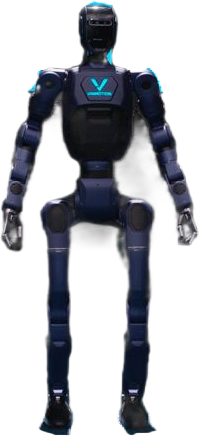
Motion 2 is the second-generation general-purpose humanoid robot developed by VinMotion, a robotics subsidiary of the Vietnamese conglomerate Vingroup. It stands 178 cm (5 ft 10 in) tall, weighs 75 kg (165 lb), can lift 40 kg (88 lb) with its back, and runs a Qualcomm Dragonwing IQ9 Series processor for on-device AI. After a 10-second teaser clip in late December 2025, the robot made its international debut at CES 2026, held January 6-9, 2026 in Las Vegas,[30] where it performed boxing moves, backbends, and heavy lifting at Qualcomm's booth #5001 alongside other humanoid platforms.[8][26] Motion 2 is a substantial upgrade over its predecessor, Motion 1, with a more natural walking gait, greater agility and payload capacity, autonomous fall recovery, and dual hot-swappable batteries designed for continuous 24/7 operation.
Motion 2 features 31 proprietary smart motors, five-fingered dexterous hands, and a dual hot-swappable battery system. It was developed around a "3S" design philosophy (Self-standing, Self-charging, Stable) that prioritizes practical, uninterrupted operation in real-world environments. VinMotion has positioned it for pilot deployments in industrial logistics, light manufacturing, and service applications, with initial testing underway at VinFast factories, Vinpearl hospitality properties, and Vinmec healthcare facilities.
Background
VinMotion
VinMotion was established in January 2025 with a charter capital of 1,000 billion VND (approximately $39 to $40 million USD). Vingroup holds a 51% stake in the company, with the remaining 49% owned by Vingroup chairman Pham Nhat Vuong and his two sons, Pham Nhat Quan and Pham Nhat Minh Hoang.[1][2] The company is headquartered in Hanoi, Vietnam, and its core business covers research, development, production, and technology transfer in humanoid robotics.[23]
Pham Nhat Vuong, Vietnam's wealthiest individual and Southeast Asia's second-richest, has driven Vingroup's expansion into technology and artificial intelligence. Forbes valued his net worth at $32.3 billion on January 7, 2026, during CES week, ranking him 65th in the world.[3] Vingroup's technology ecosystem includes VinFast (electric vehicles), VinAI (artificial intelligence research), VinBigdata (data analytics), VinRobotics (industrial automation), and several other subsidiaries. This ecosystem provides VinMotion with access to AI research talent, big data capabilities, and real-world testing environments across Vingroup's manufacturing, hospitality, and healthcare operations.
VinMotion is distinct from VinRobotics, another Vingroup subsidiary founded in November 2024. While VinRobotics focuses on industrial robot arms and manufacturing automation systems, VinMotion specializes in general-purpose humanoid robots designed to operate in environments built for humans.[4] VinFast's manufacturing facilities already employ more than 1,200 industrial robots, providing a foundation of automation expertise that both subsidiaries draw upon.
VinMotion's leadership is headed by Dr. Nguyen Trung Quan (also known as Quan Nguyen), who serves as the company's chief scientific officer. Dr. Nguyen holds a doctorate in mechanical engineering from Carnegie Mellon University, where he received the Best Dissertation Award in 2017, and is an assistant professor of Aerospace and Mechanical Engineering at the University of Southern California (USC). Before joining USC, he worked as a postdoctoral associate in the Biomimetic Robotics Lab at the Massachusetts Institute of Technology (MIT).[5] His academic credentials include the Best Presentation of the Session award at the 2016 American Control Conference, the Best System Paper Finalist at the 2017 Robotics: Science & Systems conference, and the 2020 Charles Lee Powell Foundation Faculty Research Award.
Vingroup's Broader AI Strategy
VinMotion is part of a broader pattern of Vingroup investing in and sometimes divesting artificial intelligence assets. In late November 2024, Vingroup split its AI subsidiary VinAI into two companies, one of which was Movian AI. In March 2025, Qualcomm acquired a 65% stake in Movian AI for $66.93 million, bringing VinAI founder and CEO Bui Hai Hung to Qualcomm.[6] Separately, in December 2024, Vingroup sold VinBrain, another AI-focused subsidiary, to NVIDIA.[7] These transactions reflect a strategy of developing AI talent domestically while forging partnerships with major global chip companies, relationships that directly benefit VinMotion's access to cutting-edge hardware and AI development tools.
The Qualcomm-Vingroup relationship is particularly significant for VinMotion. The Movian AI acquisition created direct links between Qualcomm's engineering teams and Vietnam-based AI researchers, and Qualcomm subsequently chose VinMotion's Motion 2 as one of the showcase robots for its Dragonwing IQ9/IQ10 platform launch at CES 2026.[8]
Vietnam's Humanoid Robotics History
VinMotion represents Vietnam's most significant entry into the humanoid robotics field since TOSY Robotics and its TOPIO robot in the late 2000s. TOPIO, a table-tennis-playing bipedal humanoid standing 1.88 m tall and weighing 120 kg, was publicly demonstrated at the Tokyo International Robot Exhibition (IREX) in November 2007.[9] However, TOPIO was primarily designed for entertainment and research purposes. VinMotion's approach differs fundamentally in targeting practical industrial deployment from the outset, designing robots to fit into existing factory workflows for tasks like material transport, visual inspection, and assembly support.
Dr. Nguyen Trung Quan has framed the current period as a rare opening for Vietnam, saying "this is the 'golden time' for us to dream of it" and arguing that the country faces fewer barriers than the United States or China in this field and possesses a highly flexible manufacturing base suitable for rapid production iteration and cost control.[10]
Motion 1 Predecessor
Motion 1, VinMotion's first humanoid robot prototype, was introduced in June 2025, just five months after the company's founding. The robot demonstrated basic capabilities including walking, waving, and interacting through gestures and voice commands. VinMotion's engineering team built and tested five prototype versions of Motion 1, developing all mechanical, electronic, and software systems in-house.[11]
On August 8, 2025, during Vingroup's 32nd anniversary celebration in Hanoi, VinMotion staged a synchronized dance performance with multiple Motion 1 units before more than 1,000 attendees. The demonstration showcased the company's real-time coordination algorithms, with the robots using distance sensors, networked communication, and simultaneously executed motion-control algorithms to maintain synchronized movement despite potential Wi-Fi interference from the large crowd.[10][12] The performance attracted widespread media attention and marked VinMotion's public emergence as a serious robotics company.
Motion 1 operated as a semi-autonomous system with a human-in-the-loop control architecture, using adaptive learning to improve over time based on human feedback and task repetition. Its primary design targets were light-duty industrial tasks: warehouse transportation, visual inspection, and basic assembly support at VinFast manufacturing facilities.[11]
When and How Was Motion 2 Unveiled?
In early December 2025, Dr. Nguyen Trung Quan revealed at the "Robots and Intelligent Automation" seminar during VinFuture 2025 Technology Science Week that VinMotion was developing the Motion 2 robot model, describing it as "much more groundbreaking" compared to Motion 1. At the same event, VinMotion announced a strategic partnership with a leading global AI chip corporation that would be formally presented at CES in January 2026.[13]
Later in December 2025, VinMotion released a 10-second teaser video on social media that partially revealed Motion 2's refined design and hinted at its new capabilities, including autonomous fall recovery and battery swapping. The brief clip generated significant interest in the Vietnamese and international robotics communities.[14]
Motion 2 made its full international debut at CES 2026, held January 6-9, 2026 in Las Vegas, displayed at Qualcomm Booth #5001 alongside the Booster Robotics K1 Geek humanoid and an Advantech robotics development kit as part of Qualcomm's Dragonwing robotics platform showcase.[8][30] During the demonstration, Motion 2 performed dynamic physical actions including punching (described by Nikkei Asia as "Matrix"-like movements), backbends, lifting heavy loads, and grasping and manipulating objects with its five-fingered hands.[15] The boxing-style demonstrations highlighted the robot's dynamic balance control and force management capabilities.
What Are the Motion 2's Specifications?
Physical Design
Motion 2 stands 178 cm (5 ft 10 in) tall and weighs 75 kg (165 lb), giving it dimensions comparable to an average adult male. The robot features a refined exterior design compared to Motion 1, with an integrated body structure housing 31 proprietary smart motors.[24] Each hand has five fingers capable of dexterous manipulation, allowing the robot to grasp, carry, and throw objects.
The robot demonstrated several dynamic physical feats at CES 2026, including lifting 40 kg (88 lb) with its back, karate-chopping through a wooden plank, performing a deep backbend, reaching to the ground, and grabbing and discarding paper with its hands.[16] These demonstrations served to illustrate the robot's range of motion, force output, and balance control under diverse loading conditions.
Detailed Specifications
| Parameter | Value |
|---|---|
| Height | 178 cm (5 ft 10 in) |
| Weight | 75 kg (165 lb) |
| Actuators | 31 proprietary smart motors |
| Hands | Five-fingered dexterous hands (2 hands) |
| Payload capacity | 40 kg (88 lb) back lifting |
| Battery system | Two hot-swappable batteries |
| Operational uptime | 24/7 (with autonomous battery management) |
| Processor | Qualcomm Dragonwing IQ9 Series |
| AI features | LLM integration, Automatic Speech Recognition |
| Language support | Vietnamese, English (multilingual) |
| Sensors | Distance sensors, vision sensors, proprietary balance sensors |
| Connectivity | WiFi, Bluetooth |
| Actuator type | Electric servo actuators |
| Autonomous charging | Yes (self-navigating to charging station) |
| Fall recovery | Yes (autonomous self-standing) |
| Multi-robot synchronization | Yes |
What Is the 3S Design Philosophy?
VinMotion engineered Motion 2 around a core principle that a robot can only be useful if it can operate continuously without direct human intervention. This led to the "3S" design philosophy, which defines three requirements for practical deployment:[13][16]
Self-standing: The robot can autonomously recover from falls and return to an upright position without human assistance. This capability is essential for factory floor environments where trips and collisions may occur.
Self-charging: When the robot detects low battery levels, it autonomously navigates to a charging station and initiates the recharging process. The dual hot-swappable battery system allows one battery to be charged while the other powers the robot, enabling continuous operation without downtime.
Stable: The hardware and software systems are designed to operate stably and continuously for extended periods. The robot maintains real-time center-of-mass control under varying load conditions, adjusting its posture and gait dynamically to preserve balance during tasks like lifting, carrying, and bending.
The 3S philosophy represents VinMotion's focus on industrial readiness rather than laboratory demonstration. By solving the fundamental problems of uptime, power management, and operational stability, VinMotion aims to produce robots that can function in real factory and service environments where interruptions carry economic cost.
What Processor and AI Does Motion 2 Use?
Motion 2 is powered by the Qualcomm Dragonwing IQ9 Series processor, which provides on-device AI processing capabilities for motion planning, perception, and human interaction without requiring a cloud connection.[8][26] The Dragonwing IQ9 family is designed for demanding industrial applications, delivering high-performance AI inference alongside built-in safety features.
At CES 2026, Qualcomm also announced the next-generation Dragonwing IQ10 Series processor, which offers 700 TOPS of AI compute in sparse mode (350 TOPS dense), 18 Oryon CPU cores, and support for up to 20 concurrent camera streams.[17][25] While Motion 2 debuted with the IQ9, the IQ10 platform represents the natural upgrade path for future VinMotion robots. Some sources have referenced the IQ10 in connection with Motion 2, suggesting the robot may transition to the newer chip as it moves toward commercial production.[18]
In June 2026, Qualcomm formally unveiled the Dragonwing IQ10 Robotics Reference Design (RRD) at Computex in Taipei, a production-ready platform delivering up to 700 TOPS of on-device AI on 18 Qualcomm Oryon CPU cores, with ROS 2 support and cloud-based fleet management through Qualcomm's AI Hub. Qualcomm opened early customer access in June 2026 and targeted general availability for September 2026, giving VinMotion and other Dragonwing partners a defined path to a higher-performance compute platform for production humanoids.[28]
The robot integrates large language model (LLM) capabilities and automatic speech recognition (ASR), enabling multilingual voice interaction in both Vietnamese and English. This allows operators and other humans in the workspace to communicate with Motion 2 through natural language commands and receive spoken responses.
Power System
Motion 2 uses a dual hot-swappable battery system, a design choice that directly supports the 3S philosophy of uninterrupted operation. When one battery is depleted, the robot can autonomously swap to the second battery or navigate to a charging station, eliminating the downtime that plagues single-battery humanoid designs.[16] VinMotion has described this capability as enabling true 24/7 operation, though specific battery capacity (in watt-hours) and per-charge runtime have not been publicly disclosed as of early 2026.
Sensors and Perception
Motion 2 incorporates distance sensors for spatial awareness, vision sensors for object detection and environment mapping, and proprietary balance sensors for real-time stability control.[16] The sensor suite feeds data to the onboard Dragonwing processor for integrated perception and motion planning. Detailed specifications for camera resolution, depth sensing capabilities, and sensor configurations have not been fully disclosed, as the robot remains in active development.
How Does Motion 2 Differ From Motion 1?
Motion 2 represents a substantial generational upgrade over Motion 1 across multiple dimensions.
| Feature | Motion 1 | Motion 2 |
|---|---|---|
| Introduced | June 2025 | December 2025 / January 2026 |
| Height | Not disclosed | 178 cm (5 ft 10 in) |
| Weight | Not disclosed | 75 kg (165 lb) |
| Actuators | In-house motors | 31 proprietary smart motors |
| Payload capacity | Light-duty (unspecified) | 40 kg (88 lb) |
| Walking gait | Basic | More natural, faster speed |
| Fall recovery | No | Yes (autonomous self-standing) |
| Battery system | Standard | Dual hot-swappable (24/7 operation) |
| Autonomous charging | No | Yes (self-navigating) |
| Processor | Not disclosed | Qualcomm Dragonwing IQ9 |
| Voice interaction | Basic voice commands | Multilingual LLM + ASR |
| Hand dexterity | Basic gestures | Five-fingered dexterous manipulation |
| Control mode | Semi-autonomous (human-in-the-loop) | Enhanced autonomy |
| Dynamic actions | Walking, waving, dancing | Boxing, backbends, heavy lifting, object manipulation |
The most notable improvements include the transition from a semi-autonomous, human-in-the-loop control system to greater autonomous capability; the addition of fall recovery and autonomous battery management; a major increase in payload capacity to 40 kg; and the integration of a high-performance Qualcomm processor for on-device AI inference.[16][19] VinMotion's engineers also achieved a more natural walking gait and faster locomotion speed, essential requirements for practical factory floor deployment where robots must navigate alongside human workers. Vietnamese coverage of the CES demonstration noted that Motion 2's redesigned drivetrain eliminated the cruder mechanical linkages visible on the first-generation prototype, contributing to smoother, more controlled motion and improved center-of-gravity and force control.[29]
What Is Motion 2 Used For?
Industrial Manufacturing
VinMotion's primary near-term deployment target for Motion 2 is industrial manufacturing, beginning with VinFast electric vehicle factories. The robot is designed to handle tasks including parts transportation between workstations, quality inspection of components and assemblies, and basic assembly support.[11] VinFast's production facilities in Vietnam, India, and Indonesia provide a large-scale testing ground where Motion 2 can be evaluated under real manufacturing conditions.
The strategy of deploying first within Vingroup's own operations is deliberate. Successful performance at VinFast factories serves as proof of concept that can be used to market the robots to external customers. VinFast already employs more than 1,200 industrial robots in its production lines, giving VinMotion access to established automation infrastructure and operational data.[4]
Hospitality and Healthcare
VinMotion is also testing Motion 2 at Vinpearl (Vingroup's hospitality and resort chain) and Vinmec (Vingroup's healthcare system).[20] These testing environments represent the service-sector applications that VinMotion envisions as a longer-term market, where humanoid robots could assist with customer interaction, concierge services, patient support, and facility navigation. The robot's multilingual voice capabilities in Vietnamese and English are particularly relevant for Vinpearl's tourism-oriented environments.
Logistics and Warehousing
Motion 2's 40 kg payload capacity and autonomous navigation features make it a candidate for logistics and warehousing applications. The robot can transport materials between locations, load and unload items, and operate in environments with standard human-scale infrastructure (doorways, corridors, elevators) without requiring facility modifications.[16]
Research and Education
As a general-purpose humanoid platform, Motion 2 is also positioned for research and education applications. VinMotion's collaboration with Qualcomm on the Dragonwing platform and the company's academic connections through Dr. Nguyen Trung Quan at USC create pathways for Motion 2 to serve as a research testbed for embodied AI, locomotion control, and human-robot interaction studies.
US Expansion
In 2026, VinMotion announced plans to open an office in southern California to accelerate the development and deployment of its industrial humanoids.[5] The US office leverages Dr. Nguyen Trung Quan's existing presence at USC in Los Angeles and positions VinMotion closer to the American robotics and AI talent pool.
VinMotion is actively recruiting AI researchers with expertise in three primary areas: large language models (LLMs), automatic speech recognition (ASR), and motion research covering control, planning, and manipulation.[5] The southern California office is intended to complement the company's Hanoi headquarters, with the US team focused on AI and software development while Vietnamese operations handle hardware engineering and manufacturing.
This US expansion places VinMotion in geographic proximity to several major humanoid robotics competitors, including Figure AI (San Jose), Apptronik (Austin, Texas), and numerous AI research labs in the Los Angeles and San Francisco Bay areas.
Why Did Qualcomm Partner With VinMotion?
The partnership between VinMotion and Qualcomm is one of Motion 2's most distinctive aspects. At CES 2026, Qualcomm introduced its full-stack robotics architecture built around the Dragonwing processor family, positioning Motion 2 as one of several reference robots. Qualcomm showed Motion 2 alongside the Booster Robotics K1 Geek and robots and development kits from Advantech, APLUX, AutoCore, and Robotec.ai, named Figure AI as a platform partner, and disclosed ongoing discussions with Germany's KUKA Robotics.[8][26]
Nakul Duggal, Qualcomm's executive vice president and group general manager for automotive, industrial and embedded IoT and robotics, framed the effort as "redefining what's possible with physical AI by moving intelligent machines out of the labs and into real-world environments."[26] Figure AI founder Brett Adcock described the Qualcomm platform's "combination of exceptional compute capabilities and energy efficiency" as "a valuable building block," underscoring the caliber of the hardware VinMotion secured for a company of its size.[26]
The Dragonwing IQ9 Series provides Motion 2 with dedicated on-device AI processing for perception, motion planning, and natural language understanding. Key capabilities of the Dragonwing platform include support for end-to-end AI models such as vision-language-action models (VLAs) and vision-language models (VLMs), which enable generalized manipulation capabilities and human-robot interaction.[17] The platform emphasizes energy efficiency and edge computing, allowing Motion 2 to operate autonomously without reliance on cloud connectivity.
Qualcomm's relationship with Vingroup extends beyond VinMotion. The 2025 acquisition of Movian AI (a VinAI spinoff) brought Vietnamese AI researchers directly into Qualcomm's organization, creating ongoing technical collaboration that benefits VinMotion's access to the latest Dragonwing hardware and software development kits.[6]
How Does Motion 2 Compare to Other Humanoid Robots?
Motion 2 enters a rapidly expanding global humanoid robotics market where dozens of companies are racing to deploy practical humanoid robots in industrial and commercial settings. At CES 2026 alone, 38 companies were listed in the humanoid robotics category, reflecting the explosive growth of the sector.[21]
| Company | Robot | Country | Key Differentiator |
|---|---|---|---|
| VinMotion | Motion 2 | Vietnam | 3S design, Qualcomm Dragonwing, Vingroup ecosystem |
| Figure AI | Figure 02 / Figure 03 | United States | Helix VLA, BMW deployment, BotQ factory |
| Tesla | Optimus | United States | Target sub-$30,000 price, Tesla factory pipeline |
| Unitree Robotics | G1 / H1 | China | Low cost, open ecosystem |
| Agility Robotics | Digit | United States | Logistics-focused, Amazon pilot |
| Boston Dynamics | Atlas | United States | 56 DOF, Hyundai backing |
| UBTECH | Walker S | China | BYD factory deployment |
| Booster Robotics | T1 / K1 Geek | China | Qualcomm Dragonwing partner |
VinMotion's competitive position rests on several factors. First, its integration within the Vingroup ecosystem provides captive testing environments and a path to initial deployment that most startups lack. Second, the Qualcomm partnership gives it access to purpose-built robotics AI hardware. Third, Vietnam's manufacturing base offers potential cost advantages for production scaling. However, VinMotion faces significant challenges competing against far more heavily funded rivals; Figure AI, for example, has raised approximately $1.9 billion and achieved a $39 billion valuation, while VinMotion's initial capitalization was approximately $39 to $40 million.[22]
Dr. Nguyen has acknowledged these dynamics, arguing that Vietnam's advantage lies not in outspending competitors but in the country's flexible manufacturing capabilities, which allow rapid iteration on robot designs while maintaining quality and keeping costs reasonable.[10]
Significance
Motion 2 holds particular significance as a symbol of Vietnam's growing ambitions in advanced technology. While Vietnam has become a major global manufacturing hub for electronics, automotive components, and consumer goods, the country has historically been associated with contract manufacturing rather than indigenous high-technology product development. VinMotion's development of a humanoid robot with in-house engineering represents an effort to move Vietnam up the technology value chain. Vingroup chairman Pham Nhat Vuong has framed the project in national terms, calling VinMotion "proof of the Vietnamese people's ability to master high technology" and stating that the company aims to affirm "Vietnam is not only a place for technology consumption, but also a place that can create technology."[27]
The robot also demonstrates the potential of conglomerate-backed robotics development. Unlike most humanoid robotics startups that must seek external customers from their earliest stages, VinMotion can deploy and iterate within Vingroup's own vast network of factories, hotels, hospitals, and retail operations. This internal deployment model, similar to how Tesla has used its own factories as a testbed for Optimus, provides a shorter feedback loop between engineering and real-world application.
For the broader humanoid robotics industry, VinMotion's emergence adds a Southeast Asian competitor to a field previously dominated by American, Chinese, Japanese, and Korean companies. If VinMotion can successfully scale production and demonstrate practical utility, it could encourage similar efforts by other companies in the region and expand the geographic diversity of the humanoid robotics ecosystem.
See also
- VinMotion
- Motion 1
- Humanoid robot
- Humanoid robots
- VinFast
- Qualcomm
- Figure AI
- Booster Robotics
- TOPIO
- Embodied AI
- AI robotics
References
- "Vingroup to establish robotics subsidiary." VnExpress International, January 2025. https://e.vnexpress.net/news/tech/enterprises/vingroup-to-establish-robotics-subsidiary-4838026.html ↩
- "Vingroup forms new company for humanoid robot production." The Investor, 2025. https://theinvestor.vn/vingroup-forms-new-company-for-humanoid-robot-production-d17105.html ↩
- "Vietnam's richest man Pham Nhat Vuong tops $32B net worth, overtaking Xiaomi's Lei Jun." VnExpress International, January 7, 2026. https://e.vnexpress.net/news/business/billionaires/vietnam-s-richest-man-pham-nhat-vuong-tops-32b-net-worth-overtaking-xiaomi-s-lei-jun-5003279.html ↩
- "VinGroup's VinMotion debuts humanoid robots to support EV factory automation in Vietnam." DigiTimes, August 27, 2025. https://www.digitimes.com/news/a20250827PD209/manufacturing-vingroup-robot-vehicle-technology.html ↩
- "VinMotion Eyes US Expansion for Humanoid Development." Mike Kalil, 2025. https://mikekalil.com/blog/vietnam-vinmotion-us-expansion/ ↩
- "Vingroup earns $67 mln from selling 65% of Movian AI to Qualcomm." The Investor, 2025. https://theinvestor.vn/vingroup-earns-67-mln-from-selling-65-of-movian-ai-to-qualcomm-d16872.html ↩
- "Vingroup sells AI company to Qualcomm." Vietnam.vn, 2025. https://www.vietnam.vn/en/vingroup-ban-cong-ty-ai-cho-tap-doan-qualcomm ↩
- "Qualcomm and division of Vietnam's Vingroup debut industrial robot at CES." Nikkei Asia, January 2026. https://asia.nikkei.com/business/technology/artificial-intelligence/qualcomm-and-division-of-vietnam-s-vingroup-debut-industrial-robot-at-ces ↩
- "TOPIO." Wikipedia. https://en.wikipedia.org/wiki/TOPIO ↩
- "Vietnam's first humanoid robots dazzle crowd with precise dance moves." Interesting Engineering, August 2025. https://interestingengineering.com/innovation/vietnams-dancing-humanoid-robots ↩
- "VinMotion Motion_1 Humanoid Robot to Work at VinFast." Mike Kalil, June 2025. https://mikekalil.com/blog/vinmotion-humanoid-robot/ ↩
- "Vietnam's VinMotion unveils dancing humanoid robots just 7 months after founding." VnExpress International, August 2025. https://e.vnexpress.net/news/tech/tech-news/vietnam-s-vinmotion-unveils-dancing-humanoid-robots-just-7-months-after-founding-4926410.html ↩
- "VinMotion leader: 'We have been developing the Motion 2 robot model.'" Vietnam.vn, December 2025. https://www.vietnam.vn/en/lanh-dao-vinmotion-chung-toi-da-va-dang-phat-trien-mau-robot-motion-2 ↩
- "A 10-second clip reveals VinMotion's second-generation humanoid robot." Vietnam.vn, December 2025. https://www.vietnam.vn/en/clip-10-giay-he-lo-robot-hinh-nguoi-the-he-thu-2-cua-vinmotion ↩
- "Qualcomm and division of Vietnam's Vingroup debut industrial robot at CES." Nikkei Asia, January 2026. https://asia.nikkei.com/business/technology/artificial-intelligence/qualcomm-and-division-of-vietnam-s-vingroup-debut-industrial-robot-at-ces ↩
- "Vietnam's VinMotion Unveils Gen 2 Humanoid Robot." Mike Kalil, 2025. https://mikekalil.com/blog/vietnam-vinmotion-motion2-humanoid-robot/ ↩
- "Qualcomm Introduces a Full Suite of Robotics Technologies, Powering Physical AI from Household Robots up to Full-Size Humanoids." Edge AI and Vision Alliance, January 2026. https://www.edge-ai-vision.com/2026/01/qualcomm-introduces-a-full-suite-of-robotics-technologies-powering-physical-ai-from-household-robots-up-to-full-size-humanoids/ ↩
- "Motion 2 - Robot Details, Use Case and Specifications." Aparobot. https://www.aparobot.com/robots/motion-2 ↩
- "Six months later, Vietnamese robotics company VinMotion has launched Motion 2." CyberRobo, X (formerly Twitter). https://x.com/CyberRobooo/status/2006012497569186255 ↩
- "Humanoid robots 'made in Vietnam' will be more flexible and superior in the future." Vietnam.vn, 2025. https://www.vietnam.vn/en/robot-hinh-nguoi-made-in-viet-nam-se-linh-hoat-va-uu-viet-hon-trong-tuong-lai ↩
- "CES 2026 Lists 38 Companies In The Humanoid Robotics Category." 21st Century Tech Blog, January 2026. https://www.21stcentech.com/ces-2026-lists-38-companies-in-the-humanoid-robotics-category/ ↩
- "Figure AI raises $1B+ at $39B valuation." Convergence Now, September 2025. ↩
- "Vietnam's Vingroup launches VinMotion to develop general-purpose humanoid robots." Robotics and Automation News, May 3, 2025. https://roboticsandautomationnews.com/2025/05/03/vietnamese-conglomerate-vingroup-to-enter-humanoid-robot-market/90277/ ↩
- "VinMotion Motion 2 - Humanoid Robot Specs & Review." Awesome Robots. https://www.awesomerobots.xyz/robots/vinmotion-motion-2 ↩
- "Qualcomm Announces Dragonwing IQ10 Robotics Platform at CES 2026." Android Headlines, January 2026. https://www.androidheadlines.com/2026/01/qualcomm-dragonwing-iq10-robotics-platform.html ↩
- "Qualcomm introduces general-purpose architecture for robotics." The Robot Report, January 2026. https://www.therobotreport.com/qualcomm-introduces-general-purpose-architecture-for-robotics/ ↩
- "VinMotion, the first 'Made in Vietnam' humanoid robot, has been launched." Vietnam.vn, 2025. https://www.vietnam.vn/en/vinmotion-robot-hinh-nguoi-made-in-vietnam-dau-tien-ra-mat ↩
- "Introducing the Qualcomm Dragonwing IQ10 RRD: A full-stack robotics reference design." Edge AI and Vision Alliance, June 2026. https://www.edge-ai-vision.com/2026/06/introducing-the-qualcomm-dragonwing-iq10-rrd-a-full-stack-robotics-reference-design/ ↩
- "Robot Viet Nam trinh dien kha nang dam boc tai CES 2026" (Vietnamese robot demonstrates boxing ability at CES 2026). Thanh Nien, January 2026. https://thanhnien.vn/robot-viet-nam-trinh-dien-kha-nang-dam-boc-tai-ces-2026-185260109173424196.htm ↩
- "Innovators Show Up: CES 2026 Opens Today." Consumer Technology Association (CES), January 6, 2026. https://www.ces.tech/press-releases/innovators-show-up-ces-2026-opens-today/ ↩
Improve this article
Add missing citations, update stale details, or suggest a clearer explanation. Every suggestion is reviewed for sourcing before it goes live.
3 revisions by 1 contributors · full history