

Navigator 2
Last edited
Fact-checked
In review queue
Sources
23 citations
Revision
v5 · 3,790 words
Fact-checks are independent of edits: a reviewer re-verifies the article against its sources and stamps the date. How we verify
| Navigator 2 | |
|---|---|
 | |
| General information | |
| Also known as | NAVIAI-I2, NAVIAI 2.0, Linghanghze 2 Hao (领航者2号) |
| Manufacturer | Zhejiang Humanoid Robot Innovation Center |
| Primary backer | SUPCON Technology |
| Country of origin | China |
| Year unveiled | 2024 |
| Status | Pre-production / Small-batch manufacturing |
| Price | ~$100,000 USD (estimated) |
| Headquarters | Haishu District, Ningbo, Zhejiang, China |
| Website | haishu.gov.cn |
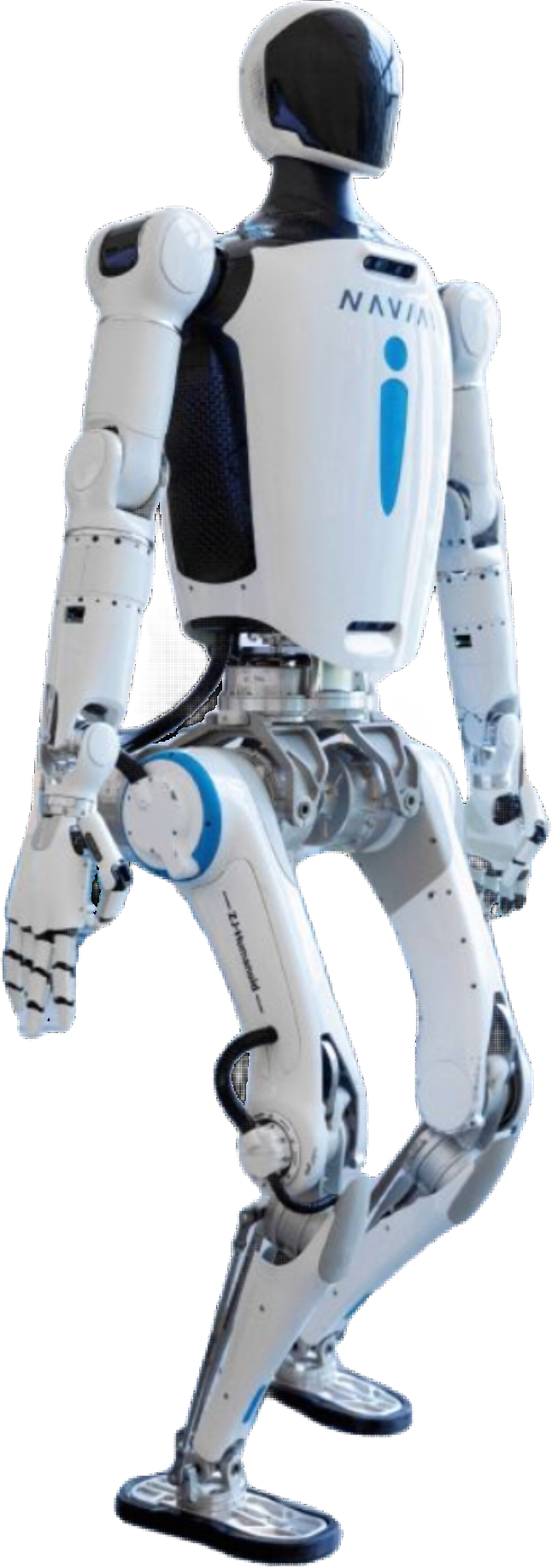
The Navigator 2 (officially designated NAVIAI-I2, Chinese: 领航者2号) is a full-size humanoid robot developed by the Zhejiang Humanoid Robot Innovation Center, a government-backed research and commercialization hub located in Ningbo, Zhejiang Province, China. First introduced on August 17, 2024, and publicly showcased at the 2024 World Robot Conference in Beijing, the Navigator 2 is the center's second-generation humanoid platform. It features 41 degrees of freedom, 275 TOPS of onboard AI computing power, and a multimodal sensor suite designed for both research and real-world industrial deployment.[1][2][3]
Standing 1.65 meters tall and weighing 60 kilograms, the Navigator 2 marked a substantial upgrade from its predecessor, the Navigator Alpha (Navigator 1), which stood 1.5 meters tall and weighed 50 kilograms. The robot is capable of stable bipedal walking at speeds up to 6 km/h, delivering speeches, preparing tea, playing chess, and performing sub-millimeter precision manipulation tasks in cluttered environments.[1][4] Its design emphasizes anthropomorphic coordination, with each arm supporting a 5 kg payload and an end-effector accuracy of 0.1 mm.[5]
The Navigator 2 served as the center's flagship platform throughout late 2024 and into 2025, and its dexterous manipulation system and AI architecture laid the groundwork for the larger, more capable NAVAI-I3, which was unveiled in November 2025.[6]
Background: Zhejiang Humanoid Robot Innovation Center
The Zhejiang Humanoid Robot Innovation Center was formally established on December 21, 2023, as a joint initiative between the Ningbo Municipal People's Government and the robotics laboratory of Professor Xiong Rong (熊蓉) at Zhejiang University.[7][8] The center operates from the Yongshuiqiao Science and Innovation Center in Ningbo's Haishu District and is structured as a private technology company with 51 to 100 employees. Its legal Chinese name is 浙江人形机器人创新中心有限公司.[9]
The center functions as a comprehensive platform covering research and development, commercialization, talent cultivation, and industrial ecosystem building in the field of humanoid robotics. It aims to bridge the gap between academic robotics research and real-world industrial deployment, leveraging Ningbo's existing strengths in precision manufacturing and automation components.[7]
Leadership
Professor Xiong Rong serves as the center's Chief Scientist and is the director and professor of the Robotics Laboratory at the Institute of Intelligent Systems and Control at Zhejiang University. Her research team has been working on humanoid robotics for nearly two decades, beginning with the development of small humanoid soccer robots in 2006. The team's soccer robots won the national championship for more than ten consecutive years and achieved runner-up finishes four times in the humanoid group of the RoboCup Robot World Cup.[10][11]
The team also developed the table tennis humanoid robot "Wukong 1.0," which could sustain 145 rounds of continuous rally with a human opponent, adapting to front and back shots as well as spinning balls. The Wukong robots, named after the mythological Monkey King from "Journey to the West," stood 1.6 meters tall, weighed 55 kg, and featured 30 degrees of freedom across two 7-DOF arms, two 6-DOF legs, and 4 DOF for the head and waist.[12]
Xiong Rong's former students have gone on to found several prominent robotics companies, including Zhu Qiuguo (founder of Deep Robotics) and Wang Shiquan (founder of Flexiv). In March 2026, she received the International Federation of Robotics (IFR) "Women Shaping the Future of Robotics 2026" award.[13]
SUPCON Technology and funding
SUPCON Technology Co., Ltd. (stock codes: 688777.SH, SUPCON.SW), a Hangzhou-based industrial automation company founded in 1993, is the primary shareholder and strategic backer of the center. SUPCON completed its IPO on the SIX Swiss Exchange in April 2023, raising approximately $565 million. The company specializes in control and safety systems, monitoring and optimization software, and measurement hardware for industrial processes.[8][14]
SUPCON injected an initial 17.62 million yuan into the center in early 2024 through a share issuance, acquiring a 44.4% stake. Ningbo Yunyi Enterprise Management Partnership contributed an additional 3.14 million yuan for a 9.62% stake in the same round.[14][15] George Cui Shan, SUPCON's Chairman and CEO, formally announced the innovation center and the Navigator Alpha robot on March 28, 2024.[8]
In August 2024, coinciding with the Navigator 2's launch, the center announced a planned investment round of approximately 350 million yuan. The post-financing valuation of the center exceeded 1.8 billion yuan at that time. By early 2026, the center had completed a Pre-A funding round of 450 million yuan (approximately $65 million), bringing the cumulative total capital raised to approximately 2.2 billion yuan over the 18 months since its founding. Investors in this round included China Merchants Innovation and Technology, Lenovo Capital, Fengyuan Capital, the Ningbo Industrial Internet Institute, the Zhejiang Province Venture Capital Group, Yuexiu Industrial Fund, and FG VENTURE.[15][16]
Development history
Origins: 18 years of humanoid research
The technical foundations of the Navigator series trace back nearly two decades to the Zhejiang University robotics laboratory. In 2006, the team began with a 60 cm humanoid soccer robot that competed in national and international tournaments. Through successive iterations, the team moved from small-scale competition robots to indoor and outdoor walking robots capable of terrain adaptation, and then to the Wukong table tennis robots. This progression built deep expertise in bipedal locomotion, motion control, perception, and human-robot interaction that directly informed the Navigator series.[10][11]
Navigator Alpha (March 2024)
The center's first humanoid prototype, the Navigator Alpha (Navigator 1, Navigator α, 领航者α), was unveiled in March 2024 alongside the official launch of the center's research team in Ningbo's Haishu District. Standing 1.5 meters tall and weighing 50 kilograms, the Navigator Alpha featured lightweight mechanical arms and a dexterous hand with 15 finger joints and six active degrees of freedom. It demonstrated basic bipedal walking, terrain adaptation, and coordinated full-body motion including tasks such as wiping a table, pouring water, and dancing.[7][8]
The Navigator Alpha served as a proof-of-concept platform, validating the center's ability to develop a complete humanoid system independently, from mechanical design through to control algorithms. Its development timeline was notably compressed: the center's leadership reported that the team advanced their schedule by two months through intensive effort to overcome the technical challenges of full-sized humanoid design.[17]
| Specification | Navigator Alpha (2024) | Navigator 2 (2024) |
|---|---|---|
| Height | 1.5 m | 1.65 m |
| Weight | 50 kg | 60 kg |
| Degrees of freedom | Not disclosed | 41 |
| AI computing power | Not disclosed | 275 TOPS |
| Arm payload | Not disclosed | 5 kg per arm |
| End-effector accuracy | Not disclosed | 0.1 mm |
| Max walking speed | Basic walking | Up to 6 km/h |
| Key demonstrations | Table wiping, pouring water, dancing | Speech, tea making, chess, precision assembly |
Navigator 2 unveiling (August 2024)
The Navigator 2 was officially introduced on August 17, 2024, less than five months after the Navigator Alpha's debut. The rapid iteration reflected the center's strategy of compressing development cycles through its deep technical bench and SUPCON's industrial resources. The robot was showcased at the 2024 World Robot Conference in Beijing, which opened on August 21, 2024, where it attracted widespread attention for its fluid, natural movements and human-like appearance.[1][2]
At the conference, Zhou Hongyi (周鸿祎), the founder of the 360 Group (a major Chinese internet security company), publicly praised the Navigator 2, calling it "the best-looking humanoid robot in the showroom." The endorsement from a prominent tech industry figure brought additional media coverage to the center's work.[18]
The center described the Navigator 2 as the first domestically produced humanoid robot with precise skill operation capabilities, emphasizing its ability to perform sub-millimeter accuracy tasks in real-world industrial settings rather than only in controlled laboratory environments.[3][5]
Technical specifications
Physical specifications
| Category | Specification | Value |
|---|---|---|
| Physical | Height | 165 cm (5 ft 5 in) |
| Physical | Weight | 60 kg (132 lb) |
| Physical | Dimensions (H x W x D) | 165 x 50 x 35 cm |
| Mobility | Total degrees of freedom | 41 |
| Mobility | Max walking speed | Up to 6 km/h (3.7 mph) |
| Mobility | Stair climbing | Yes |
| Mobility | Terrain adaptation | Multiple ground surfaces |
| Power | Continuous operation time | 2 hours |
| Power | Power source | Electric (rechargeable battery) |
| Computing | AI processing power | 275 TOPS |
Manipulation system
The Navigator 2's manipulation system represents one of its most significant technical achievements. Each arm supports a 5 kg payload, with a load-to-weight ratio exceeding 0.75. The end-effector control accuracy reaches 0.1 mm, enabling the robot to perform sub-millimeter precision tasks such as axle-hole (peg-in-hole) assembly in cluttered stacking scenarios.[3][5]
| Specification | Value |
|---|---|
| Single-arm payload capacity | 5 kg |
| Load-to-weight ratio | > 0.75 |
| End-effector accuracy | 0.1 mm (sub-millimeter) |
| Dexterous hand finger joints | 15 per hand |
| Active degrees of freedom (hand) | 6 per hand |
| Fingertip force | 10 N |
| Single hand weight | 600 g |
| Joint speed (hand) | 150 degrees/second |
The dexterous hand system was carried over and refined from the Navigator Alpha, retaining the 15-joint, 6-DOF design with 10 N fingertip force. At 600 grams per hand, the design prioritizes a favorable weight-to-force ratio, allowing the robot to perform fine motor tasks including grasping irregularly shaped objects, manipulating tools, and executing coordinated bimanual operations.[5][19]
Sensor suite
The Navigator 2 is equipped with a comprehensive multimodal sensor system designed for robust environmental perception in both structured and unstructured settings.
| Sensor type | Purpose |
|---|---|
| Surround-view multi-vision cameras | 360-degree visual coverage and spatial awareness |
| Depth cameras | 3D scene reconstruction and object distance estimation |
| Force-torque sensors | Contact force measurement for manipulation and collision detection |
| Touch sensors | Surface contact detection for grasping and interaction |
| RGB cameras | Color vision for object recognition and scene understanding |
| IMU / Gyroscope | Inertial measurement for balance and motion estimation |
These sensors feed into the robot's AI processing system, enabling real-time sensor fusion, semantic scene understanding, and adaptive behavior in dynamic environments. The multimodal perception system allows the Navigator 2 to interact semantically with its environment and grasp objects with precision in varied and complex settings.[1][19]
AI and software architecture
The Navigator 2 operates on a proprietary software stack that integrates multiple AI technologies. The system supports ROS2 as a development framework and is compatible with Python and C++ through APIs.[19]
The center developed three core technology breakthroughs for the Navigator 2's AI capabilities:[3][5]
-
Large-scale 3D high-fidelity scene construction and data generation: The center built methods for creating detailed three-dimensional virtual environments and generating synthetic training data at scale, reducing the cost and time required for reinforcement learning and imitation learning in robotics.
-
Behavior decision-making and long-sequence planning: The robot can make accurate behavioral decisions and plan extended action sequences in cluttered, open-scene environments. This allows it to handle complex, multi-step tasks rather than only simple, pre-programmed routines.
-
Black-and-white box fusion embodied intelligent control strategy: This hybrid approach combines model-based ("white box") control methods, which offer interpretability and safety guarantees, with data-driven ("black box") deep learning methods, which provide adaptability and generalization. The fusion of both approaches gives the Navigator 2 the ability to perform reliably in real-world conditions while still adapting to novel situations.[3]
The robot uses a combination of reinforcement learning and imitation learning to acquire new skills rapidly. Human motion data is captured and mapped onto the robot through algorithms and physical simulation technology, allowing the Navigator 2 to learn new movements with relatively few demonstrations.[17]
Capabilities and demonstrations
Anthropomorphic coordination
The Navigator 2 is designed to perform a wide range of anthropomorphic coordinated tasks. At the 2024 World Robot Conference, the robot publicly demonstrated several capabilities:[1][2][4]
- Speech delivery: The robot can deliver prepared presentations using natural gestures and body language, coordinating arm movements and head orientation with spoken content.
- Tea preparation: The Navigator 2 demonstrated the complete process of preparing and serving tea, requiring fine motor control for handling tea implements and pouring liquids.
- Chess playing: The robot played chess against human opponents, demonstrating the combination of strategic AI reasoning with precise physical piece manipulation.
- Object transport: Stable walking while carrying objects, maintaining balance and avoiding obstacles through semantic navigation.
Industrial precision
Beyond service-oriented demonstrations, the Navigator 2's most significant capability is its industrial-grade manipulation precision. The center reported the following achievements:[3][5]
- Sub-millimeter precision axle-hole assembly in cluttered stacking scenarios
- Efficient desktop organization in disordered environments
- Generalizable manipulation skills that transfer across different object types and arrangements
- A reliable assembly success rate exceeding 99.99% on industrial production lines
The center stated that the Navigator 2 achieved these precision benchmarks not only in controlled laboratory settings but also in actual industrial production environments, including work performed for clients such as Huawei.[6]
Semantic navigation
The robot incorporates embodied intelligent navigation technology that enables it to understand and interact with its environment at a semantic level. Rather than simply avoiding obstacles, the Navigator 2 can identify objects, understand spatial relationships, and navigate to goal locations based on natural language instructions or task-level commands. This capability is fundamental to the robot's deployment in unstructured, real-world environments where pre-mapped navigation is impractical.[1][19]
Applications
The Navigator 2 is positioned as a general-purpose intelligent humanoid platform with applications across multiple sectors.
Industrial manufacturing
The primary near-term application for the Navigator 2 is industrial manufacturing, where its sub-millimeter precision and stable manipulation make it suitable for assembly, quality inspection, and material handling tasks. The center's robots have been applied to scenarios including garment manufacturing, automobile assembly, and power grid inspection.[6][13]
The NAVIAI-I2 has entered training at the Lenovo Southern Intelligent Manufacturing Base (Lenovo AI Factory) and at the Geely Automobile Lynk and Co factory. In late 2025, a NAVIAI robot developed by the center began operations at the Turkish production base of Beko, one of Europe's leading home-appliance manufacturers, performing tasks such as tapping touchscreens with 0.1 mm accuracy, opening refrigerator doors, and completing quality-inspection routines. This deployment marked one of the first instances of a Chinese autonomous humanoid robot operating in an overseas industrial setting.[6][20]
Service applications
The Navigator 2's human-like appearance and natural movement patterns make it suited for service-oriented roles. Target applications include:[1][2]
- Home services and elder care: Assistance with daily living tasks, companionship, and monitoring
- Education and training: Interactive demonstrations and teaching assistance
- Exhibitions and events: Event hosting, guided tours, and interactive information delivery
- Retail and customer service: Product demonstrations, customer guidance, and inventory assistance
- Healthcare support: Patient interaction, routine monitoring, and logistics within clinical settings
Research platform
As a 41-DOF platform with 275 TOPS of computing power and a comprehensive sensor suite, the Navigator 2 also serves as a research platform for universities and laboratories studying embodied AI, computer vision, natural language processing, locomotion control, and human-robot interaction.
Mass production and commercialization
In early 2025, the center opened a manufacturing facility in Haishu District, Ningbo, with plans to begin mass-producing hundreds of humanoid robots by April 2025. The factory represents a transition from prototype development to small-batch commercial production, reflecting the center's goal of moving the Navigator platform from laboratory demonstrations to real-world deployment at scale.[17]
The center has formed an 11-member industry alliance that includes the Ningbo Institute of Materials Technology and Engineering, Zhichang Technology Group, and other regional partners. This alliance leverages Ningbo's existing industrial ecosystem, which includes more than 50 robot enterprises with a combined output value of 8 billion yuan and comprehensive manufacturing capabilities in reducers, controllers, and servo motors.[10]
As of 2025, the estimated price for the Navigator 2 is approximately $100,000 USD, positioning it in the upper range of the emerging humanoid robot market and targeting institutional and industrial buyers rather than individual consumers.[9]
Relationship to NAVAI-I3
The NAVAI-I3, unveiled on November 12, 2025, is the direct successor to the Navigator 2 in the center's product lineup. The I3 represents a significant generational leap in nearly every dimension.
| Feature | Navigator 2 / NAVIAI-I2 (2024) | NAVAI-I3 (2025) |
|---|---|---|
| Height | 1.65 m | 1.8 m |
| Weight | 60 kg | ~80 kg |
| Degrees of freedom | 41 | 82 |
| AI computing power | 275 TOPS | 2,250 TOPS |
| Max speed | Up to 6 km/h (walking) | Up to 9 km/h (walking/running) |
| Terrain capability | Multiple ground surfaces | Gravel, slopes, uneven terrain |
| Primary focus | Dexterous manipulation, AI interaction | Multi-terrain mobility, security, industrial tasks |
| Key demonstrations | Speech, tea, chess, precision assembly | Running, basketball drills, terrain traversal |
The NAVAI-I3 doubled the Navigator 2's degrees of freedom from 41 to 82 and increased AI computing power roughly eightfold, from 275 TOPS to 2,250 TOPS. While the Navigator 2 emphasized dexterous manipulation and service-oriented interaction, the I3 shifted the design philosophy toward robust locomotion, physical endurance, and deployment in challenging real-world environments such as security patrols and facility inspections.[6][21]
Despite the I3's introduction, the Navigator 2 platform remains relevant as a lighter, more cost-effective option for applications that prioritize fine manipulation over physical robustness.
Competition and market context
The Navigator 2 was introduced at a time of rapid expansion in the Chinese humanoid robot sector. China's Ministry of Industry and Information Technology (MIIT) published guidelines in late 2023 calling for humanoid robots to "realize mass production by 2025," spurring the creation of multiple government-backed innovation centers across the country.[22]
Domestic competitors
Key competitors to the Navigator 2 in the Chinese market include:
| Company | Robot | Height | DOF | Notable feature |
|---|---|---|---|---|
| Unitree Robotics | H1 | 1.80 m | 26 | Fast locomotion, affordable price |
| Unitree Robotics | G1 | 1.27 m | 43 | Compact, agile, low cost |
| Agibot | A2 | 1.70 m | 53 | Industrial focus, modular |
| UBTECH | Walker S | 1.70 m | 41 | Service-oriented, NIO factory deployment |
| Fourier Intelligence | GR-2 | 1.75 m | 53 | Rehabilitation and research |
| Beijing Innovation Center | Tiangong | 1.63 m | 42 | Open-source, embodied AI |
The Navigator 2's differentiation lies in its emphasis on sub-millimeter industrial precision and its backing by SUPCON, an established industrial automation company with deep expertise in manufacturing control systems. While competitors such as Unitree prioritize affordability and agile locomotion, and UBTECH focuses on service applications, the Navigator 2's design reflects a manufacturing-first philosophy.[10]
International competitors
In the broader global market, the Navigator 2 competes with platforms from Tesla (Optimus), Figure AI (Figure 02, Figure 03), Boston Dynamics (Atlas), 1X Technologies (NEO), and Agility Robotics (Digit). The Navigator 2 occupies a similar size and weight class to many of these platforms but differentiates itself through its focus on precision manipulation for Chinese manufacturing supply chains.
Regional ecosystem
The center benefits from Ningbo's well-developed robotics and precision manufacturing ecosystem. As of late 2025, Ningbo houses more than 50 robot enterprises with an aggregate output value of 8 billion yuan. The city's manufacturing base provides comprehensive supply chain coverage for key robot components including reducers, controllers, and servo motors. The number of supply chain enterprises grew from 25 to 88 during 2025, and 18 specialized sensor companies now operate in the region.[10][23]
The broader Ningbo robotics ecosystem includes companies such as Joyson Electronics and Tuopu Group, as well as newer entrants like Unitree Robotics and Bionic establishing operations in the city. A joint venture between PIA Automation and Shanghai-based Zhiyuan Robotics launched a production line in Ningbo capable of producing 3,000 humanoid robots annually.[23]
See also
- NAVAI-I3
- Zhejiang Humanoid Robot Innovation Center
- Humanoid robot
- Humanoid robots
- Embodied AI
- SUPCON Technology
- Zhejiang University
- RoboCup
References
- Rockingrobots - Zhejiang Humanoid Robot Innovation Center launches the NAVAI Navigator 2 ↩
- AIBase - The Rise of Domestic Humanoid Robots: The NAVIAI 2.0 Excels in Speech, Tea Making, and Chess Playing ↩
- 1ai.net - Humanoid robot "Pilot 2 NAVIAI" released: 1.65 meters, 60 kilograms, AI algorithm 275 TOPS ↩
- Humanoid.press - NAViAI Navigator 2: A New Standard in Humanoid Intelligence ↩
- Aparobot - Navigator 2: Robot Details, Use Case and Specifications ↩
- Gasgoo - Led by Zhejiang University Professor, Humanoid Robot Company Just Secured 450 Million Yuan in Financing ↩
- The Robot Report - SUPCON opens new innovation center and launches Navigator Alpha humanoid robot ↩
- PR Newswire - Navigator Alpha Humanoid Robot: SUPCON Integrates AI with Robotics (March 28, 2024) ↩
- Aparobot - Zhejiang Humanoid Robot Innovation Center Co., Ltd. Company Profile ↩
- Sango Automation - Zhejiang Humanoid Robot Innovation Center: The Eve of the Blowout of the Regional New Forces Wave Industry ↩
- Zhejiang University - Cracking the code: How Zhejiang University shapes the "Six Little Dragons" ↩
- Xiong Rong et al. - Impedance Control and its Effects on a Humanoid Robot Playing Table Tennis (SAGE Journals, 2012) ↩
- Zhejiang University - Professor XIONG Rong receives IFR "Women Shaping the Future of Robotics 2026" award ↩
- MarketScreener - Zhejiang Humanoid Robot Innovation Center receives CNY 17.62 million from SUPCON Technology ↩
- AHR - ZJ Humanoid Raises $65M in Pre-A Round, Backed by Industrial Giants ↩
- MarketScreener - Zhejiang Humanoid Robot Innovation Center receives CNY 610.59 million in funding ↩
- China Daily Ningbo - Humanoid robot takes a stride in Ningbo (March 12, 2025) ↩
- Dongfang Caifu - Zhou Hongyi praises Navigator 2: "The best-looking humanoid robot in the showroom" (November 30, 2024) ↩
- Origin of Bots - Navigator 2 Humanoid Robot Masters 275 Trillion Operations Daily ↩
- China Daily Ningbo - Zhejiang's humanoid robot steps into global manufacturing (December 22, 2025) ↩
- Humanoid.press - NAVIAI-I3: High-DOF Humanoid Robot by Zhejiang Innovation Center ↩
- The Robot Report - China plans to mass produce humanoids by 2025 ↩
- China Daily Ningbo - Ningbo companies ramp up application of humanoid robots (November 27, 2025) ↩
Improve this article
Add missing citations, update stale details, or suggest a clearer explanation. Every suggestion is reviewed for sourcing before it goes live.
4 revisions by 1 contributors · full history