

Ameca (robot)
Last edited
Fact-checked
In review queue
Sources
42 citations
Revision
v6 · 5,014 words
Fact-checks are independent of edits: a reviewer re-verifies the article against its sources and stamps the date. How we verify
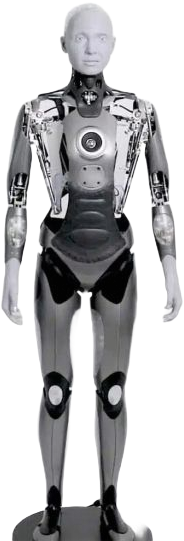 | |
| Developer | Engineered Arts |
| Type | Humanoid robot (social/expressive) |
| Unveiled | December 1, 2021 (video); CES 2022 (public debut) |
| Height | 187 cm (6 ft 2 in) |
| Weight | 62 kg (137 lb) |
| Degrees of Freedom | 61 total; 27 in face/head; 34 upper body |
| Facial expressions | 50+ pre-programmed |
| Languages | 70+ |
| Locomotion | Stationary (wheeled base); walking prototype in Gen 3 |
| Sensors | Dual 8 MP eye cameras, chest camera, LiDAR, IMU, microphones |
| Operating System | Tritium (proprietary) |
| AI Integration | GPT-3, GPT-4, Claude, Gemini via cloud API |
| Runtime | 4 to 6 hours per charge |
| Price | From ~$100,000 (half-body) to $500,000+ (full custom) |
| Units Deployed | 29+ worldwide (as of 2025) |
Ameca is a humanoid robot developed by Engineered Arts, a British robotics company based in Falmouth, Cornwall, United Kingdom, that the company markets as "the world's most advanced social humanoid robot." [41] First revealed in a viral video on December 1, 2021, and publicly demonstrated at CES 2022 in Las Vegas, Ameca is a stationary, upper-body social robot built to make eye contact, hold spoken conversations, and display lifelike facial expressions rather than to walk or do physical labor. It has 61 actuated degrees of freedom (27 in the face and head, 34 in the upper body), can produce more than 50 pre-programmed facial expressions, and can converse in over 70 languages through cloud-connected large language models. [9][41] The 27 facial actuators sit beneath grey silicone skin and let Ameca smile, frown, blink, wink, and form subtle micro-expressions that approximate human emotional responses.
Unlike industrial humanoid robots such as Tesla Optimus or Boston Dynamics' Atlas, Ameca is not designed for physical labor or locomotion. Instead, it serves as a research and development platform for human-robot interaction, embodied AI, and public engagement. Ameca occupies a distinct niche in the humanoid robotics landscape, prioritizing realistic facial expression and conversational ability over walking, lifting, or manipulation tasks. As of 2025, 29 Ameca units have been deployed worldwide at museums, science centers, research laboratories, universities, and corporate events.
Background
Engineered Arts
Engineered Arts Ltd was founded in October 2004 by Will Jackson, a Brighton University graduate with a BA in 3D design. Before founding the company, Jackson worked in special effects, film, and television, spending time in New York and Melbourne. While creating exhibitions for London's Science Museum in the 1990s, Jackson identified a need for a machine that could explain concepts and ideas to visitors repetitively in an entertaining way. He began assembling a team of local artists and engineers in Cornwall to produce mixed-media installations for UK science centers and museums. [1]
The company is headquartered in Falmouth, Cornwall, with additional offices in London and Redwood City, California. In December 2024, Engineered Arts restructured as a U.S. entity and secured $10 million in Series A funding led by Helium-3 Ventures. Matthew Bellamy, frontman of the rock band Muse and a partner in Helium-3 Ventures, joined the company's board as an observer. [2] As of 2026, the company employs approximately 49 people and has deployed over 200 robots across more than 200 unique installations in over 30 countries worldwide. [3]
Predecessor Robots
Ameca builds on nearly two decades of humanoid robot development at Engineered Arts. The company produced several notable predecessor platforms before Ameca's creation.
| Robot | Year Introduced | Key Characteristics |
|---|---|---|
| RoboThespian | 2005 | First humanoid robot by Engineered Arts; 1.75 m tall, 33 kg; LCD screen eyes; pneumatic motors; 30+ axes of movement; speaks 30+ languages; over 50 units installed globally at venues including NASA's Kennedy Space Center and the Copernicus Science Centre in Warsaw |
| SociBot | ~2012 | Compact desktop/kiosk-sized platform; combines RoboThespian core technologies with a projected computer-generated face; designed for reception and interactive kiosk applications |
| Mesmer | 2018 | Ultra-realistic animatronic humanoid featuring skin-like rubber face created from 3D scans of real people; exhibits highly lifelike human expressions; serves as the foundational technology for Ameca's facial expression system |
| Ai-Da | 2019 | Based on RoboThespian platform; an AI robot artist that creates drawings, paintings, and sculptures using a bionic hand and ocular cameras; named after Ada Lovelace; teleoperated rather than conversational |
RoboThespian established Engineered Arts' reputation in the entertainment and educational robotics space, while the Mesmer platform provided the critical facial expression technology that would become Ameca's defining feature. [4]
Development and Unveiling
Design Philosophy
Ameca was conceived as a platform for artificial intelligence research and human-robot interaction rather than as a product for physical work. The development team at Engineered Arts intentionally designed Ameca with a neutral, genderless appearance, using grey silicone skin and no hair. This aesthetic choice was made to minimize social bias and reduce the uncanny valley effect that can occur when robots attempt to look too realistically human. The grey, abstract appearance signals to viewers that Ameca is a machine while still conveying human-like emotional cues through its expressions. [5]
The robot was built on the company's Mesmer technology, which uses customized photogrammetry equipment to perform 360-degree 3D scans of the human body. The scanning process captures multiple overlapping digital photographs from different angles, then reconstructs a 3D model by comparing pixel color and anchor point positioning. This data provides a detailed map of human bone anatomy, skin texture, and facial muscle movement, which informs the placement and range of Ameca's actuators. [6]
First Video and Viral Sensation
On December 1, 2021, Engineered Arts released a short video showing Ameca appearing to wake up, scanning its surroundings, and reacting with expressions of curiosity and surprise. The video spread rapidly across social media platforms including Twitter, TikTok, and YouTube, accumulating millions of views within days; one Twitter post of the clip drew roughly 24 million views, amplified when model Chrissy Teigen reshared it to her followers. [42] The footage struck viewers as remarkably lifelike, prompting reactions ranging from fascination to unease. Tesla CEO Elon Musk responded to the video on Twitter with a single word: "Yikes." [7][42]
The viral success established Ameca as a cultural phenomenon and brought significant public attention to the field of expressive humanoid robotics. Numerous media outlets covered the video, with many describing Ameca as the most realistic humanoid robot face ever created.
CES 2022 Public Debut
Ameca made its first in-person public appearance at CES 2022 in Las Vegas in January 2022. The demonstration drew large crowds and extensive media coverage, with journalists and attendees noting the robot's ability to maintain eye contact, respond to questions in real time, and display emotional reactions during conversation. The CES debut cemented Ameca's reputation as a breakthrough in social robotics. [8]
Technical Specifications
Physical Design
Ameca stands 187 cm (6 feet 2 inches) tall, including its base platform, and weighs approximately 62 kg (137 pounds). The robot's frame consists of modular aluminum and plastic components, with grey rubber skin covering the face and hands. The body is finished in a combination of black metal and grey shell panels. The arm span measures 180 cm (70.9 inches), and the base has a diameter of 600 mm. [9]
The current production version (Generation 2.6 as of 2024) is a stationary upper-body humanoid. The legs are present for aesthetic purposes but are not functional for locomotion; the robot is mounted on a wheeled base or fixed platform. Walking prototypes were demonstrated with the Generation 3 model at ICRA 2025.
Degrees of Freedom and Actuators
Ameca has 61 actuated degrees of freedom distributed across its body, with 27 in the face and head and 34 in the upper body. The distribution is optimized for facial expression and upper-body movement rather than locomotion. [9][41]
| Body Region | Degrees of Freedom |
|---|---|
| Face | 27 |
| Neck | 5 |
| Shoulders | 8 (4 per side) |
| Arms | 10 (5 per arm) |
| Hands | 8 (4 per hand) |
| Torso | 3 |
| Total | 61 |
The 27 facial degrees of freedom are the robot's most distinctive feature. Each actuator sits beneath a layer of soft silicone skin stretched over a modular aluminum and plastic skull. The actuators control individual movements of the brows, eyelids, eyes, cheeks, nose, lips, and jaw, enabling Ameca to produce over 50 pre-programmed expressions and generate novel expressions in response to conversational context. [10][41]
Detailed Specifications
| Parameter | Value |
|---|---|
| Height | 187 cm (6 ft 2 in) |
| Weight | 62 kg (137 lb) |
| Width | 47 cm (18.5 in) |
| Depth | 85 cm (33.5 in) |
| Arm span | 180 cm (70.9 in) |
| Base diameter | 600 mm |
| Total degrees of freedom | 61 |
| Facial/head degrees of freedom | 27 |
| Upper-body degrees of freedom | 34 |
| Pre-programmed facial expressions | 50+ |
| Languages supported | 70+ |
| Eye cameras | 2 x 8 megapixel |
| Audio input | 2 ear microphones + 4-channel chest array |
| Speaker | 20 W (chest) |
| Chest camera | Yes |
| LiDAR | Yes |
| IMU | Yes |
| Force/torque sensors | Yes |
| Depth sensor | RGB-D |
| Arm payload capacity | ~2 kg per arm |
| Runtime | 4 to 6 hours per charge |
| Operating temperature | 10 to 30 degrees C (indoor only) |
| Connectivity | Wi-Fi, Ethernet, Thunderbolt, USB, HDMI |
| Operating system | Tritium (proprietary) |
| Locomotion | Stationary (current); walking prototype (Gen 3) |
Sensor Suite
Ameca carries a comprehensive sensor package for perceiving its environment and the people around it. Two 8-megapixel cameras are mounted in the robot's eyes, providing binocular vision and enabling face tracking and eye contact. A chest-mounted camera supplements the eye cameras with a wider field of view. An RGB-D depth sensor and LiDAR unit provide spatial awareness and are used for safety monitoring to detect approaching humans. The robot includes an inertial measurement unit (IMU), force/torque sensors, a gyroscope, an accelerometer, and joint encoders for proprioception. Two ear-mounted microphones and a four-channel microphone array in the chest capture audio for speech recognition and sound localization. [11]
Software and AI
Tritium Operating System
Every Ameca robot runs on the Tritium software suite, a proprietary platform developed by Engineered Arts over more than 12 years of iterative improvement. Tritium is a cloud-connected framework consisting of three core layers: a web browser-based user interface, integrated AI applications, and a robot operating system. [12]
The underlying robot OS is built on a custom Linux distribution created with the Yocto Project, with dedicated software written in a combination of C++, Rust, and Python. Users can write Python scripts directly in the browser to create custom robot behaviors with minimal friction. The web-based interface also allows operators to customize and fine-tune every individual degree of freedom, adjusting the eyes, mouth, eyebrows, and cheeks with precision. [13]
Tritium includes an intelligent buffer system that manages conflicting commands. If Ameca receives two simultaneous instructions, the buffer system resolves the conflict by arranging the priority of actions in a safe order, ensuring smooth and coherent behavior. The platform also supports telepresence mode, allowing a human operator to control Ameca remotely from any location. [14]
The latest version, Tritium 3, was released alongside Ameca Generation 3 in 2025. It features improved integration with modern large language models including GPT-4, Claude, and Gemini, enabling more natural and responsive conversations. Tritium 3 also introduced cloud AI capabilities for instant personality rewrites, language shifts, and role adaptations. [15]
What AI powers Ameca's conversations?
Ameca's conversational abilities rely on cloud-based connections to third-party large language models. The integration pipeline uses Tritium AI, a cloud service that combines speech recognition, natural language processing, and text-to-speech into a single workflow. When a person speaks to Ameca, the microphones capture the audio, which is transcribed using speech recognition. The text is then sent to an LLM for response generation, and the output is synthesized into speech while the system simultaneously selects appropriate facial expressions to accompany the response. [16]
The integration timeline reflects the rapid evolution of language models:
- 2022: Early demonstrations used GPT-3 for conversation and translation, with DeepL for language detection and Amazon Polly Neural voices for speech synthesis.
- 2023: ChatGPT was integrated into the conversational engine, enabling Ameca to develop more nuanced facial expression responses during dialogue. Engineers found that GPT-3 was preferable to GPT-4 for real-time interaction: in their words, "the processing time with GPT-4 was much longer and made Ameca appear less responsive" with her facial expressions. [17]
- 2024: By Mobile World Congress 2024, Ameca was demonstrated with full GPT-4 capability, as improvements to the model's response speed addressed earlier latency concerns.
- 2025: Tritium 3 expanded support to multiple LLM providers, including Anthropic's Claude and Google's Gemini, in addition to OpenAI models. [17]
This latency tradeoff illustrates a general lesson in embodied AI: for a face-to-face social robot, perceived responsiveness can matter more than raw model capability, because long pauses break the illusion of a natural conversation.
Ameca is capable of conversing in over 70 languages, with a video demonstration showing the robot switching between English, Japanese, German, Chinese, and French in a single session. [18][41]
Facial Expression Engine
The mapping between conversational content and facial expression is one of Ameca's most technically sophisticated features. The system analyzes the semantic content and emotional tone of both incoming questions and outgoing responses, then selects and blends facial actuator movements to produce expressions that feel natural in context. This process happens automatically, with the robot transitioning between expressions at speeds comparable to human response times. [19]
Using the Tritium web platform, operators can also manually program specific expression sequences, create custom animations, and define behavioral scripts. The system supports a workflow similar to 3D animation software used in visual effects and game development. [20]
What is Mesmer technology?
Ameca's facial expression capabilities are rooted in the Mesmer technology platform, which Engineered Arts first introduced as a standalone product line in 2018. The Mesmer system provides a framework for building humanoid robots with realistic human-like faces, and it serves as the internal skeleton and expression engine for Ameca. [21]
The Mesmer process begins with photogrammetry: a subject's face and body are scanned using specialized equipment that captures hundreds of overlapping photographs from multiple angles. These images are processed into a detailed 3D model that maps bone structure, muscle placement, and skin deformation. The resulting data informs the design of the robot's internal actuator layout, ensuring that mechanical movements closely replicate the way human facial muscles pull and stretch skin. [22]
Mesmer robots use powerful, silent, high-torque motors to drive facial movements. The motors are designed from scratch to work together as an integrated system rather than being off-the-shelf components assembled into a face. This custom engineering allows for smooth, coordinated movements across multiple actuators simultaneously, producing the fluid expressions that distinguish Ameca from other robots. [23]
The Mesmer platform has also been used to create custom robots for specific clients. Notable examples include "Fred," a robot created for the promotion of the HBO television series Westworld, and "Dr. Kalam," a Mesmer variant modeled after India's 11th President A.P.J. Abdul Kalam. [24]
Generations and Evolution
Ameca has undergone continuous development since its 2021 debut, with Engineered Arts releasing incremental updates and major generational upgrades.
Generation 1 (2021 to 2022)
The original Ameca, revealed in December 2021 and demonstrated at CES 2022, established the core design language and expression capabilities. The first generation featured a full upper-body humanoid form with articulated arms, hands, and the signature expressive face. Early models relied on GPT-3 for conversational AI. Researchers at RPTU (Rheinland-Pfalzische Technische Universitat) began developing a real-time people-robot-robot interaction system called EMAH based on a Generation 1 Ameca unit. [25]
Generation 2 and 2.6 (2023 to 2024)
Generation 2 introduced refinements to the facial actuator system, improved hand articulation, and better sensor integration. The Generation 2.6 update (2024) represented a mid-cycle refresh with enhanced camera systems, improved audio processing, and software optimizations. This version was the basis for most commercial deployments through 2024 and into 2025. [26]
Generation 3 (2025)
Engineered Arts unveiled Ameca Generation 3 at ICRA 2025 (the IEEE International Conference on Robotics and Automation) in Atlanta in May 2025. The Generation 3 model introduced several significant improvements:
- Enhanced facial actuators providing additional degrees of freedom for subtler micro-expressions
- Improved hand dexterity with more articulated fingers and better force feedback
- Updated Tritium 3 software with broader LLM support
- Faster response times with reduced latency between sensory input and expressive output
- Gaze tracking for more natural eye contact during conversations
- Walking prototypes, marking Ameca's first steps toward mobile locomotion
- Cloud AI integration for instant personality customization and multilingual dialogue [27]
Alongside Ameca Generation 3, Engineered Arts introduced "Ami," a smaller, more affordable desktop companion robot built on the same core technology. Ami is designed for wider deployment in settings where a full-sized humanoid is not practical. A second desktop variant called "Azi" was also introduced as part of the expanded product family. [28]
Public Appearances and Viral Moments
Ameca has become one of the most recognizable robots in the world through a series of high-profile public appearances and viral social media moments.
| Event | Date | Notable Details |
|---|---|---|
| Viral "waking up" video | December 2021 | First public reveal; roughly 24 million views on one Twitter post; Elon Musk responds "Yikes" |
| CES 2022 | January 2022 | First in-person public demonstration; extensive media coverage |
| GITEX 2022 | October 2022 | Demonstrated in Dubai alongside regional tech exhibitions |
| ICRA 2023 | May 2023 | Showcased at the IEEE robotics conference |
| MWC 2024 | February 2024 | Presented by Etisalat (UAE telecom); demonstrated real-time generative AI conversation |
| CES 2025 | January 2025 | Upgraded model with improved hand coordination |
| MWC 2025 | February/March 2025 | "Unleashed from the booth": Ameca wore casual clothes and mingled freely with attendees in Barcelona, fielding spontaneous questions |
| ICRA 2025 | May 2025 | Generation 3 unveiled alongside Ami desktop robot; walking prototype demonstrated |
Several of Ameca's interactions have gone viral individually. A widely shared clip features Ameca responding to the question "Will robots take our jobs?" with the reply: "It depends... how good are you at your job?" delivered with a smirk. Another viral moment from MWC 2025 showed the robot engaging with passersby about whether robots would take over the world, responding with notable sass and humor. [29]
Ameca has also appeared on television programming, including UK's Channel 4, and has been featured in coverage by CNET, BBC, CNN, The Guardian, and numerous other international media outlets.
Deployments and Installations
As of 2025, 29 Ameca units have been deployed to institutions across the globe. The robot's primary deployment contexts are museums, science centers, educational institutions, and corporate events.
Notable Installations
| Location | Country | Details |
|---|---|---|
| National Robotarium, Edinburgh | United Kingdom | Permanent installation since 2024; used in student workshops introducing robotics and AI concepts |
| Museum of the Future, Dubai | United Arab Emirates | Part of permanent exhibition on future technology |
| Computer History Museum, Mountain View | United States | Featured in AI chatbot exhibit since late 2024; demonstration video viewed more than 2.3 million times on YouTube |
| Heinz Nixdorf MuseumsForum, Paderborn | Germany | Installed 2025; connected to ChatGPT for multilingual visitor conversations |
| Copernicus Science Centre, Warsaw | Poland | Long-standing Engineered Arts installation venue |
| Deutsches Museum, Nuremberg | Germany | Part of robotics and technology exhibitions |
| MSG Sphere, Las Vegas | United States | Entertainment venue deployment |
| RPTU, Kaiserslautern | Germany | Research platform for real-time human-robot interaction studies |
Teachers and educators at the National Robotarium in Edinburgh have reported that interacting with Ameca makes abstract AI and robotics concepts tangible for students, sparking greater enthusiasm and engagement compared to traditional teaching methods. [30]
Major corporate clients that have used Ameca for events and demonstrations include GlaxoSmithKline and various telecommunications companies. The robot is available both for purchase and for short-term event rental. [31]
How much does Ameca cost?
Pricing and Configurations
Ameca's modular architecture allows customers to purchase individual components rather than a complete humanoid unit, so the price depends heavily on configuration. Reported starting prices run from approximately $130,000 for a partial build, rising to $500,000 or more for a fully customized enterprise deployment. [32][35]
| Configuration | Approximate Price Range |
|---|---|
| Head only | $25,000 to $50,000 |
| Half-body (torso, head, arms) | $100,000 to $150,000 |
| Full humanoid | $250,000 to $500,000 |
| Custom enterprise deployment | Up to $500,000+ |
All configurations require professional installation by Engineered Arts engineers. Additional costs include ongoing software licensing for Tritium, maintenance and support services, and optional customization. The robot comes with a standard two-year warranty. [32]
Rental Services
In addition to outright sales, Engineered Arts offers event rental services for trade shows, corporate events, product launches, and media appearances. This model allows organizations to deploy Ameca for short-term engagements without the capital expenditure of a full purchase. [33]
Funding and Business Growth
Engineered Arts has raised a total of approximately $16.2 million in funding as of 2025. The most significant round was a $10 million Series A in December 2024, led by Helium-3 Ventures with participation from AppDirect CEO Nicolas Desmarais, Belvoir Investments, ThirtySeven Holdings, and Figueira Capital. The funding was directed toward product refinement, manufacturing readiness, and U.S. expansion, including plans to hire approximately 20 employees at the Redwood City, California office across executive, sales, software, assembly, and support engineering roles. [2][34]
Competitive Context
Ameca occupies a fundamentally different niche in the humanoid robotics market compared to most other prominent humanoid robots. While companies like Tesla, Boston Dynamics, Figure AI, and Unitree Robotics focus on locomotion, manipulation, and physical labor, Ameca is optimized for social interaction, emotional expression, and conversational engagement.
How does Ameca differ from other humanoid robots?
| Robot | Developer | Primary Focus | Locomotion | Key Differentiator |
|---|---|---|---|---|
| Ameca | Engineered Arts | Expression, interaction, research | Stationary (walking in development) | 27 facial/head DOF; most expressive face |
| Sophia | Hanson Robotics | Media personality, diplomacy | Stationary/wheeled | Celebrity status; UN appearances |
| Optimus | Tesla | Factory automation, consumer use | Bipedal walking | Target price $20,000 to $30,000 |
| Atlas | Boston Dynamics | Athletic tasks, research | Advanced bipedal | 56 DOF; 50 kg lift; acrobatic agility |
| Figure 02 | Figure AI | Manufacturing, logistics | Bipedal walking | Helix VLA; BMW deployment |
| Digit | Agility Robotics | Warehouse logistics | Bipedal walking | Amazon pilot; lightweight design |
The closest competitor in the social/expressive robotics category is Sophia by Hanson Robotics, which gained international fame starting in 2016 through talk show appearances and being granted Saudi Arabian citizenship. However, Ameca is widely considered to have more advanced and realistic facial expression technology, a more modern software platform with better developer tools and API access, and a clearer positioning as a research and development platform. [35]
Strategic Positioning
Engineered Arts has deliberately positioned Ameca outside the physical labor and industrial automation segment. The robot lacks full mobility and cannot walk, carry heavy loads, or perform complex manipulation tasks in its current form. Instead, Ameca is designed for creating engaging, lifelike human-robot interactions in controlled indoor environments. This positioning allows Engineered Arts to avoid direct competition with the heavily funded industrial humanoid companies while addressing a growing market for social robots in education, entertainment, hospitality, and research. [36]
The humanoid robotics market overall is projected to reach $38 billion by 2035 according to Goldman Sachs, with over one million units shipped annually by that timeframe. Engineered Arts' focus on the social and interactive segment of this market represents a bet that human-facing applications such as reception, education, entertainment, and customer service will be a significant portion of total humanoid robot demand. [37]
Can Ameca walk? Limitations
No. Ameca cannot walk in its current production form, and it has several other notable limitations:
- No locomotion: Current production models cannot walk. The legs are non-functional and the robot is mounted on a fixed or wheeled base. Walking capability is in prototype stage as of Generation 3.
- Low payload capacity: The arms can carry approximately 2 kg each, limiting physical manipulation tasks.
- Indoor only: Ameca requires a controlled environment with temperatures between 10 and 30 degrees Celsius and is not weather-sealed or rated for outdoor use.
- Cloud dependency: Conversational AI features require an active internet connection to reach cloud-based LLMs. Without connectivity, Ameca's conversational abilities are limited to pre-programmed scripts.
- Movement speed: Upper-body movement speed is limited to approximately 0.5 m/s.
- No autonomous navigation: The robot cannot independently navigate between locations without human guidance or predefined paths. [38]
These limitations are by design rather than oversight. Engineered Arts has stated that Ameca is intended as a platform for AI and human-robot interaction research, not as a general-purpose humanoid worker. The company's development roadmap includes plans to address locomotion in future generations. [39]
Future Development
Engineered Arts has outlined several development priorities for Ameca's future iterations:
- Functional bipedal locomotion: Walking prototypes demonstrated at ICRA 2025 indicate that future production models may include full walking capability.
- Enhanced hand dexterity: Ongoing improvements to finger articulation and force feedback for more capable object manipulation.
- Virtual Ameca: A planned cloud-based digital platform that would allow developers to interact with a virtual version of Ameca for software development and testing without requiring physical hardware.
- Expanded AI integration: Continued support for new and emerging large language models as the technology evolves.
- Scaled manufacturing: The $10 million Series A funding is supporting the development of manufacturing capacity at the Redwood City facility to increase production volume. [40]
See Also
- Engineered Arts
- Humanoid robot
- Social robot
- Human-robot interaction
- Embodied AI
- Sophia (robot)
- Uncanny valley
- Large language model
- GPT-4
- ChatGPT
- RoboThespian
References
- "Engineered Arts." Wikipedia. Accessed April 2026. ↩
- "Engineered Arts Restructures as U.S. Company, Secures Series A Funding to Scale Social, Interactive Humanoid Robot Production." BusinessWire, December 17, 2024. ↩
- "Engineered Arts 2026 Company Profile." PitchBook. Accessed April 2026. ↩
- "About Engineered Arts." Engineered Arts official website. Accessed April 2026. ↩
- "Ameca Humanoid Robot Puts AI In A Gender-Neutral, 'Non-Threatening' Body." SlashGear, 2022. ↩
- "Engineered Arts Developed a Mesmer Robot With AI-Powered Robotic Head That Can Make Realistic Human Facial Expressions." Science Times, December 14, 2021. ↩
- "'Most Advanced Humanoid Robot' goes viral for a terrifyingly real face." TweakTown, December 3, 2021. ↩
- "Humanoid robot Ameca shown to public at CES 2022." Xinhua, January 9, 2022. ↩
- "Ameca: Expressive Humanoid Robot for Human Interaction." Humanoid Press. Accessed April 2026. ↩
- "Ameca's Humanlike Expressions are Redefining Robot-Human Interaction." Diamandis.com, 2024. ↩
- "Engineered Arts Ameca Specifications." QVIRO. Accessed April 2026. ↩
- "Tritium Software." Engineered Arts official website. Accessed April 2026. ↩
- "Engineered Arts to Unveil New Humanoid Robot at CES 2022." PRWeb, December 2021. ↩
- "Tritium intelligent buffer system supports Ameca, a robot with rich expressions." iMedia, 2022. ↩
- "Meet Ameca: The Humanoid Robot Wowing the World in 2025." TS2 Tech, 2025. ↩
- "ChatGPT Gives Humanoid Robot Ability to Speak in Multiple Languages." AI Business, 2023. ↩
- "Researchers train 'world's most advanced humanoid robot' Ameca on GPT-4, finds her less responsive." Interesting Engineering, April 10, 2023. ↩
- "ChatGPT Gives Humanoid Robot Ability to Speak in Multiple Languages." IoT World Today, 2023. ↩
- "Ameca robot review, features, advantages, disadvantages and what can Ameca do?" Science Online. Accessed April 2026. ↩
- "Westworld-like 'Mesmer' robot comes alive in a UK factory." Engadget, May 22, 2018. ↩
- "Meet Ameca, the Humanoid Robot With Eerily Realistic Facial Expressions." autoevolution, 2021. ↩
- "Meet Ameca, the remarkable (really) human-like robot." Maker Faire Rome, 2023. ↩
- "'Ameca' robot shows off more human-like facial expressions." Engadget, 2022. ↩
- "Engineered Arts." Wikipedia. Accessed April 2026. ↩
- "Ameca." AG Robotersysteme, RPTU. Accessed April 2026. ↩
- "Ameca by Engineered Arts: Price, Details, Review 2026." OriginOfBots. Accessed April 2026. ↩
- "Ameca (robot)." Wikipedia. Accessed April 2026. ↩
- "Azi, Engineered Arts' New Desktop AI Robot." Mike Kalil, 2025. ↩
- "Meet Ameca: The Humanoid Robot Wowing the World in 2025." TS2 Tech, 2025. ↩
- "Museum of the Future debuts enhanced Ameca humanoid robot." blooloop, 2024. ↩
- "Engineered Arts restructures in US and secures $10M to scale up humanoid robots." SiliconANGLE, December 17, 2024. ↩
- "Ameca Robot Review: $150K AI Humanoid." Robozaps, 2025. ↩
- "Ameca: revolutionary breakthrough in humanoid robotics at Mobile World Congress 2024." Ineltec, 2024. ↩
- "Engineered Arts restructures with $10M to create humanoid robots." VentureBeat, December 2024. ↩
- "Ameca by Engineered Arts: Price, Details, Review 2026." OriginOfBots. Accessed April 2026. ↩
- "Ameca Is Proof Hyper-Realistic Robots Won't Be Long." Towards Data Science, 2022. ↩
- "Humanoid Robot Cost in 2026: Prices and Models." Keyi Robot, 2026. ↩
- "Ameca Robot Review: $150K AI Humanoid." Robozaps, 2025. ↩
- "Ameca: The Most Advanced Humanoid Interaction Left Audience Stunned." Intimedia, 2024. ↩
- "Engineered Arts Restructures as U.S. Company, Secures Series A Funding." BusinessWire, December 17, 2024. ↩
- "Ameca." Engineered Arts official website (engineeredarts.com/robots/ameca). Accessed June 2026. ↩
- "Humanoid robot Ameca steals the show at this year's CES." IOL / Independent Online, January 9, 2022. ↩
Improve this article
Add missing citations, update stale details, or suggest a clearer explanation. Every suggestion is reviewed for sourcing before it goes live.
5 revisions by 1 contributors · full history