

Sulu.be Steve
Last edited
Fact-checked
In review queue
Sources
24 citations
Revision
v5 · 4,491 words
Fact-checks are independent of edits: a reviewer re-verifies the article against its sources and stamps the date. How we verify
| Steve | |
|---|---|
 | |
| General information | |
| Manufacturer | Sulu.be (Slightly Overdone Robots) |
| Designer | Jan De Coster |
| Type | Humanoid robot (social/character) |
| Country of origin | Belgium |
| Year introduced | 2014 |
| Height | 210 cm (6 ft 11 in) |
| Weight | ~100 kg (220 lb) |
| Degrees of freedom | 22 |
| Locomotion | Wheeled base |
| Max speed | 2.2 m/s (7.9 km/h) |
| Battery life | 2 hours |
| Operating system | Arduino |
| Materials | Aluminium, steel |
| Price | ~$60,000 USD |
| Status | Production / Available |
| Target markets | Entertainment, hospitality |
| Website | sulu.be/Steve |
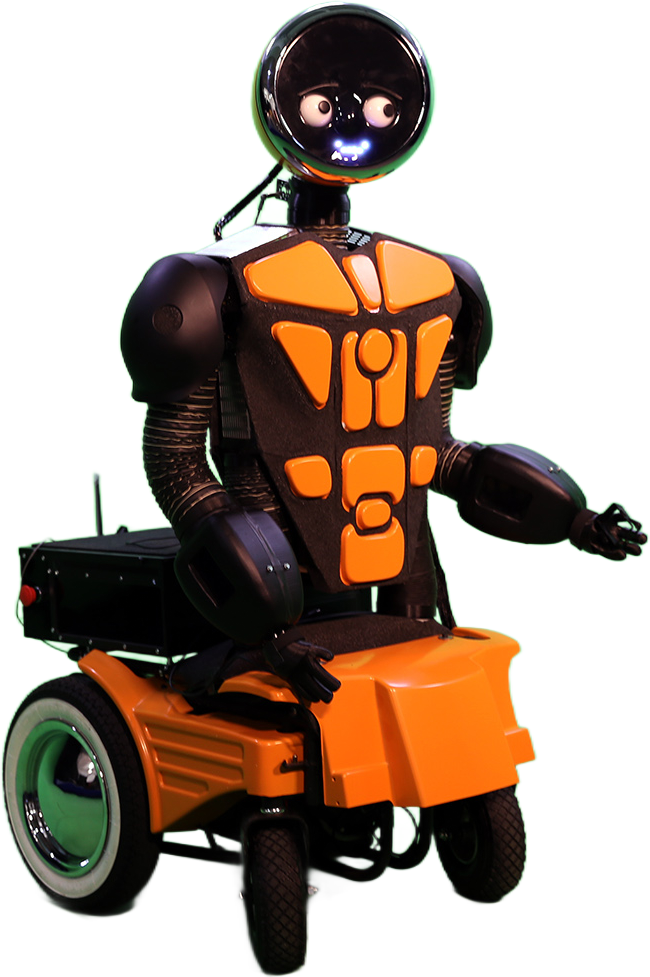
Steve is a 210 cm (6 ft 11 in) social humanoid robot built by Belgian robot designer Jan De Coster for Brightfish, Belgium's leading cinema advertising company, and deployed as a character host in Belgian movie theaters since 2015. [1][2] Named after the American actor Steve McQueen, Steve was created as a "character robot" meant to engage audiences emotionally rather than perform functional industrial tasks, and De Coster designed it, in his own words, to be a robot that "feels at home on a stage and between people." [1] The robot weighs about 100 kilograms. [24] De Coster works under the studio identity Slightly Overdone Robots, documented on his portfolio site Sulu.be; the project was first sketched in the spring of 2013 and completed in 2014. [1][2]
Steve occupies a distinctive niche in the robotics landscape. Unlike industrial humanoids designed for warehouse logistics or manufacturing, and unlike research platforms built to advance artificial intelligence capabilities, Steve belongs to a growing category of social and entertainment robots that prioritize character design, theatrical presence, and emotional resonance. With 22 degrees of freedom, a wheeled base, and Arduino-based control electronics, Steve bridges the gap between art, technology, and public engagement. [3]
Who created Steve?
Jan De Coster
Jan De Coster is a Belgian artist, robot designer, and creative technologist based in Mechelen, Belgium. He has been creating physical interactive installations since 1999, with storytelling and communication consistently at the core of his work. De Coster grew up with a fascination for physics and science fiction, and in the mid-1990s he began producing multimedia projects. He started a web design studio in Antwerp in 1997 before transitioning to advertising, where he worked as an art director and producer for major Belgian agencies including BBDO, TBWA, and Boondoggle. [4][5]
While working at BBDO in the early 2000s, De Coster developed a strong passion for character design, partly inspired by his discovery of the Pictoplasma Festival in Berlin in 2004. As his interest in virtual and digital worlds diminished, he began turning his attention to physical machines and interactive installations. Robots captured his attention as the ideal intersection of his interests in physical projects and character design. [6]
The turning point came in 2012, when an advertising agency (Boondoggle) commissioned De Coster to build a robot on roughly a month's notice. Despite having no prior robotics experience, he completed "Yummy the Robot," a kitchen-themed character robot that launched his career as a full-time robot maker. From that moment, De Coster devoted himself to exploring the boundaries of human-robot interaction. [6]
Slightly Overdone Robots
De Coster founded Slightly Overdone Robots in the late 2000s, a one-person production studio that explores the horizons of human-robot interaction through contemporary character design in what he describes as "sentient, social and empathic machines." Operating from his home in Mechelen, the studio has produced a wide range of robot characters and interactive installations for galleries, museums, factories, emergency response environments, advertising campaigns, and public events. [7][8]
The studio's services span several areas: custom robot design, interactive installations, a "Robot School" offering educational workshops for creative people of all ages, "Rent-a-Bot" services for events and product demonstrations, and speaking engagements at conferences worldwide. De Coster has also maintained a teaching position at Erasmus University College in Brussels, where he instructs students specializing in "Art & Technology" on the creative applications of electronics and physical interaction design. [7][8]
Notable robots created under the Slightly Overdone banner include Yummy, gEOF, Rachel, Robin, NOR Bert, Herb, Bradley, Peter, Lemmy, Ted, Leo, and Steve. Several of these robots have traveled internationally, with Rachel and Robin appearing at events from Moscow to Mexico City to Beijing. A key collaborator has been Robovision (now Robovision AI), a Belgian company specializing in industrial robot arms, camera systems, and deep learning for gesture and speech recognition. [7][9]
In 2024, De Coster decided to wind down the Slightly Overdone studio, ending it on a high note after a European tour that included presentations at beyond tellerrand in Berlin, Pictoplasma in Berlin, OFFF in Sevilla, and Tasmeem Doha in Qatar. [10][11]
Sulu.be
Sulu.be serves as Jan De Coster's personal website and portfolio, hosting documentation of his robots, interactive installations, exhibitions, campaigns, talks, and short films. The site's tagline reads: "Bring robot dreams to life by creating interactive installations and robotic prototypes that transcend the virtual realm into the tangible world." While not a traditional robotics company in the commercial sense, Sulu.be and Slightly Overdone Robots together represent De Coster's creative enterprise, which has produced robots deployed across entertainment, advertising, industrial, and educational settings. [4]
How was Steve built?
Concept and Design
The first idea for Steve originated in the spring of 2013, more than a year and a half before final production. De Coster envisioned a robot that would feel at home on a stage and among people. He wanted Steve to be slightly larger than the average human and capable of raising himself above crowds, making the robot instantly noticeable in busy event environments. The character was inspired by the American actor Steve McQueen and the aesthetic of 1970s sports cars, resulting in a personality that De Coster describes as naive: a character that does not fully understand the world but genuinely wants to get to know people. [1][2]
The project was shelved temporarily before being revived. De Coster collaborated with FablabXL (a fabrication laboratory in Belgium) and Robovision during the production phase. Robovision contributed expertise in 3D imaging systems, gesture recognition, and speech recognition through deep learning, while De Coster handled character design, animation, and system integration. [1][12]
Construction and Production
Steve's body is constructed from aluminium and steel, giving the robot a mass of about 100 kg at a height of 210 cm. [24] The robot features a minimalist, non-threatening aesthetic deliberately designed to evoke curiosity rather than fear. De Coster's background in character design is evident in Steve's slightly stylized face and expressive proportions, which are intended to make the robot instantly memorable without triggering the uncanny valley effect that can occur when robots attempt to look too realistically human. [3][13]
Final production was completed by late 2014, and Steve was ready for deployment in 2015. [1]
Why did Brightfish commission Steve?
Steve was built for Brightfish, Belgium's leading cinema advertising company. Brightfish has combined decades of cinema expertise since 1985 and operates as a creative cinema advertising sales house in Belgium, selling on-screen ads, producing branded content, and organizing events. The company markets over 436 cinema screens, representing more than 97 percent of total cinema attendance in Belgium. In 2011, Kinepolis Group acquired 100 percent of Brightfish's shares. [14][15]
Steve became a Brightfish "employee" with a specific mission: to spearhead several advertising campaigns in movie theaters across Belgium beginning in 2015. The concept placed Steve in cinema lobbies as an event host and interviewer, interacting with moviegoers and generating buzz for Brightfish's clients. The robot was designed to hang around the movie theater, greet attendees, and conduct brief interviews, functioning as a novel bridge between cinema audiences and brand messaging. [1][2]
What are Steve's specifications?
Overview
Steve is a wheeled humanoid robot built around an Arduino microcontroller platform. The robot features 22 degrees of freedom distributed across its body, dual arms with five-fingered hands (2 DOF per hand), and a wheeled base for mobility. The system runs on battery power with an approximate runtime of two hours per charge. [3]
Detailed Specifications
| Category | Parameter | Value |
|---|---|---|
| Physical | Height | 210 cm (6 ft 11 in) |
| Physical | Weight | ~100 kg (220 lb) |
| Physical | Materials | Aluminium, steel |
| Mobility | Total degrees of freedom | 22 |
| Mobility | Locomotion type | Wheeled base |
| Mobility | Maximum speed | 2.2 m/s (7.9 km/h / 4.9 mph) |
| Manipulation | DOF per hand | 2 |
| Manipulation | Fingers per hand | 5 |
| Power | Battery life | ~2 hours |
| Computing | Operating system | Arduino |
| Connectivity | Wireless | Wi-Fi |
Actuation and Movement
Steve uses DC motor actuators rather than the servo motors or hydraulic systems found in more advanced humanoid robots. The 22 degrees of freedom allow for coordinated upper-body gestures, head movements, and arm articulation. Steve's dual-arm structure enables carefully choreographed gestures that De Coster programs to accompany interactions with people, such as greeting guests, pointing, waving, or delivering brief messages with theatrical presence. [3][13]
The wheeled base provides mobility at speeds up to 2.2 m/s (approximately 7.9 km/h), allowing Steve to navigate indoor event spaces. This design choice reflects the robot's intended use in flat, controlled environments like cinema lobbies, convention halls, and event venues rather than rough outdoor terrain. The wheeled configuration also keeps the robot's center of gravity low and stable despite its towering 210 cm height. [3]
Computing and Software
Steve's control system is built on the Arduino platform, an open-source microcontroller ecosystem widely used in robotics prototyping and maker communities. Arduino provides a straightforward programming environment for managing motor control, sensor input, and communication protocols. The robot connects via Wi-Fi for remote operation and data exchange. [3]
Steve's interactions have historically combined pre-programmed scripts with choreographed movement, with De Coster tailoring specific gestures and dialogue to each event context. This script-and-performance approach is characteristic of social and entertainment robots, which prioritize reliable, repeatable stage presence over open-ended autonomy. [13]
What has Steve been used for?
Cinema Campaigns (2015)
Steve's primary deployment began in 2015 when the robot started working for Brightfish at Kinepolis cinema locations across Belgium. In this role, Steve served as an event host and interviewer, stationed in cinema lobbies during premieres, screenings, and promotional events. The robot greeted arriving moviegoers, conducted brief on-camera interviews, and created an interactive spectacle that drew attention to Brightfish's advertising clients. Steve's towering height and distinctive character design made it immediately recognizable in crowded cinema environments. [1][2]
Trends Manager of the Year (2021)
In 2021, Steve returned to his interviewing role for the annual Trends Manager of the Year election, a prestigious Belgian business award organized by the financial magazine Trends. Working on behalf of Accenture Interactive, Steve conducted interviews with attendees at the award ceremony. The assignment demonstrated Steve's continued relevance and operational capability seven years after his initial construction, and highlighted the robot's versatility as a media personality and brand activation tool. [16]
Ongoing Event Work
Steve has been active for over a decade since his completion, appearing at corporate events, cultural festivals, product launches, and brand activations across Belgium. The robot's "Rent-a-Bot" availability through Slightly Overdone Robots made it accessible to a range of clients seeking a novel, attention-grabbing presence at their events. Steve's design as a character rather than a utilitarian machine means that each appearance involves a degree of theatrical performance, with De Coster programming specific gestures and interactions tailored to each event context. [7][13]
What is Steve's design philosophy?
Character-First Approach
Steve represents Jan De Coster's distinctive philosophy of robot design, which prioritizes character, personality, and emotional connection over technical capability or functional utility. De Coster has consistently argued that robots need not solve practical problems to be valuable. Instead, he views robots as a legitimate creative medium, comparable to sculpture, animation, or theater, through which designers can explore the emotional dynamics of human-robot interaction. [5][6] Reflecting on Yummy, his first robot, De Coster told GE Reports in 2015 that conventional robots "usually have a purpose" and are "perfect and very functional in nature," qualities Yummy deliberately lacked. He has said that "imperfection, beauty, maybe even a form of empathy" are the qualities that matter most to him, and that "robots have become a genuine creative medium." [24]
In his CreativeMornings Brussels talk titled "The Robot Soul" (May 15, 2015), De Coster articulated his core insight: "We don't see robots as they are; we see them as we are." This perspective frames the robot not as a tool but as a mirror, reflecting human emotions, expectations, and anxieties back at the people who encounter it. Steve embodies this philosophy by functioning as a bridge between machine and audience, inviting people to reflect on how technology fits into human rituals and spaces through personality and emotional resonance rather than through efficiency or productivity. [5]
De Coster has noted that the emotional connections people form with his robots, often after very brief interactions, are what fascinate him most. Steve's minimalist yet expressive design deliberately avoids hyper-realistic human features, which can trigger discomfort. Instead, the robot's slightly stylized appearance signals clearly that it is a machine while still conveying warmth, curiosity, and approachability. [6]
Naming and Personality
The choice to name the robot after Steve McQueen was intentional. McQueen, known as the "King of Cool," embodied a particular combination of charisma, confidence, and understated presence that De Coster wanted to capture in his creation. The name frames Steve not as a generic machine but as a character with an implied backstory and personality. De Coster has described Steve as a naive character who does not fully comprehend the complexities of the human world but possesses a genuine desire to learn about and connect with people. [1][2]
This approach to robot personality design distinguishes Steve from most commercial humanoid robots, which are typically marketed based on their technical specifications, task capabilities, or AI intelligence. Steve's value proposition is fundamentally theatrical: the robot succeeds when it makes people smile, pause, or engage in conversation, not when it completes a task efficiently.
How does Steve compare with other social robots?
Steve exists within a broader ecosystem of social, entertainment, and character-driven robots. The following table compares Steve with other notable platforms in this category.
| Robot | Developer | Height | DOF | Locomotion | Primary Application | Approx. Price |
|---|---|---|---|---|---|---|
| Steve | Sulu.be | 210 cm | 22 | Wheeled | Entertainment, hospitality | ~$60,000 |
| Ameca | Engineered Arts | 187 cm | 61 | Stationary/wheeled | Research, interaction | $100,000 to $500,000 |
| Sophia | Hanson Robotics | 167 cm | ~70+ | Stationary/wheeled | Media, diplomacy | Custom pricing |
| Pepper | SoftBank Robotics | 120 cm | 20 | Wheeled | Retail, hospitality | ~$25,000 |
| NAO | SoftBank Robotics | 58 cm | 25 | Bipedal | Education, research | ~$9,000 |
| Mirokai | Enchanted Tools | 140 cm | N/A | Wheeled | Hospitality | Custom pricing |
| RoboThespian | Engineered Arts | 175 cm | 30+ | Stationary | Education, museums | ~$80,000 |
Steve's most direct comparison is with other character-driven social robots rather than with industrial or research humanoids. Compared to Ameca, which leads the field in facial expression realism with 27 dedicated facial degrees of freedom, Steve takes a simpler approach with fewer actuators but compensates through thoughtful character design and theatrical deployment. Compared to Pepper, which was designed for retail and customer service applications with built-in emotion recognition, Steve is larger, more physically imposing, and oriented toward event-based spectacle rather than ongoing retail assistance. [17][18]
Steve's $60,000 price point positions it in the mid-range of the social robotics market, more accessible than high-end platforms like Ameca but significantly more expensive than educational robots like NAO. The price reflects Steve's custom-built nature, large physical size, and the bespoke character design work that distinguishes it from mass-produced platforms.
Belgium's Robotics Ecosystem
Steve emerged from Belgium's growing robotics ecosystem, which has positioned the country as one of the rising players in European robotics. Belgium ranks among the top countries globally for robot density in manufacturing, with roughly 214 robots per 10,000 employees compared to the European Union average of 99. The Belgian robotics market is valued at several hundred million euros, with an estimated average annual growth rate of 7 to 9 percent. [19][20]
Research Institutions
Belgium's robotics strength is built on a foundation of academic research excellence. KU Leuven pioneered active force feedback in robotic assembly during the 1970s and 1980s and developed the Orocos (Open Robot Control Software) framework, spawning spinoff companies including Octinion and Flexible Robotic Solutions. The Vrije Universiteit Brussel (VUB) developed soft actuators in 1990 for safe human-robot interaction and houses the AI Lab where Luc Steels conducted foundational artificial intelligence research. The Universite Libre de Bruxelles pioneered swarm robotics and multi-robot systems under Marco Dorigo. The University of Ghent focuses on socially assistive robots for applications in autism therapy, diabetes management, and language learning. [19]
BruBotics, a joint initiative of eight research groups at VUB, serves as the Brussels Human Robotics Research Center with a mission to improve quality of life through human robotics. The FARI Institute addresses ethical considerations in AI and robotics, and Belgium has taken a leading position internationally in advocating for bans on lethal autonomous weapons. [19]
Industry Players
Flanders Make, founded in 2014, supports manufacturing innovation through collaborative projects with companies such as Tractonomy and Robovision. ZoraBots (formerly Zora Robotics), founded in Liege in 2011, became a significant player in social robotics by developing human-robot interaction software compatible with platforms from SoftBank Robotics, UBTech, and Boston Dynamics, deploying solutions in more than 60 countries. Other notable Belgian robotics ventures include Toadi (autonomous lawn robots), Exobotic Technologies, and Alberts (smoothie robot vending machines). The Orsi Academy in Ghent operates as a world-leading robotic training center for new technologies in medical practice. [19][20]
Jan De Coster's work with Steve and his other robots represents the artistic and social end of Belgium's robotics spectrum. While much of Belgium's robotics industry focuses on industrial automation, collaborative manufacturing, and medical applications, De Coster's character robots demonstrate the country's capacity for innovation in social robotics, entertainment, and creative human-robot interaction.
What other robots has Jan De Coster made?
Steve is one of many robot characters created by Jan De Coster over more than a decade of work. Each robot has a distinct personality, purpose, and design.
| Robot | Year | Description |
|---|---|---|
| Yummy | 2012 | Kitchen-themed robot created in roughly a month for the agency Boondoggle; De Coster's first robot, which launched his career |
| Rachel | ~2013 | Inspired by the film Blade Runner; designed to require human interaction to "feel real"; has traveled internationally |
| Robin | ~2013 | A gender-fluid companion robot designed to travel with Rachel; has appeared at events from Moscow to Beijing |
| Steve | 2014 | 210 cm character robot for Brightfish cinema campaigns; named after Steve McQueen |
| Walt | 2016 | Collaborative robot (cobot) for the Audi factory in Brussels; developed through the ClaXon research project (2015 to 2016) with Robovision, VUB, and the University of Hasselt; features facial recognition and gesture control |
| Leo | ~2017 | A platform allowing children to experience the effects of technology directly |
| Jeff | ~2017 | A photographer robot that autonomously posted images to Twitter during a deployment in Peru |
| Fons | ~2019 | An ash-collection robot deployed in Ghent; gained viral attention following a malfunction incident |
| Max | 2021 | A quadruped robot dog based on the open-source Spot Micro project; created as a student teaching example at Karel De Grote Hogeschool Antwerpen |
| Reddy | 2024 | Built for Recupel, Belgium's electronics recycling organization; premiered at the Nerdland Festival 2024 before 20,000 attendees; designed for roadshows where people can bring electronic items directly to the robot |
The Walt project is particularly notable as it placed De Coster's character design approach within an industrial manufacturing context. Walt worked alongside human employees at the Audi factory in Brussels, assembling Audi A1 car bodies. Developed through the ClaXon research project (January 2015 to December 2016), Walt combined Robovision's deep learning capabilities for worker recognition and gesture commands with De Coster's signature friendly robot face, featuring a chromed ring referencing the Audi logo. The project brought together academic researchers from VUB and the University of Hasselt with industry partners, and demonstrated that character design principles could improve human acceptance of collaborative robots in workplace settings. [12][21]
Speaking Engagements and Recognition
Jan De Coster has presented his work and philosophy at numerous international conferences and festivals, using Steve and his other robots as case studies for exploring the relationship between humans and machines.
| Event | Year | Location | Talk Title |
|---|---|---|---|
| Pictoplasma | 2013 | Berlin, Germany | (Character design and robots) |
| FITC Amsterdam | 2014 | Amsterdam, Netherlands | "The Robot Soul" |
| CreativeMornings Brussels | 2015 | Brussels, Belgium | "The Robot Soul" |
| beyond tellerrand | 2018 | Dusseldorf, Germany | "In the Brink of Consciousness" |
| FITC Amsterdam | 2018 | Amsterdam, Netherlands | "On the Brink of Consciousness" |
| Tasmeem Doha | 2024 | Doha, Qatar | Workshop: "Building a Painting, With Robots" |
| OFFF Sevilla | 2024 | Sevilla, Spain | "Slightly Overdone Robots" |
| beyond tellerrand | 2024 | Berlin, Germany | "Never Let Go of Your Dragon" |
| Pictoplasma | 2024 | Berlin, Germany | (Exhibition and presentation) |
In 2021, Steve played a role in the annual Trends Manager of the Year ceremony, conducting interviews on behalf of Accenture Interactive. The same year, De Coster was featured in connection with the Trends Manager of the Year event, bringing visibility to his robotics work in Belgium's mainstream business community. He was also featured in De Tijd, Belgium's leading financial newspaper, in 2024. [16][22]
De Coster's 2024 beyond tellerrand talk, "Never Let Go of Your Dragon," reflected on the lifecycle of creative work through the lens of his robot projects, addressing questions about the future of his creations, his ongoing responsibility to them, and the emotional weight of artistic legacy. [11]
Rise of the Robots Short Film
De Coster has also used his robots, including characters from the same creative universe as Steve, in narrative filmmaking. "Rise of the Robots" is a short film directed by De Coster that presents a story about a group of robots left in a dystopian environment while engaged in very human activities. The film is narrated by Ron, a small robot positioned on a beach who opens with dialogue referencing the television series "Mr. Robot" and addresses an imaginary human friend. The narrative explores robots' desire to learn common human behaviors and examines humanity's fears about robot advancement, using graffiti as a metaphor for protest art and the struggle toward individuality. The film's music was provided by Scott Holmes. [23]
While Steve does not appear directly in the film, the project illustrates the broader creative ecosystem in which Steve was conceived: one where robots are treated as characters with inner lives, stories, and emotional depth rather than as purely functional machines.
Why is Steve significant?
Steve holds a distinctive position in the landscape of humanoid robots. At a time when the robotics industry is dominated by headlines about billion-dollar investments in industrial humanoids from companies like Tesla, Figure AI, and Boston Dynamics, Steve represents an alternative vision of what robots can be. Built by a single designer working from his home in Mechelen rather than by a venture-backed engineering team, Steve demonstrates that meaningful human-robot interaction does not require cutting-edge locomotion, advanced manipulation, or massive computational infrastructure.
Steve's longevity is itself remarkable. First deployed in 2015, the robot has remained operational and relevant for over a decade, adapting to new contexts from cinema lobbies to business award ceremonies. The robot's endurance shows how a machine built on relatively simple, low-cost hardware can stay useful for years when its value rests on character and performance rather than on raw technical capability. [3]
De Coster's work with Steve and his other robots has influenced how Belgium's creative and technology communities think about the social dimensions of robotics. By demonstrating that robots can function as characters, storytellers, and emotional catalysts, De Coster has helped expand the definition of what counts as robotics innovation beyond the traditional boundaries of engineering and computer science.
See also
- Humanoid robot
- Humanoid robots
- Sulu.be
- Human-robot interaction
- Social robot
- Ameca (robot)
- Sophia (robot)
- Pepper (robot)
- Uncanny valley
- Arduino
- Robotics
References
- "Steve the Robot." Sulu.be. Accessed April 2026. http://www.sulu.be/Steve/ ↩
- "Steve with Brightfish." Sulu.be. Accessed April 2026. http://sulu.be/?p=149 ↩
- "Steve - Humanoid Robot Specifications." HumanoidSpecs.com. Accessed April 2026. https://humanoidspecs.com/robots/sulube-steve ↩
- "Jan De Coster - Portfolio." Sulu.be. Accessed April 2026. http://sulu.be/ ↩
- "Jan De Coster: The Robot Soul." CreativeMornings Brussels, May 15, 2015. https://creativemornings.com/talks/jan-de-coster/1 ↩
- "Jan de Coster on sci-fi and robots." Inkygoodness / Pictoplasma. Accessed April 2026. https://inkygoodness.com/features/pictoplasma-jan-de-coster-sci-fi-robots/ ↩
- "Slightly Overdone by Jan De Coster." Sulu.be. Accessed April 2026. http://www.sulu.be/SlightlyOverdone/ ↩
- "About Jan De Coster." Sulu.be. Accessed April 2026. https://sulu.be/?page_id=118 ↩
- "Jan De Coster - Speaker Profile." beyond tellerrand Dusseldorf 2018. https://beyondtellerrand.com/events/dusseldorf-2018/speakers/jan-de-coster ↩
- "Jan De Coster - Speaker Profile." beyond tellerrand Berlin 2024. https://beyondtellerrand.com/events/berlin-2024/speakers/jan-de-coster ↩
- "Jan De Coster: Never Let Go of Your Dragon." beyond tellerrand Berlin 2024. https://beyondtellerrand.com/events/berlin-2024/speakers/jan-de-coster ↩
- "Cobot with Deep Learning and Gesture Recognition Hits Audi Production Floor." All About Circuits. https://www.allaboutcircuits.com/news/collaborative-robot-deep-learning-gesture-recognition-audi-brussels-factory/ ↩
- "Steve." Humanoid.guide. Accessed April 2026. https://humanoid.guide/product/steve/ ↩
- "About Brightfish." Brightfish. Accessed April 2026. https://www.brightfish.be/about/ ↩
- "Kinepolis takes over advertising agency Brightfish." Kinepolis Group, December 20, 2011. https://corporate.kinepolis.com/en/press-releases/kinepolis-groupkinepolis-takes-over-advertising-agency-brightfish ↩
- "Trends Manager of the Year 2021." Sulu.be. Accessed April 2026. https://sulu.be/?p=881 ↩
- "Ameca: Expressive Humanoid Robot." Engineered Arts. Accessed April 2026. ↩
- "SoftBank Pepper Review." Robozaps, 2026. https://blog.robozaps.com/b/softbank-pepper-review ↩
- "Belgium, a country with a rich ecosystem for robotics innovation." euRobotics. Accessed April 2026. https://old.eu-robotics.net/eurobotics/newsroom/press/belgium-a-country-with-a-rich-ecosystem-for-robotics-innovation.html ↩
- "The Robotics Market in Belgium." Robot Magazine. Accessed April 2026. https://www.robot-magazine.fr/en/the-robotics-market-in-belgium/ ↩
- "Walt for Audi." Sulu.be. Accessed April 2026. https://sulu.be/?p=29 ↩
- "Jan De Coster - Speaker Profile." FITC. Accessed April 2026. https://fitc.ca/speaker/jan-de-coster/ ↩
- "Rise of the Robots, a short-film by Jan De Coster." Sulu.be. Accessed April 2026. http://sulu.be/Rise/ ↩
- "Jan De Coster: The Robot Soul." GE News (GE Reports), January 26, 2015. https://www.ge.com/news/reports/the-robot-soul ↩
Improve this article
Add missing citations, update stale details, or suggest a clearer explanation. Every suggestion is reviewed for sourcing before it goes live.
4 revisions by 1 contributors · full history