

IGRIS-C
Last edited
Fact-checked
In review queue
Sources
14 citations
Revision
v6 · 2,906 words
Fact-checks are independent of edits: a reviewer re-verifies the article against its sources and stamps the date. How we verify
| IGRIS-C | |
|---|---|
 | |
| General information | |
| Manufacturer | Robros |
| Country | South Korea |
| Year introduced | 2025 |
| Status | In production |
| Type | Humanoid robot |
| Height | 154 cm (5 ft 1 in) |
| Weight | 56 kg (123 lb) |
| Degrees of freedom | 31 (body) + 11 per hand |
| Processor | Intel Core i7 + NVIDIA Jetson Orin NX |
| Website | robros.co.kr |
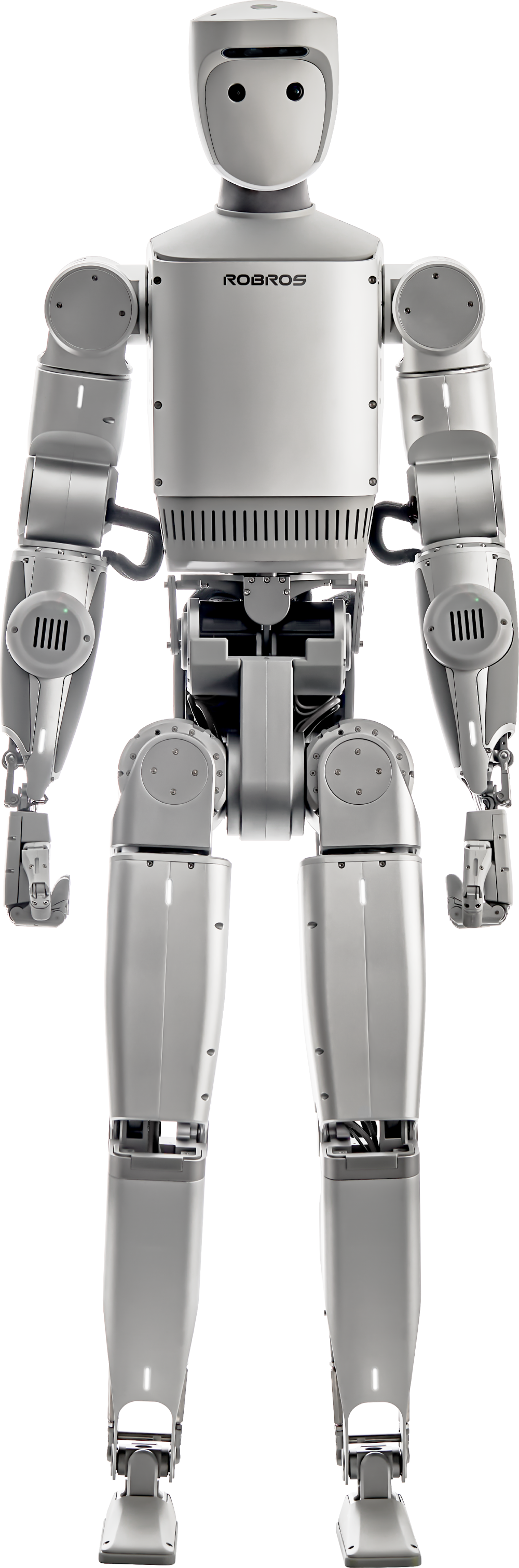
IGRIS-C is a compact humanoid robot developed by South Korean robotics company Robros. Designed as a production-ready platform for artificial intelligence research and industrial proof-of-concept deployments, IGRIS-C stands 154 cm tall and weighs 56 kg.[1] The robot features 31 degrees of freedom in the body and 11 degrees of freedom in each tendon-driven hand, allowing it to perform complex locomotion and dexterous object manipulation.[1] Robros unveiled IGRIS-C at the HUMANOID M.AX Alliance pavilion during CES 2026 in January 2026,[2] and the robot won first place in the bipedal walking and static obstacle avoidance category at the 24th IEEE-RAS International Conference on Humanoid Robots in September 2025.[9]
Background
Robros
Robros is a private robotics company headquartered in Seoul, South Korea, led by CEO Ryan Ro.[7] Founded in 2020, the company set out to innovate and blur the boundaries between humans and robots, with a particular focus on the service industry. Robros employs a multidisciplinary team that combines expertise in mechanical engineering, electrical engineering, computer science, UI/UX design, branding, and interior design. As of early 2026, the team had grown to more than 40 members and was continuing to scale.[2]
Before entering the humanoid robot market, Robros established a track record in robotic automation through its "Better Than Yours" unmanned cafe concept, which launched in the Seongsu-dong neighborhood of eastern Seoul in 2023. The cafe features two robot baristas: Porty, a three-jointed arm that extracts espresso shots, and Mixie, which prepares toppings and mixed beverages. Together they operate 24 hours a day with only two hours of daily manual maintenance, serving drinks at prices significantly below those of conventional cafes in the area.[10] The Better Than Yours project earned Robros a Red Dot Design Award for its integration of robotics, safety, and intuitive user experience.
Robros has attracted investment from several notable backers, including Lotte Ventures, HB Investment, Stick Ventures, GS Retail, and STIC Ventures.[7] The company supplies robots domestically for research, education, and exhibition purposes, and is a core member of South Korea's K-Humanoid Alliance.[2]
Development history
Robros developed the IGRIS platform as a full-stack humanoid robotics solution, building in-house capabilities across mechanical design, system integration, assembly, production, control software, and AI. The company's first humanoid model, the IGRIS-A, was introduced in early 2024 as a service-oriented robot targeting environments such as cafes and customer-facing settings. The IGRIS-A featured 29 articulated joints, an 11-joint tendon-driven hand, and a dual battery system, and it weighed 106 kg.[6]
IGRIS-C followed as a more compact, lighter successor designed to bridge the gap between advanced AI research and real-world industrial deployment. Where the IGRIS-A focused primarily on service applications, the IGRIS-C was engineered as a versatile research platform suitable for embodied AI experiments, proof-of-concept demonstrations, and collaborative robotics research. Robros began sales of the IGRIS-C in 2025, marking the company's shift toward commercialization and international expansion.[1]
Design and hardware
Physical design
IGRIS-C measures 1540 x 440 x 300 mm (height x depth x width) and weighs 56 kg including the battery.[1] Its compact 154 cm stature was a deliberate design choice, optimized for operation in narrow, complex indoor environments where overhead clearance and spatial constraints are common. The robot features what Robros describes as a "friendly industrial design" with a flatter head profile to minimize clearance issues in indoor spaces.[1] This approach reflects a design philosophy centered on practical deployment rather than purely anthropomorphic aesthetics.
The overall proportions of IGRIS-C are engineered to approximate a human frame closely enough for operation in workspaces built for people, including factories, laboratories, retail environments, and logistics facilities.
Degrees of freedom and joint configuration
IGRIS-C incorporates a total of 31 degrees of freedom across the body (excluding the hands), distributed as follows:
| Body region | Degrees of freedom | Notes |
|---|---|---|
| Arms | 7 DoF per arm (14 total) | Full range of motion for manipulation tasks |
| Waist | 3 DoF | Enables torso rotation and bending |
| Neck | 2 DoF | Supports head orientation for sensor pointing |
| Legs | 12 DoF (6 per leg) | Bipedal locomotion, running, and jumping |
This joint configuration allows the robot to achieve expressive, precise movement across its entire body. The combination of a 3-DoF waist and 7-DoF arms provides a large workspace for dual-arm manipulation tasks.[1]
Hands
Each hand on the IGRIS-C employs a tendon-driven structure in which actuators and joints are connected via wire cables. This design delivers 6 active degrees of freedom per hand, powered by 6 motors. When passive degrees of freedom are included, each hand reaches a total of 11 DoF. The five-finger hands weigh approximately 300 grams each and can handle payloads of up to 3 kg per hand (6 kg total for dual-arm operation).[1]
The tendon-driven architecture couples joint motion while still enabling independent finger control. This allows the hands to perform versatile object manipulation tasks, from grasping irregularly shaped items to executing precise pinch grips. Cable routing through the hand structure provides a favorable balance between dexterity, weight, and mechanical simplicity compared to alternative approaches such as direct-drive finger actuation.
Actuators
IGRIS-C uses quasi-direct-drive (QDD) actuators with low reduction ratios of 20:1 or less.[1] QDD actuators enhance joint compliance, meaning the joints can absorb unexpected external forces rather than rigidly resisting them. This property is important for safe human-robot interaction and for maintaining balance during dynamic locomotion.
The knee and hip joints deliver up to 150 Nm of torque, providing the force necessary for bipedal walking, running, jumping, and even acrobatic maneuvers such as backflips and cartwheels.[1] The combination of high torque output and low gear reduction enables the robot to respond quickly to control commands while maintaining smooth, natural-looking motion.
| Actuator specification | Value |
|---|---|
| Actuator type | Quasi-direct-drive (QDD), electric |
| Gear reduction ratio | 20:1 or less |
| Maximum joint torque (hip/knee) | 150 Nm |
| Dual-arm payload capacity | 6 kg |
| Hand payload (per hand) | 3 kg |
| Hand weight | ~300 g each |
Computing and sensors
Processing hardware
IGRIS-C runs on a dual-processor computing stack:
| Component | Model | Role |
|---|---|---|
| CPU | Intel Core i7 | Primary computation, motion planning, system control |
| AI accelerator | NVIDIA Jetson Orin NX | Real-time perception, neural network inference, edge AI processing |
The Intel Core i7 handles general-purpose computation, including motion planning and high-level task coordination. The NVIDIA Jetson Orin NX serves as a dedicated edge AI accelerator, running perception models and neural network inference for real-time decision-making. This dual-processor arrangement allows the robot to handle computationally intensive AI workloads locally without relying on cloud connectivity.[1]
Sensor suite
The robot's perception system combines multiple sensor modalities for environmental awareness and interaction:
| Sensor | Type | Purpose |
|---|---|---|
| Stereo camera | RGB (x2) | Depth estimation, visual perception, object recognition |
| Depth camera | Intel RealSense | 3D environment mapping, obstacle detection |
| IMU | Inertial measurement unit | Balance and orientation tracking |
| Microphone | Audio input | Voice interaction, sound localization |
| Speaker | Audio output | Voice feedback, alerts |
The 3D vision setup consists of two RGB cameras paired with a rear-mounted depth sensor, providing the robot with both stereo depth estimation and structured-light depth data.[3] This dual approach to depth perception allows IGRIS-C to build reliable 3D models of its environment for navigation and manipulation tasks. The IMU provides continuous balance feedback, which is critical for stable bipedal locomotion.
Power system
IGRIS-C is powered by a 17,000 mAh, 48V battery pack.[1] A quick charger is included as standard equipment. Specific battery life and maximum operating time figures have not been publicly disclosed by Robros as of early 2026, and these specifications are listed as still in development.
Software and AI
Reinforcement learning for locomotion
IGRIS-C's bipedal walking capabilities were developed through reinforcement learning in simulation environments. In this approach, a virtual model of the robot is trained through millions of simulated walking trials, learning to maintain balance and navigate terrain through trial and error. The resulting control policy is then transferred to the physical robot. This sim-to-real transfer methodology has become a standard technique in modern humanoid robotics, allowing developers to train locomotion behaviors far more quickly and safely than on physical hardware alone.
The reinforcement learning pipeline enables IGRIS-C to perform autonomous bipedal walking with 10 default locomotion poses.[1] Robros reports that the robot can execute running, jumping, backflips, and cartwheels, demonstrating significant agility and dynamic stability. The combination of extensive simulation training and the compliance provided by the QDD actuators contributes to robust, adaptive locomotion even on uneven or unpredictable surfaces.
Imitation learning for manipulation
For object manipulation tasks, IGRIS-C relies on imitation learning (IL). In this paradigm, human operators teleoperate the robot using a "master hand" controller, performing target tasks repeatedly to collect demonstration datasets. These demonstrations are then used to train machine learning models that allow the robot to reproduce the same tasks autonomously in similar environments.[3]
The imitation learning workflow follows several steps:
- A human operator teleoperates IGRIS-C through the desired task using the master hand controller.
- The system records the operator's movements, sensor data, and task outcomes across many repetitions.
- The collected demonstration data is used to train a policy model.
- The trained model is deployed on the robot, enabling it to perform the task autonomously.
This approach is particularly well suited to dexterous manipulation tasks where programming explicit control rules would be impractical. By learning directly from human demonstrations, IGRIS-C can acquire complex hand-eye coordination skills such as grasping objects of varying shapes, pouring liquids, and assembling components.
Software platform
IGRIS-C runs on a closed-source software platform developed by Robros.[1] The software supports both autonomous operation and remote teleoperation modes. The system also supports data collection for AI training, allowing researchers to gather manipulation and locomotion datasets through the robot's sensors and actuators for offline model training.
Competition results
IGRIS-C achieved a notable result in its first year by winning first place in the bipedal walking and static obstacle avoidance category at the 24th IEEE-RAS International Conference on Humanoid Robots (Humanoids 2025).[9] The conference was held from September 30 to October 2, 2025, at COEX in Seoul, South Korea.[8] The robot competition took place on October 1, 2025, in the Grand Ballroom Lobby at COEX, where developers showcased how their robots walk, balance, and perform goal-oriented tasks.[9]
This competition victory provided independent validation of IGRIS-C's locomotion capabilities and helped establish Robros' credibility in the international humanoid robotics community.
Applications
IGRIS-C is designed to serve multiple application domains:
| Application area | Description |
|---|---|
| AI research | Platform for embodied AI experiments at universities and research institutes |
| Industrial proof-of-concept | Testing humanoid deployment in factories and logistics facilities |
| Hospitality and cafe service | Serving customers in food and beverage environments |
| Retail assistance | Product handling and customer interaction in retail settings |
| Education | Teaching robotics, AI, and control systems in academic settings |
| Exhibition and demonstration | Showcasing humanoid technology at events and trade shows |
| Human-robot interaction research | Studying collaborative behaviors between humans and robots |
Robros primarily targets universities, research institutes, and government-funded laboratories in North America and Europe as its international customer base.[2] These institutions seek full humanoid platforms for embodied AI experiments, and IGRIS-C's combination of dexterous manipulation, dynamic locomotion, and onboard AI processing makes it suitable for a wide range of research applications.
On the commercial side, the robot's compact form factor and service-industry heritage (drawing on Robros' experience with the Better Than Yours cafe) position it for customer-facing roles in hospitality, retail, and similar environments.
CES 2026
Robros showcased IGRIS-C at CES 2026 in Las Vegas on January 6, 2026, as part of the HUMANOID M.AX Alliance pavilion.[2] The HUMANOID M.AX Alliance is a public-private consultative body formed in April 2025, comprising approximately 260 organizations including AI research institutes, robot manufacturers, component suppliers, universities, and research institutions. The alliance was established to promote AI-based humanoid commercialization in industrial environments and represents a core element of South Korea's national robotics strategy.[2]
At the event, IGRIS-C demonstrated bipedal walking under a safety harness, showcasing the platform's locomotion capabilities to an international audience. A Robros representative stated that CES 2026 provided "an excellent opportunity to introduce our humanoid robotics technology and the IGRIS-C platform to the global market."[2]
The demonstration attracted attention as part of a broader wave of humanoid robot showcases at CES 2026, where multiple companies from around the world presented their latest platforms.[14] The event marked Robros' first major appearance at an international consumer electronics show and signaled the company's intent to expand beyond the Korean domestic market.
Competitive landscape
IGRIS-C operates within a rapidly growing global humanoid robotics market. In South Korea alone, at least eight companies have unveiled humanoid robots as of 2025, reflecting significant domestic competition.[11] Key players in the Korean humanoid ecosystem include:
| Company | Notable robot | Focus |
|---|---|---|
| Robros | IGRIS-C | Research platforms, service robotics |
| Rainbow Robotics | RB-Y1 | Industrial and research humanoids |
| AeiRobot | Alice | General-purpose humanoids |
| Holiday Robotics | Various | Humanoid development |
| WIRobotics | Allex | Wearable and humanoid robotics |
Internationally, IGRIS-C competes with platforms from companies such as Unitree (H1, G1), Agility Robotics (Digit), Figure (Figure 02), Tesla (Optimus), and numerous Chinese manufacturers. The South Korean government has recognized the competitive pressure from Chinese manufacturers, which captured over 50 percent of Korea's industrial mobile robot and commercial service robot markets in 2024, and has responded with substantial investment in domestic humanoid development.[11]
South Korea's national strategy aims to begin mass production of humanoid robots by 2029.[13] The government, through the Ministry of Trade, Industry and Energy (MOTIE), allocated 700 billion Korean won (approximately 525 million USD) in 2026 to accelerate the Manufacturing AI Transformation (M.AX) program. The K-Humanoid Alliance, of which Robros is a core member, has set a target of developing a commercial humanoid robot that can lift objects weighing 20 kg or more, weighs less than 60 kg, has more than 50 joints, and moves at a speed of 2.5 m/s or faster by 2028.[12]
Technical specifications summary
| Specification | Value |
|---|---|
| Manufacturer | Robros |
| Height | 154 cm (1540 mm) |
| Width | 300 mm |
| Depth | 440 mm |
| Weight (with battery) | 56 kg |
| Body degrees of freedom | 31 |
| Hand degrees of freedom | 11 per hand (6 active + passive) |
| Hand motors | 6 per hand |
| Arm DoF | 7 per arm |
| Waist DoF | 3 |
| Neck DoF | 2 |
| Hand weight | ~300 g each |
| Payload (dual arm) | 6 kg |
| Payload (per hand) | 3 kg |
| Maximum joint torque | 150 Nm |
| Actuator type | Quasi-direct-drive (QDD), electric |
| Gear reduction ratio | 20:1 or less |
| CPU | Intel Core i7 |
| AI accelerator | NVIDIA Jetson Orin NX |
| Cameras | Stereo RGB (x2) + Intel RealSense depth |
| IMU | Yes |
| Audio | Microphone + speaker |
| Battery | 17,000 mAh, 48V |
| Locomotion | Bipedal walking, running, jumping, backflips, cartwheels |
| Default poses | 10 |
| Learning methods | Reinforcement learning (locomotion), imitation learning (manipulation) |
| Software | Closed source |
| Operation modes | Autonomous, teleoperation |
See also
- Humanoid robot
- Humanoid robots
- Robros
- IGRIS-A
- Reinforcement learning
- Imitation learning
- Quasi-direct-drive actuator
- CES
References
- Robros official website: IGRIS-C ↩
- Robros Showcases Humanoid Platform "IGRIS-C" at CES 2026 HUMANOID M.AX Alliance Pavilion, Targets Overseas Robotics Research Institutes - AVING NEWS ↩
- ROBROS IGRIS-C Korean humanoid robot at CES 2026: 29-joint platform, RGB+depth sensing, IL training - ARMdevices.net ↩
- IGRIS-C Humanoid Robot by Robros - Humanoid.guide
- Igris-C: Robot Details, Use Case and Specifications - Aparobot
- ROBROS Robots and Specifications - OriginOfBots ↩
- ROBROS Company Profile - Aparobot ↩
- Humanoids 2025: 24th IEEE-RAS International Conference on Humanoid Robots ↩
- Humanoids 2025 Robot Competition ↩
- How robotics reflect shift in S. Korea's food industry - The Korea Herald ↩
- South Korea: A prominent emerging market in AI robotics - Interact Analysis ↩
- K-Humanoid Alliance Launches to Lead Next-Gen Robotics Revolution - WOWTALE ↩
- Korea aims to enter mass production of humanoid robots in 2029 - The Korea Times ↩
- CES 2026 Robotics Announcements Recap - Counterpoint Research ↩
Improve this article
Add missing citations, update stale details, or suggest a clearer explanation. Every suggestion is reviewed for sourcing before it goes live.
5 revisions by 1 contributors · full history