

WIRobotics ALLEX
Last edited
Fact-checked
In review queue
Sources
20 citations
Revision
v7 · 3,594 words
Fact-checks are independent of edits: a reviewer re-verifies the article against its sources and stamps the date. How we verify
| WIRobotics ALLEX | |
|---|---|
 | |
| General information | |
| Manufacturer | WIRobotics |
| Country of origin | South Korea |
| Year unveiled | 2025 |
| Status | Research platform (available late 2026; mass production targeted 2027) |
| Total funding | KRW 108 billion (Series A and B combined) |
| Price | ~$180,000 USD (estimated) |
| Website | wirobotics.com |
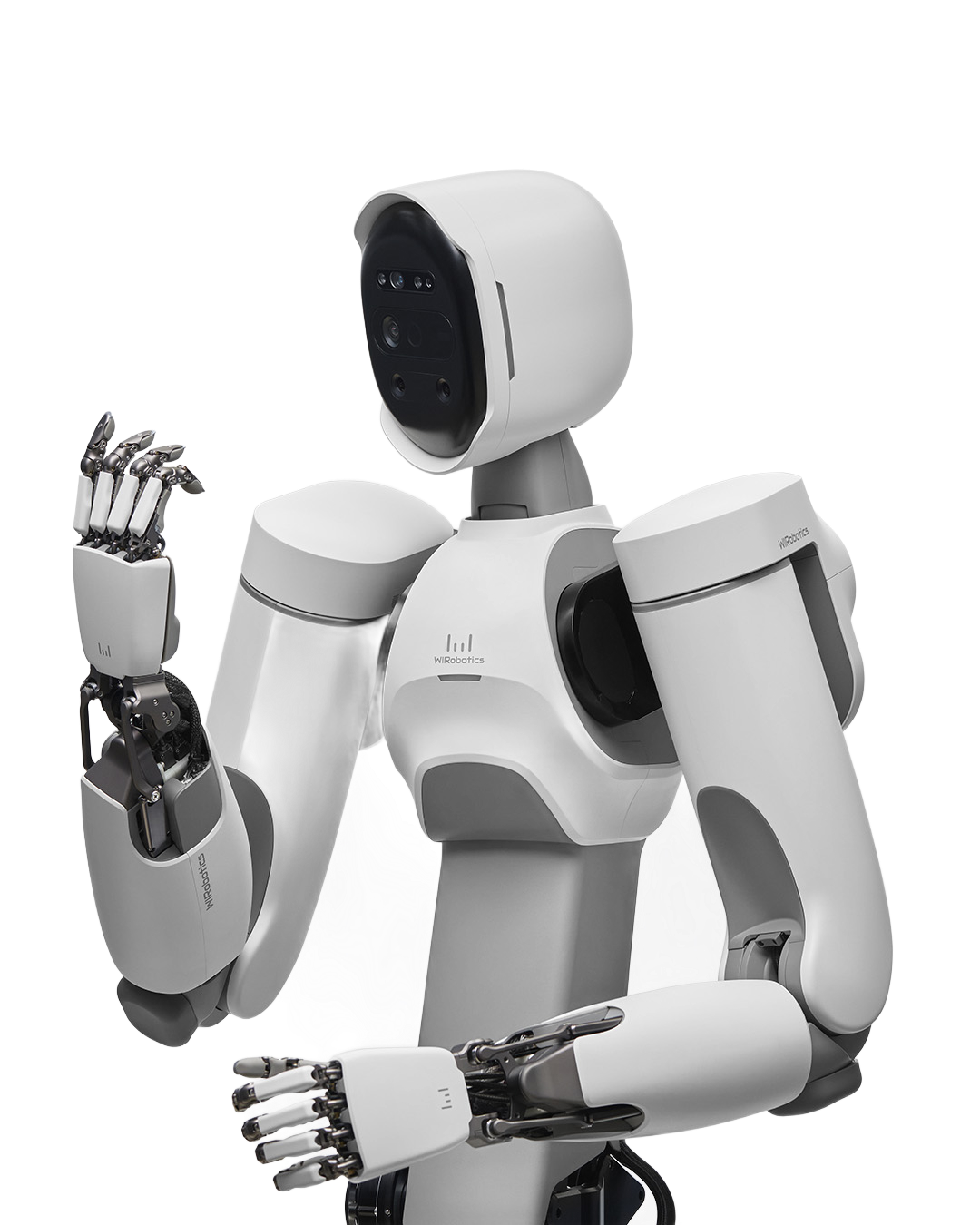
ALLEX (short for ALL-EXperience) is a general-purpose humanoid robot developed by WIRobotics, a South Korean robotics company founded by former Samsung engineers. Unveiled on August 18, 2025, at the Robot Innovation Hub on the campus of the Korea University of Technology and Education (KOREATECH) in Cheonan, South Korea, ALLEX is designed around the principle of safe, compliant physical interaction with humans. The robot features proprietary ultra-low-friction backdrivable actuators, a 15-degree-of-freedom (DOF) compliant hand capable of 40 N fingertip force and a hook-grip strength above 30 kg, and whole-body force sensing that operates without conventional external force or torque sensors. [1]
Co-CEO and CTO Yong-Jae Kim describes ALLEX as a robot that "goes beyond merely replicating human movement," calling it "the first robot that truly experiences and responds to the real world" because it detects and reacts to force, contact, and impact across its arms, fingers, and waist. [1] The robot has attracted significant attention from global technology leaders including NVIDIA, Meta, and Amazon. In March 2026 WIRobotics was selected for the Physical AI Fellowship powered by AWS, NVIDIA, and MassRobotics, and in May 2026 the company raised a KRW 95 billion (about $68 million USD) Series B round, one of the larger early-stage financings in South Korean robotics, to carry ALLEX toward mass production. [4][17]
Company background
WIRobotics
WIRobotics ("We Innovate Robotics") was founded in June 2021 by four former engineers from Samsung Electronics' Robotics Development Team. The founding team consists of Co-CEO Younbaek Lee, Co-CEO and CTO Yong-Jae Kim (a professor at KOREATECH who studied at the Korea Advanced Institute of Science and Technology, or KAIST), CFO Changhyun Noh, and COO Byungjun Choi. The company operates under the vision "Technology for People, Enhancing Quality of Life," with a stated goal of bringing robotic assistance out of laboratories and industrial facilities and into everyday life.
Before entering the humanoid robotics space, WIRobotics established itself through wearable robotics. The company's first product was WIBS (We Innovate Back Support), an unpowered back-support exoskeleton designed for industrial workers. This was followed by WIM (We Innovate Mobility), an ultra-lightweight walking-assist wearable robot weighing just 1.6 kilograms. WIM provides hip-joint actuation to both legs from a single motor worn at the waist and offers four operational modes: Assist Mode (reducing energy consumption by 20% during level-ground walking), Resist Mode (adding resistance for lower-body strengthening), Hiking Mode (stabilizing uphill and downhill movement), and Slow Gait Mode (enhancing control for rehabilitation). A four-week usability test with seniors demonstrated a 78% improvement in physical functions, including enhanced walking speed, endurance, and lower-body strength.
In 2025, WIRobotics expanded its wearable lineup with WIM Kids, a walking-assist device for children ages 4 to 15. Featuring a growth-adaptive modular leg frame and weighing only 990 grams, WIM Kids won the CES 2026 Innovation Award in the Digital Health category. This marked WIRobotics' third consecutive CES Innovation Award, following wins in the Robotics category in 2024 and 2025.
How much funding has WIRobotics raised?
WIRobotics has raised capital through multiple rounds to support its expansion from wearable to humanoid robotics.
| Round | Date | Amount | Lead Investor | Other Investors |
|---|---|---|---|---|
| Pre-Series A | April 2023 | KRW 4 billion (~$3M USD) | Not disclosed | Not disclosed |
| Series A | March 2024 | KRW 13 billion (~$10M USD) | InterVest | GU Equity Partners, JB Investment, Company K Partners, Hana Ventures, FuturePlay |
| Series B | May 2026 | KRW 95 billion (~$68M USD) | JB Investment | InterVest, Hana Ventures, Smilegate Investment, SBVA, NH Investment & Securities, Company K Partners, GU Investment, FuturePlay |
The Pre-Series A funds were used primarily for the development, operations, and marketing of the WIM wearable robot, as well as team expansion. The Series A round was directed toward accelerating the commercialization of wearable robots and initiating the development of ALLEX.
In May 2026, WIRobotics closed a KRW 95 billion (about $68 million USD) Series B round led by JB Investment, bringing its combined Series A and B funding to KRW 108 billion. [17] Notably, every Series A investor re-invested. The company said the capital would fund continued development of the ALLEX platform, the 2026 launch of a research-focused humanoid, mass-production readiness by late 2027, a manufacturing proof-of-concept with a global automotive manufacturer, and expansion into North America (including operations in California). "This investment represents global recognition that real-world movement data can evolve into next-generation humanoid robotics," said Co-CEO Younbaek Lee. [17]
Design and technical specifications
Design philosophy
ALLEX was designed with a fundamentally different approach from many competing humanoid platforms. Rather than relying primarily on vision and position control, the robot prioritizes force-based interaction. Its proprietary actuators provide ultra-low friction and high backdrivability, meaning the robot's joints can be moved easily by external forces. This makes the robot inherently safe for human contact, as the low mechanical resistance means the robot yields to unexpected forces rather than resisting them.
The name ALLEX reflects this philosophy: "ALL-EXperience" signifies the robot's capacity to perceive and respond to physical stimuli across its entire body. WIRobotics positions ALLEX not merely as a robot that replicates human movement, but as one that can sense and adapt to the physical environment in real time.
Upper body and actuators
As of its August 2025 unveiling, ALLEX has been presented as an upper-body system (torso, arms, and hands), with plans for full-body configurations in subsequent development phases. The total system has 48 degrees of freedom.
The core of ALLEX's mechanical design is its ultra-low-friction, high-load actuator. According to WIRobotics, these actuators exhibit more than 10 times lower friction and rotational inertia than conventional collaborative robot arms. This low friction enables several key capabilities:
- Backdrivability: The joints can be pushed and guided by a human hand, allowing intuitive physical teaching and safe co-working.
- Inherent compliance: The robot responds naturally to external forces without requiring dedicated external force/torque sensors.
- Energy efficiency: A gravity compensation mechanism integrated from the waist through the upper body reduces the energy required to maintain postures and hold loads.
The shoulder-to-hand assembly weighs approximately 5 kilograms, yet the system can handle payloads of 3 kilograms or more per hand across the full workspace. WIRobotics claims this gives ALLEX performance equivalent to collaborative robots weighing over 20 kilograms.
Hand system
The ALLEX hand is one of the robot's most distinctive subsystems and a primary differentiator in the competitive landscape. Each hand is human-sized, features five fingers, and provides 15 degrees of freedom.
| Specification | Value |
|---|---|
| Degrees of freedom (per hand) | 15 |
| Fingers per hand | 5 |
| Hand weight | ~700 g |
| Fingertip force | 40 N |
| Hook-grip strength | >30 kg |
| Fingertip repeatability | ≤0.3 mm |
| Force detection threshold | ~100 gf (without tactile sensors) |
The 40 N fingertip force is notable because it places ALLEX among the strongest high-DOF, human-scale robotic hands documented. For comparison, the human hand can typically exert between 7 N and 50 N of fingertip pinch force depending on the finger, making ALLEX's force output comparable to a moderately strong human grip. The hook-grip strength exceeding 30 kilograms further demonstrates the hand's capacity for heavy holding tasks. [1]
Despite this grip strength, the hand maintains fine force sensitivity. WIRobotics reports that ALLEX's fingers can detect reaction forces as small as 100 gram-force (approximately 1 N) without any dedicated tactile sensors. [1] This sensitivity is achieved through the mechanical compliance of the actuators themselves, which allows the control system to infer contact forces from motor current and position data. The fingertip repeatability of 0.3 mm or less enables precise manipulation of small objects.
This combination of high force output and fine sensitivity means ALLEX can perform both power grasps (carrying heavy bags, turning stiff door handles) and precision tasks (handling eggs, buttoning shirts, folding laundry, picking up thin objects) with the same end-effector. [6]
Control system
ALLEX uses a motor-control algorithm that integrates position control, force control, and stiffness control. This allows the robot to switch smoothly between rigid positioning (for accurate placement tasks) and compliant behavior (for safe human interaction). The system implements whole-body force sensing across the arms, fingers, and waist, enabling coordinated responses to physical contact anywhere on the upper body.
The control architecture was also designed to minimize the sim-to-real gap for machine learning applications. By providing consistent, low-friction mechanical behavior, the real robot more closely matches the idealized conditions of physics simulators, which makes learned policies transfer more reliably from simulation to the physical platform.
Computing and AI
ALLEX is equipped with onboard processors optimized for executing AI motion and force control algorithms in real time. The system supports large language model (LLM) integration and is compatible with cloud robotics architectures. The software stack is proprietary (closed source) but supports integration with external AI platforms.
For intelligence development, WIRobotics has partnered with RLWRLD, a South Korean physical AI startup that develops robot foundation models for industrial environments. RLWRLD has raised about $41 million across two seed rounds, including a $26 million Seed 2 in February 2026 led by Headline Asia and Z Venture Capital, and it uses ALLEX as a testbed and reference platform for its AI models. [13][16] This partnership pairs WIRobotics' hardware expertise with RLWRLD's capabilities in learned manipulation and physical reasoning.
How does ALLEX perform with AI foundation models?
In May 2026, RLWRLD unveiled RLDX-1, described as a "dexterity-first" vision-language-action model (VLA) for humanoid robots, and used ALLEX as the physical embodiment for training and evaluating it. RLDX-1 pairs Alibaba's Qwen Qwen3-VL-8B vision-language backbone with a Multi-Stream Action Transformer action head. [18] On a real-world coffee-pouring task performed with the ALLEX humanoid, RLDX-1 reached a 70.8% success rate, roughly double that of competing foundation models. [18] On the RoboCasa Kitchen benchmark it scored 70.6 points, which RLWRLD said made it the first VLA model to break the 70-point mark, and on the GR-1 tabletop benchmark it outperformed NVIDIA's Isaac GR00T N1.6 by 10.7 percentage points. [18]
NVIDIA's Amit Goel, comparing the opportunity to CUDA's role in making GPU computing accessible, said that "for industrial manipulation and dexterity, the five-finger hand has the opportunity to become a platform." [20] RLWRLD founder and CEO Junghee Ryu framed the goal directly: "If robots are going to do real work in factories, kitchens and warehouses, they need to grasp, feel and hold on." [18]
Comparison with other humanoid hands
The dexterous hand market for humanoid robots has become increasingly competitive. The table below compares ALLEX's hand specifications with several prominent systems.
| Robot | Hand DOF | Fingertip Force | Hand Weight | Actuation Type |
|---|---|---|---|---|
| ALLEX (WIRobotics) | 15 | 40 N | ~700 g | Backdrivable electric |
| Optimus (Tesla) Gen 3 | 22 | Not disclosed | Not disclosed | Tendon-driven electric |
| Figure 02 (Figure AI) | 16 | Not disclosed | Not disclosed | Electric |
| Phoenix (Sanctuary AI) | 21 | Not disclosed | Not disclosed | Hydraulic |
| GR-2 (Fourier Intelligence) | 12 | Not disclosed | Not disclosed | Electric |
While Tesla's Optimus Gen 3 and Sanctuary AI's Phoenix offer more degrees of freedom per hand, ALLEX's publicly documented 40 N fingertip force and 30+ kg hook-grip strength represent some of the highest force figures disclosed for a high-DOF, human-scale robotic hand. Many competing platforms have not published detailed force specifications, making direct force comparisons difficult. ALLEX's 700-gram hand weight is also notably light for the level of capability it provides.
Applications and target markets
WIRobotics has identified several primary application domains for ALLEX:
- Service industries: Customer-facing roles requiring safe physical interaction with people, such as hospitality and retail.
- Manufacturing: Assembly, inspection, and collaborative tasks alongside human workers, leveraging the robot's compliance for safe co-working.
- Healthcare and eldercare: Assistive tasks for elderly or mobility-impaired individuals, building on WIRobotics' experience with the WIM wearable robot.
- Household automation: General domestic tasks including cleaning, object manipulation, and home organization.
- Logistics: Picking, packing, and sorting operations where dexterous manipulation reduces the need for specialized grippers.
WIRobotics plans to develop ALLEX as a modular platform, offering arms, hands, body modules, and leader (teleoperation) systems either individually or in combination. A wheeled mobile base configuration, marketed as Mobile ALLEX, has also been announced; the company plans to supply this research-oriented mobile humanoid to global research institutions and overseas partners for collaborative R&D and real-world technology validation, beginning in 2026. [17][19] The company has stated its goal of delivering a general-purpose humanoid platform that "anyone can use in everyday life" by 2030.
Partnerships and collaborations
WIRobotics has built an extensive network of research and industry partnerships to accelerate ALLEX's development:
| Partner | Type | Focus Area |
|---|---|---|
| RLWRLD | Industry (physical AI startup) | Robot foundation models, AI intelligence |
| MIT | Academic | Robotics research |
| University of Illinois Urbana-Champaign (UIUC) | Academic | Robotics research |
| University of Massachusetts (UMass) | Academic | Robotics research |
| KIST (Korea Institute of Science and Technology) | Research institute | Robotics R&D |
| Maxon | Industry (actuator supplier) | Actuators and drivetrains |
| AWS / NVIDIA / MassRobotics | Fellowship program | Physical AI development |
Physical AI Fellowship
In March 2026, WIRobotics was selected for the second cohort of the Physical AI Fellowship, a virtual program powered by AWS Startups and NVIDIA Inception. The 2026 cohort includes nine robotics startups spanning agriculture, construction, renewable energy, industrial automation, retail, logistics, and humanoid robotics. WIRobotics is the only humanoid robotics company in the cohort. [4]
Through the fellowship, WIRobotics receives $200,000 in AWS credits, embedded support from the AWS Generative AI Innovation Center, access to NVIDIA's physical AI stack (including the NVIDIA Isaac frameworks and NVIDIA Cosmos world foundation models), free NVIDIA training courses, and access to MassRobotics' testbed facilities. The fellowship culminates in high-visibility showcases at AWS re:Invent 2026 and other industry events. [4]
What is the ALLEX simulation model?
On June 28, 2026, WIRobotics began building a Physical AI development ecosystem around ALLEX, and its first release was a validated digital simulation model of the robot. [19] The model reproduces ALLEX's real physical properties, including its high backdrivability and force transparency, so that control policies trained in simulation transfer to the physical robot with a small sim-to-real gap. WIRobotics published the model on GitHub (github.com/wirobotics-rih/allex_model) in three formats: MuJoCo (MJCF), NVIDIA Isaac Sim (USD), and ROS (URDF). [19]
The release lets researchers and developers begin robot-control research, machine learning, and synthetic-data generation on ALLEX before the hardware is broadly available. "We plan to make the ALLEX research platform available later this year," said Co-CEO Yong-Jae Kim, adding that releasing the simulation model will allow developers to validate their algorithms faster. [19]
CES 2026
WIRobotics exhibited at CES 2026 in Las Vegas (Venetian Expo, Hall A-D, Booth #54635), showcasing both the ALLEX humanoid and its WIM S wearable robot. The ALLEX demonstration featured live movement and interaction sequences, including a natural handshake that showcased the robot's real-time force sensing and responsive grip adjustment. During the demonstration, ALLEX shook hands with visitors without crushing or applying excessive force, illustrating its inherent compliance and safety.
Following the demonstrations, representatives from major technology companies including NVIDIA, Meta, and Amazon expressed purchase interest. According to WIRobotics, several of these discussions progressed beyond preliminary contact to specific directions for technical collaboration and joint technology development. Media outlets and buyers from North America, the Middle East, and South America actively engaged with the company regarding its robotics portfolio and global expansion plans. [2][3]
Co-CEO Younbaek Lee stated that CES 2026 represented "a pivotal transition from presenting technology to executing real collaboration," signaling the company's shift from demonstration phase to active commercialization. [2]
South Korean robotics ecosystem
ALLEX exists within a rapidly growing South Korean humanoid robotics sector. In April 2025, the South Korean government launched the K-Humanoid Alliance, a national initiative to position the country as a global leader in humanoid robots by 2030. The government has pledged approximately $770 million in investment, with $150 million allocated for 2025 alone. [11]
The alliance includes major companies such as Rainbow Robotics (whose RB-Y1 robot benefits from Samsung's investment as the largest shareholder), Aeirobot, Holiday Robotics, BlueRobin, Robros, Angel Robotics, and Neuromeka. Over 20 universities and research institutions participate, including KAIST, Seoul National University, Yonsei University, and Korea University. The alliance's technical targets include producing humanoid robots weighing under 60 kilograms, with more than 50 joints, payload capacities exceeding 20 kilograms, and movement speeds over 2.5 meters per second.
WIRobotics occupies a distinctive niche within this ecosystem. While larger players like Rainbow Robotics (backed by Samsung) focus on full-body bipedal humanoids, WIRobotics differentiates through its emphasis on manipulation, compliance, and safe physical interaction. The company's background in wearable robotics gives it particular expertise in designing lightweight, energy-efficient systems that interact closely with the human body.
South Korea's humanoid robotics push is driven in part by demographic pressures. The country has the world's lowest birth rate and a rapidly aging population, creating urgent demand for robotic solutions in eldercare, service industries, and manufacturing. Companies like WIRobotics, with their dual focus on wearable assistive devices and humanoid platforms, are positioned to address both near-term (wearable rehabilitation) and long-term (autonomous humanoid assistance) segments of this market.
Commercialization roadmap
WIRobotics has outlined a phased approach to bringing ALLEX to market:
| Phase | Timeline | Milestone |
|---|---|---|
| Upper body unveiling | August 2025 | Demonstration of torso, arms, and hands at KOREATECH |
| CES 2026 showcase | January 2026 | Live demonstrations; industry partnership discussions |
| Series B funding | May 2026 | KRW 95 billion (~$68M) round led by JB Investment |
| ALLEX simulation model | June 2026 | Open sim model released on GitHub (MuJoCo, Isaac Sim, ROS) |
| Research platform | Late 2026 | Commercial availability of research-focused platform |
| Mobile ALLEX (wheeled base) | 2026 (planned) | Mobile manipulator for research institutions and partners |
| Mass-production readiness | Late 2027 | Manufacturing-ready ALLEX; PoC with a global automaker |
| Modular platform sales | 2027+ (projected) | Individual arms, hands, body, and leader systems |
| General-purpose deployment | 2030 (target) | Everyday-use humanoid platform |
The research platform expected in late 2026 will allow academic and industrial partners to develop applications on ALLEX hardware, complementing the simulation model that developers can already download. The wheeled mobile base configuration (Mobile ALLEX) addresses use cases in logistics and service environments where bipedal locomotion is unnecessary. WIRobotics' longer-term roadmap adds a fully bipedal version with articulated legs, and the modular platform strategy allows customers to purchase only the components they need, lowering the barrier to adoption. The May 2026 Series B is earmarked in part for reaching mass-production readiness by late 2027 and for a manufacturing proof-of-concept with a global automotive manufacturer. [17]
See also
- Humanoid robots
- Humanoid robot hands
- Humanoid robot market
- WIRobotics
- Rainbow Robotics RB-Y1
- Tesla Optimus Gen 3
- Sanctuary AI Phoenix
- Figure 02
References
- WIRobotics Unveils 'ALLEX,' a General-Purpose Humanoid with Human-Like Responsiveness - PR Newswire, August 18, 2025. ↩
- WIRobotics Concludes CES 2026, Advancing into Execution Phase of Global Collaboration Across Humanoid and Wearable Robotics - PR Newswire, January 2026. ↩
- WIRobotics Draws Global Attention at CES 2026 - PR Newswire, January 2026. ↩
- WIRobotics Selected for the Physical AI Fellowship Powered by AWS, NVIDIA, and MassRobotics - PR Newswire, March 2026. ↩
- WIRobotics Announces 'ALLEX,' a General-Purpose Humanoid - Humanoid Robotics Technology, August 2025.
- The ALLEX humanoid robot can shake hands - Interesting Engineering, 2025. ↩
- WIRobotics Secures KRW 13 Billion in Series A for Wearable Robot Innovation - WowTale, March 2024.
- WiRobotics raises KRW 4 billion in pre-Series A funding - WowTale, April 2023.
- WIRobotics' Walking-Assist Wearable Robot WIM KIDS Wins CES 2026 Innovation Award - PR Newswire, November 2025.
- Wearable Robotics Leading Company WIRobotics to Introduce WIM to the U.S. Market - PR Newswire, 2024.
- K-Humanoid Alliance Launches to Lead Next-Gen Robotics Revolution - WowTale, April 2025. ↩
- ALLEX specifications - Aparobot.
- Physical AI startup RLWRLD raises $26M - The Robot Report. ↩
- ALLEX product page - Humanoid.guide.
- WIRobotics official website
- RLWRLD Raises $26M Seed 2, Bringing Total Funding to $41M to Scale Industrial Robotics AI - GlobeNewswire, February 26, 2026. ↩
- WIRobotics Secures Approximately KRW 100 Billion (USD 68 Million) Series B Funding - PR Newswire, May 14, 2026. ↩
- RLWRLD Unveils RLDX-1, a Dexterity-First Foundation Model for Humanoid Robots - The AI Insider, May 14, 2026. ↩
- WIRobotics Begins Building a Physical AI Development Ecosystem: The First Technology Release Features the ALLEX Simulation Model - PR Newswire, June 28, 2026. ↩
- NVIDIA-backed robotics startup RLWRLD targets dexterous labor worth trillions with RLDX-1 - R&D World, May 2026. ↩
Improve this article
Add missing citations, update stale details, or suggest a clearer explanation. Every suggestion is reviewed for sourcing before it goes live.
6 revisions by 1 contributors · full history